I remember being nine years old in the summer of 1977, sitting with my dad in the cinema, watching that first epic Star Wars opening crawl.
I became a total fanatic for Star Wars. And yes, that meant Star Wars action figures, Star Wars trading cards, and much else. During that first two years of Jimmy Carter’s presidency, I wasn’t thinking about stagflation or the energy crisis, or Jimmy Carter’s “malaise”. I was thinking about Star Wars.
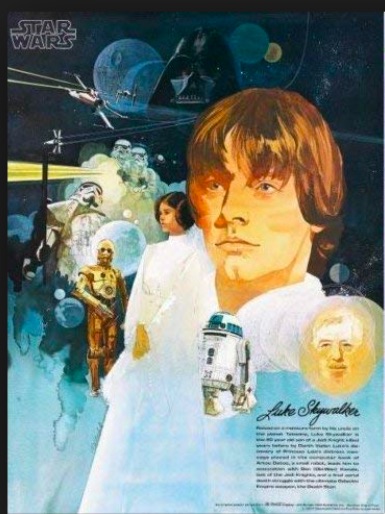
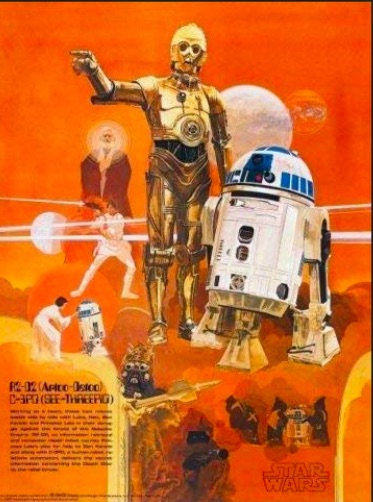
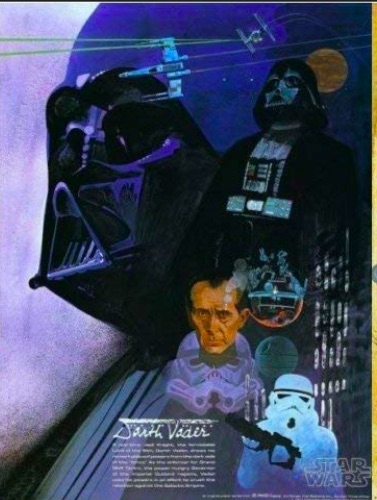
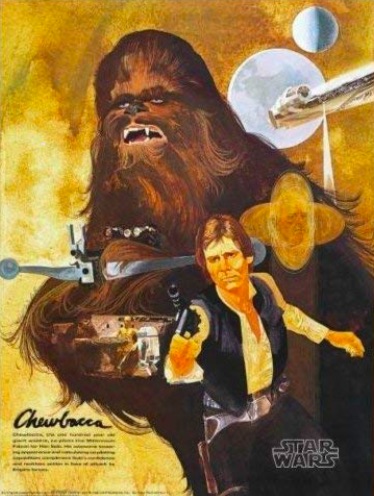
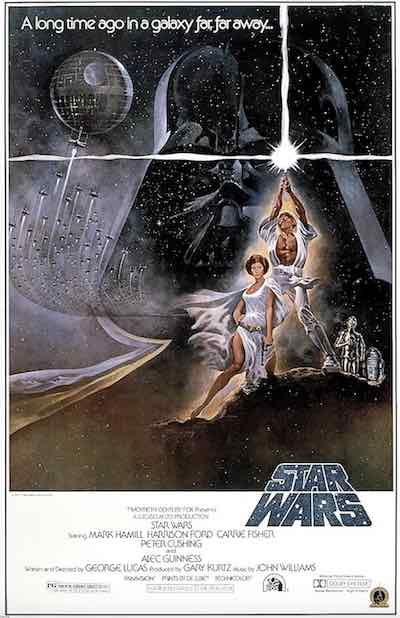
Among my favorite Star Wars memorabilia of that era were the four Star Wars posters issued by Burger Chef. (Burger Chef was a once popular fast food chain that went out of business in 1996.)
I had all four posters, and they were hung all around my bedroom. (I can still recall the exact placement of each one, in fact.)
These are now collectors’ items, of course. But they were just delightful children’s bric-a-brac in 1977.
1977 Burger King Commercial
The original Burger Chef posters from 1977. (I can vouch for their authenticity, because I was there!)
TERMINATION MAN is the story of Craig Walker, a management consultant who specializes in “removing” problem employees through entrapment and techniques of “social engineering”.
TERMINATION MAN is fiction, but it is based on my experience in the automotive industry. The novel’s premise also has a basis in HR practices.
“Managing out” is a common corporate HR practice. When an employee is “managed out”, her situation is made so unpleasant or unsustainable that she will effectively fire herself, and voluntarily resign. This saves the company hassle and expense on multiple levels.
TERMINATION MAN is an embellishment of the managing out practice, of course. But the principle exists, and all HR professionals are familiar with it.
Another thing to remember: corporate HR is not your friend. Corporate HR does not represent you. Corporate HR represents your employer, the company.
This doesn’t mean that corporate HR reps are automatically sinister, venal, etc. (Most are not.) But you should never forget who pays their salaries. (Hint: not you.)
As I write these words, meteorologists throughout the country are predicting a nationwide, historic snowstorm. I hope they’re wrong!
Of course, for American adults around my age—especially if they grew up east of the Mississippi—there are two childhood winters that stand out in memory: those are the back-to-back “blizzard winters” in the mid-1970s: the winter of 1976 to 1977, and the winter of 1977 to 1978.
The winter of 1976 to 1977
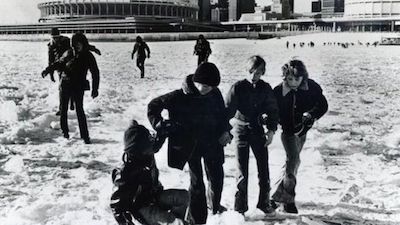
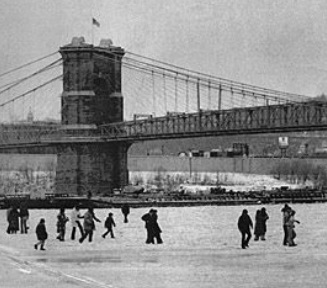
The winter of 1976 to 1977 was the winter of record-breaking, pipe-bursting, river-freezing cold. Here in Cincinnati, there were three straight days of record cold in January 1977, in which the temperature stayed below minus 20 degrees Fahrenheit the whole time.
The Ohio River froze solid—for the first time since 1958, and only the thirteenth time on record. In the Cincinnati media archives, there are photos of people walking across the Ohio River, and even driving across the ice that month. The freezing of the Ohio was quite a novelty, much talked about on the local news. One of my older friends has told me about driving his car across the Ohio River that winter on a dare. He was then nineteen years old, and he’s now in his sixties. So he obviously made it across.
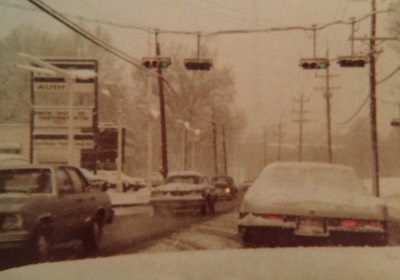
January of 1977 was also a snowy one. Cincinnati had 30.3 inches of snow that year. (The usual figure for Cincinnati in January is six inches.)
Photo: Kenton County LibraryPhoto: Kenton County LibraryBeechmont Avenue, Cincinnati, Ohio (personal photo)
The winter of 1977 to 1978
The following winter of 1977 to 1978 was just as bad, with almost as much cold, and even more snow. On January 25, 1978, one of the worst blizzards in U.S. history pummeled Cincinnati with almost seven inches of snow. There were already fourteen on the ground.
I remember the night of January 25, 1978 well. I played forward on our fourth-grade basketball team. That night we had a game at a rival Catholic school in the area, Guardian Angels. I remember walking outside at halftime with other members of my team. The air was not exceptionally cold yet by January standards. (It would soon plummet below zero degrees.) But there was a strange fog in the air. I think we all had the feeling that something momentous was imminent. On the way home from the game, the snow began. By morning, it was a whiteout.
Winter landscapes of the memory
At the age of eight or nine, one doesn’t have much life experience to draw upon. I could sense, though, that those two winters were worse than the handful of winters I could recall before. During those two winters, the outside air always seemed to be bitterly cold. Furnaces ran constantly. Fireplaces crackled nonstop. The ground was always snow-covered.
Many people are depressed by snow and cold weather, and winter in general. Not me. I will confess that some of my happiest childhood memories are winter ones, in fact.
I was particularly close to my maternal grandparents. During those blizzard years of the 1970s, they lived just down the street from us. When school was canceled due to inclement weather, I got to pass the day with my grandfather, who had recently retired. We spent a lot of time together in those years. I’m grateful for all the snow.
The cyclical nature of winter weather
It has been my observation that bad and mild winters tend to alternate in cycles. From the mid-1970s through the early 1980s, the winters were harsh, with record cold and snow.
The winter of 1981 to 1982 was cold. The Cincinnati Bengals went to the Super Bowl that year. On January 10, 1982, the Bengals won a key home game against the San Diego Chargers. The air temperature at Cincinnati’s Riverfront Stadium on game day was minus nine degrees, with wind chills down to 35 below. That game has gone down in NFL history as the “Freezer Bowl”.
I was in the eighth grade in 1981-1982, and going through a (brief, in retrospect) rebellious adolescent phase. This included hanging out with an edgier crowd, and embracing a short-lived fascination with smoking cigarettes and drinking alcohol.
Even in 1982, smoking and drinking weren’t acceptable pursuits for eighth graders. But hiding these illicit activities from adult authority figures was half the fun. I have many memories of shivering outside that bitter January, as I sipped a furtive drink of whiskey, or smoked a Marlboro. Even today, when I happen to smell someone else’s newly opened pack of cigarettes, or taste an alcoholic beverage, I’m transported back to that brutally cold winter of 1981 to 1982.
The last bad winter I remember from that larger cycle was the winter of 1983 to 1984. That winter brought record cold and snow to the entire United States, including Florida and Texas. As I recall, there was a lot of anxiety about the citrus crop that year, and skyrocketing prices of orange juice.
Over Christmas break in December 1983, my parents decided to embark on a rare family trip to Florida. When we reached Macon, Georgia, it was 4 degrees, with 23 degrees forecast for our destination in the Sunshine State. After spending a night shivering in a Macon hotel room with an inadequate heater, my parents decided to cut our losses. We headed home the next morning. We could freeze in Ohio for free, after all.
But the weather is no more constant than anything else in this world. That cycle of severe winters, from 1976 to 1984, transitioned into a milder pattern over subsequent years. The winters of 1984-1985 and 1985-1986 weren’t exactly balmy; but they weren’t severe, either. Throughout my last two years of high school, classes were rarely canceled due to weather. This was fine with me, because I generally enjoyed high school more than grade school.
And during my college years, spanning the winters of 1986 to 1987 through 1990 to 1991, the winters in Cincinnati were notably mild. I did not go away for college; I lived with my parents and commuted to two local schools. I did not miss a single class due to bad winter weather throughout my entire college career.
That mild cycle continued through the early 1990s, only to go the other way again in the middle of the decade. The winter of 1995 to 1996 was an especially bad one for the entire Midwest, resulting in a rare shutdown of the University of Cincinnati in January of ’96. By this time, I was a working adult in my mid-twenties.
The winter of 1995 to 1996 drew comparisons in the media to the blizzard winters of the mid-1970s. I remember scoffing when I heard this. Having been a kid during those fabled winters of the 1970s, I never took the comparison seriously.
But then, everything seems to happen on a larger scale when you’re a kid…even the weather.
December 31st marked not only the end of 2025, but also the end of MTV (1981 – 2025).
As I explain in the video below, I was one of MTV’s young fans back in the early 1980s.
MTV was a brilliant mechanism for content marketing. Suburban teens like me would discover new bands on MTV. Then we would go to the local mall and purchase the albums.
I discovered many of my favorite bands on MTV, including Def Leppard.
Throughout the world, people who make Internet inquiries about Kuwa6226 meet violent deaths.
In online forums and chatrooms, people are warned not to mention the mysterious entity.
But who, or what, is Kuwa6226? A supernatural force? A cult? A global conspiracy?
Most people say that it’s better not to ask…and Kuwa6226’s reign of terror goes unchallenged.
***
Then two unlikely sleuths, from opposite sides of the world, unite.
Minoru Watase is a corporate IT employee in Japan. Julie Lawrence is a college student in the American Pacific Northwest.
Julie and Minoru have each lost a friend to Kuwa6226. Together, they are determined to discover Kuwa6226’s true identity and eliminate the menace.
Their search will take them from the streets of Tokyo to an American college town in Washington State. When they finally come face-to-face with Kuwa6226, Julie and Minoru will be unprepared for the revelation…and the ruthlessness of their adversary!
Kuwa 6226 is a horror-mystery with endless twists and turns!
The following excerpt is from Chapter 1 of Kuwa6226!
Go to bed already, an internal voice told him. Be sensible. Be responsible.
Hajime Takagawa rubbed his eyes as he stared at his computer screen. He knew that he should have been asleep an hour ago. The time was already 11:47 p.m.
The main room of his studio apartment was completely dark, except for the glow of his laptop screen. The remnants of Takagawa’s late dinner—ramen and salted pork—still hung in the semi-fetid air.
He would have to clean up the kitchen before he went to bed, too.
More than that, though,Takagawa would have to report to work tomorrow. No different from any other Tuesday. Another grueling morning commute through Japan’s Kantō region, which encompassed Greater Tokyo.
The commute was even more grueling when you were sleep-deprived. (This Takagawa knew from experience.)
But Takagawa, seated in the dark at his kitchen table, was too transfixed by what was on his computer screen.
It wasn’t pornography, nor online gambling. Not even social media—not really.
It was an online forum.
The forum was called: the International Legend Hunters (ILH) forum.
The forum consisted of a series of conversations with complete strangers, about supernatural phenomena and urban legends.
Takagawa leaned forward in his chair, the time and tomorrow’s troubles forgotten again.
Someone in Scotland had just posted a field report about an investigation of a supposedly haunted castle outside Edinburgh.
The poster’s handle was IanK12. Takagawa read IanK12’s report with great interest. He struggled over a few typos, awkward sentences, and unfamiliar words. The language of the International Legend Hunter’s forum was English, which Takagawa understood, though imperfectly.
If nothing else, Takagawa told himself, his new obsession might be improving his English skills. That could come in handy at work.
“I didn’t see any ghosts,” IanK12 typed at the end of his report. “But I didn’t debunk the legend, either.”
Takagawa pondered this. The whole point of the International Legend Hunters forum was to debunk urban legends and ghost stories. IanK12 had therefore failed. (Takagawa, though, would never be so ill-mannered as to point this out.)
But he was determined to do better. When Takagawa carried out the investigation he was planning, he would not fail. He would find the truth, and he would not lose his nerve.
And he already had a doozy of an urban legend in mind.
Takagawa read two more field reports. The first of these concerned a haunted village in the Philippines. The second was about a site in Ireland where UFOs were commonly seen—if you believed the stories.
These field reports, too, were inconclusive. They were little more than descriptions of the locations, with some random speculations thrown in.
The forum has no real purpose if no one ever comes to any conclusions, Takagawa thought. These investigations should be more thorough, more systematic.
Takagawa considered for a moment, and then typed:
“Interesting reports, to be sure. Perhaps it would be worthwhile to make several more trips over the coming days, to see if any phenomena present themselves? Then we may have some concrete data to analyze.”
He paused. Was his English correct, or at least comprehensible? He believed that it was. He typed another paragraph:
“On the other hand: while no one can prove the nonexistence of a negative, a lack of a phenomenon, repeated over multiple days, weighs in favor of disproving an urban legend.”
Then he added:
“Please excuse my poor English.”
Finally he pushed the POST button, and his remarks appeared in the forum.
His handle in the forum was TokyoTaka. Everyone in the forum posted under a pseudonym, often one that suggested nationality or location.
Takagawa’s comments of constructive criticism received several upvotes, but the enthusiasm was muted. Not everyone in the forum was serious about making systematic inquiries, let alone approximating the scientific method. Many of the forum’s contributors seemed content to exchange ghost stories in cyberspace.
Finally, Takagawa went to bed.
The time was 12:21 a.m., Tuesday morning.
His sleep was tortured. He dreamt of being chased through a forest by a giant skeletal creature, one with bulging green eyes and clattering teeth.
Using various phone apps, many parents now track the movements of their progeny from minute-to-minute. Some parents even track the movements of their adult children. One of my friends can tell you, at any minute of the day, where his two children are. My friend’s children are 26 and 30 years old.
I won’t mince words here. I find all of this geo-tracking to be a little neurotic, not to mention claustrophobic for those who must endure it.
It was different for those of us who grew up in the 1970s and 1980s, of course. At most hours of the day, our parents didn’t know exactly where we were. Oh, sure, they might have had some ideas, in the same way that I know Russia is to the east of me, and Argentina is to the far south. But don’t ask me to give you air travel coordinates. Suburban parents in the 1970s and 1980s relied on similar guesstimates regarding their children’s whereabouts.
During the summer months especially, we took full advantage of this location anonymity. The one thing most every Gen X kid had was a bike. And a bike was a license to travel distances your parents never would have approved of. Some of us planned long quests that would have been worthy of a JRR Tolkien novel like The Hobbit or The Lord of the Rings.
The motivation for these unauthorized trips was often some kind of contraband: alcohol, cigarettes, or firecrackers. Sometimes it was just the thrill of seeing how far your ten speed would carry you in a single June or July morning.
Among adolescent boys, the motivations were often of an amorous inclination. I turned 13 in the summer of 1981. One of my neighborhood friends—I’ll call him Glen—had somehow initiated a running phone conversation with three girls who lived in a neighborhood far from where we lived. Somehow three of us—Glen, me, and one other boy—started talking to the girls, always via landline (the only communication option in those days) and always from Glen’s house.
The girls sounded both pretty and friendly. The girls said they wanted to meet us, but we would have to go to them. And so we planned a bicycle trip to their neighborhood.
Did we ask our parents’ permission? Of course not.
We set off on our bikes one morning around nine a.m. Being randy young males, we eagerly speculated about what might happen at our destination.
When we arrived nearly two hours later, however, the girls were nowhere to be found. Forty-five years after the fact, I’m not sure exactly what happened. We either had the wrong address, or we were duped. Disappointed, we rode back as a particularly hot afternoon settled in.
The lesson I learned from this was: if it seems too good to be true, a little too convenient, then it probably is too good to be true.
But that is the kind of life lesson that you can’t learn on a computer, and certainly not on social media. I’m grateful that I came of age when free-range childhood was still a thing. To grow up without geo-tracking was both a privilege and a blessing.
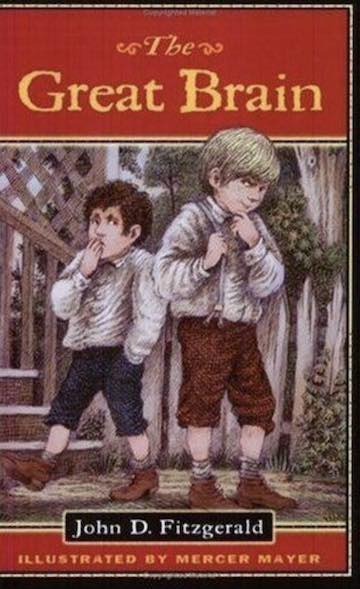
I was ten or eleven years old when I discovered John Dennis Fitzgerald’s (1906–1988) semi-autobiographical series of children’s books, The Great Brain. The books are set at the end of the 1800s in Utah. The eponymous “Great Brain” is a fictionalized version of the author’s older brother.
I’m not sure why I started reading these books back in…1979, it must have been. Probably my mom was familiar with them (?)
Anyway, I recall getting my hands on the first one, and reading the rest in quick succession. Seven books were then available. (The original series was published between 1967 and 1976. A final book, based on Fitzgerald’s notes, was published in 1995, seven years after the author’s death.)
I skimmed through the first few pages of The Great Brain using Amazon’s preview function. I found myself being drawn into the story once again—more than 45 years after my initial reading.
My TBR list is already too long, and children’s fiction has never been my thing as an adult. I must say, though, I would not mind reading The Great Brain books again, or at least one or two of them. This really was—and is—youth fiction at its best. Far better than the much overrated Harry Potter novels, I dare say.
I’m late to this party. I didn’t realize that yet another television adaptation of Stephen King’s It was in the works. So now I know.
Forgive me if I skip this one. I love Stephen King’s books. (Or well, I love many of them, anyway.) But I read It for the first time as an 18-year-old in 1986. (I purchased one of the original hardcovers at the Waldenbooks in my local mall.)
I reread the book once in the 1990s. I’ve seen two screen adaptations already.
I always preferred King’s shorter, tighter books, anyway. For me, It marked the point where every Stephen King book was no longer a guaranteed page-turner.
But that really isn’t the point. This story has been in my brain for almost 40 years now. I understand that Hollywood prefers stories with prequalified demand (i.e., decades-old franchises). But there comes a time when I want something new.
No disrespect intended toward Mr. King. It was entertaining, the first—even the second—time around. But do I need yet another tour through the mythical town of Derry? Of all the teenage experiences I’d like to relive at the ripe old age of 57, this book doesn’t rank very high on the list.
This happened 27 years before I was born. But I grew up hearing about it from my grandparents, who were members of the World War II generation.
In 2025, the living ranks of those who remember this as news are growing thin. But for me (largely because of my grandparents), December 7 will always have a special significance.
And this Pearl Harbor Day, like the first one, falls on a Sunday.
Jason Kelley is a college student who agrees to take a walk down the most paranormally active road in Ohio. His mission: to document the phenomena he encounters on the cursed stretch of rural highway.
Along the way he encounters hellhounds, malevolent spirits, and trees that come to life.
If you like traditional supernatural horror tales, you’ll love ELEVEN MILES OF NIGHT. Available on Amazon now.
I’ve recently been binge-watching Mayor of Kingstown, the gritty prison town drama co-created by Taylor Sheridan.
A few years ago I listened, just for giggles, to a lecture entitled “How to write a bestseller”. The lecturer, an author and a fan of women’s beach novels, warned her audience not to set their stories in impoverished or depressing environments.
Kingstown is a fictional small city in Michigan, on the Lake Michigan coast. Kingstown is the epitome of rust-belt poverty and decay. Kingstown is wracked by street crime and gang warfare. Mayor of Kingstown makes me grateful that I live in southwestern Ohio—no easy feat.
The only real industry in Kingstown is the city’s state prison. Most of the storylines involve the prison in one way or another.
There is no Jack Reacher-like superhero at the center of this show. Nor is there a good-looking young dude who is sure to make the female audience swoon. The hero (I use that term loosely) of Mayor of Kingstown is Mike McClusky (Jeremy Renner) a fiftyish ex-con and fixer who tries to bring some semblance of order to the town. The female lead in Mayor of Kingstown is Iris (Emma Laird) a prostitute with a history of abuse.
This show depresses me every time I watch it. But I can’t help tuning in, because the storytelling is so compelling. Every scene in Mayor of Kingstown is filled with multiple levels of conflict, and usually ends with a polarity shift.
Mayor of Kingstown is entertaining television. But for writers looking to branch out beyond clichés, the show is also proof that you don’t necessarily need to write “the same, but different” in order to find an audience. You just have to tell a good story.
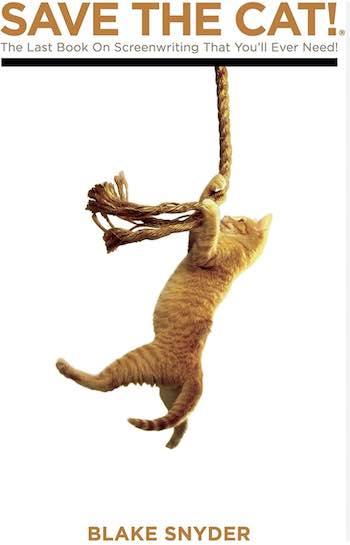
Save the Cat! is a 15-point formula found in many screenplays and movies. Is this formula worthwhile for novelists and short story writers?
Yes, and no, and maybe.
Save the Cat forces you to think about stories as systems of moving parts. This may be a new and necessary insight for many writers.
Most fiction writers know that they need an inciting incident, and a climax/conclusion. Where fiction writers most often struggle is in the vast middle portions of novels (and even long short stories). Save the Cat has remedies for this. The midpoint and “bad guys close in” are concepts that can be profitably employed in any story form.
One can argue that novelists should write with movies and television in mind, anyway. Visual media has affected the expectations that readers bring to fiction, and you ignore this at your peril. Try to write like Melville (or even Saul Bellow) today, and you won’t get far.
That said, stories and novels are fundamentally different from screen-based media. A novel is not a screenplay, just as a screenplay is not a novel. This may be why screen adaptations of novels are seldom satisfactory for viewers who have already read the book.
In particular: the screenwriter’s obsession with scenes and “show don’t tell”. Scenes are the building blocks of any story, but they aren’t the sole building blocks of fiction. All fiction contains some backstory and exposition that simply couldn’t exist in a movie. This is true even of commercial fiction. The “show don’t tell” dictum, when carried to extremes, can become counterproductive. In this regard, it’s a lot like the oft-repeated “no adverbs” rule.
If your goal is to write screenplays, stick with the original Blake Snyder book. If you’re interested in writing fiction, go with the Jessica Brody spinoff, Save the Cat! Writes a Novel.
The year is 1938. Betty Lehmann is an undercover German spy. Can anyone stop her? Find out in THE CAIRO DECEPTION, a 5-book, World War II historical fiction series.
The year is 1938. Betty Lehmann is an undercover German spy. Can anyone stop her? Find out in THE CAIRO DECEPTION, a 5-book, World War II historical fiction series.
You’re twelve years old, and trick-or-treating with your two best friends.
You know what they say about the Shipley House. Something very bad happened there in 1959.
For more than twenty years, the Shipley house has stood vacant. No one can live there for long.
You’ve been warned not to enter.
But it’s Halloween, after all. How can you resist?
You try the front door. You’re surprised to find that the Shipley house is unlocked. Almost as if the house has been waiting for you.
You go inside, and walk down the hallway toward the bedroom at the end of the corridor.
Be careful: what you find in that room may drive you mad. And you may discover things about yourself that you don’t want to know.
***
The Shipley house is featured in one of the chapters of 12 HOURS OF HALLOWEEN, a Gen X coming-of-age supernatural horror tale set on Halloween night, 1980.
Three young friends decide to go out for “one last Halloween before they enter their teenage years. But this will be a Halloween like no other.
12 HOURS OF HALLOWEEN is available on Amazon, and you can read it for free in Kindle Unlimited.