iOS 26 bugs and my old guy instincts

You all know me, or a version of me: I’m one of those stick-in-the-mud older/middle-age people who refuses to upgrade to the latest version of whatever operating system happens to be relevant.

I do this for the reason that most older people are skeptical/cautious: experience. In 2009, Microsoft destroyed my PC with an automated upgrade of the Windows XP operating system. Trust us, Microsoft said. Enable those automated updates. And I, like a fool, believed them.

I’ve since become a Mac user. Apple has yet to outright destroy any of my devices with an upgrade. But they’ve rendered several of them less usable, slower, or buggier.

I’ve therefore adopted a policy over the last five to ten years: one operating system per device. (This isn’t as radical as it sounds; I upgrade my devices at reasonable intervals.) My expectation to the tech companies is: Get it right the first time.

I purchased my iPhone 16 Plus last spring. The factory-installed iOS was 18.

I was planning to keep that. It worked. Then I read numerous online reports from the “techies” about how essential it was to upgrade. Iranian and Russian agents could exploit my current iOS, hack my phone, and steal all my data.

So I upgraded to iOS 26.4.1 last week. I’ve got a fancy new “liquid glass” display, and lots of new emojis that I’ll never use.

But CarPlay no longer works. (CarPlay worked perfectly, every time, on iOS 18.) YouTube videos freeze and error out. These are both documented flaws that have been discussed on Reddit and in other online venues.

Two observations from all this. First, this demonstrates yet again that our over- reliance on digital technology is a weakness as well as a convenience. I know young people who can’t read a map, write in cursive, or maintain their composure during a voice call, all because they’ve been hobbled by reliance on tech. But what happens when the machines glitch?

Secondly, I’m disappointed at Apple’s shoddiness. I’m an indie author, and I feel guilty if I release a $4.99 ebook with a handful of typos in it. But most of us paid close to a grand for our iPhones. Apple is a $350 billion company. Tim Cook, Apple’s CEO, earns $74 million per year in total compensation. Am I asking too much, when I humbly request that Apple not break CarPlay and destabilize YouTube when they release an update that I am told I must have?

I’m sure—or no, scratch that—I hope that Apple will eventually fix these bugs, along with the other ones I have yet to discover.

In the meantime, I wish I would have listened to my old guy instincts last week, and stayed on iOS 18.

-ET

Selective Service, then and now

In the late summer of 1986, I signed up for Selective Service, aka “the draft”. I had just turned 18, and this was the law.

In those pre-internet days, everything was paper-based. Most of us signed up at the nearest branch of the US Post Office.

I would like to claim that I was rip-roaringly gung-ho to kill commies (the default US enemy of choice in those days), but that would make me seem far more heroic than I actually was.

In those latter days of the Cold War, relations between the USSR and the West were thawing. A youthful reformer named Mikhail Gorbachev was in the Kremlin, and he seemed very eager to reach an accommodation with the West. Ronald Reagan was in the White House. Despite Reagan’s earlier remarks about the USSR being an “evil empire”, Reagan wanted peace, too.

Then, as now, the Middle East flared up from time to time. In April 1986, Reagan bombed Libya in retaliation for that country’s part in the bombing of a West German disco, in which two US service personnel were killed. This action went down in history as Operation El Dorado Canyon.

But no one expected a protracted conflict in the Middle East, some five years before the 1990-1 Persian Gulf War.

The Vietnam War, moreover, was still in recent memory (though I could not remember it). Anyone over the age of 35 could recall how divisive that war (and its accompanying draft) had been.

In August 1986, my odds of being drafted were about the same as my odds of going on a date with Heather Locklear.

That was then, and this is now. The Trump administration has just announced plans to automatically register 18 to 25 year old men for the draft, starting in December.

On one hand, this represents no substantial change of the law. To the best of my knowledge, today’s 18-year-old men are subject to the same Selective Service obligation that I complied with back in 1986.

What about the war in Iran? Disastrous and ill-advised as that conflict is turning out to be, I don’t foresee a long commitment there. This is not the USA of 1964 or 1990. There is no appetite for an extended ground conflict in the Middle East. Even President Trump seems to realize that he’s made a major blunder. At some point, we will either negotiate a settlement, or declare victory and go home.

The new policy is, rather, typical of the automating craze of the twenty-first century, one that requires us to opt out, while Big Brother (in either corporate or governmental form) constantly opts us in.

From an administrative standpoint, if there is going to be a Selective Service system at all, this new policy probably makes sense. We aren’t in 1986 anymore, and that old system was burdensome and inefficient.

I noted this even then. The government already had my name, age, address, and Social Security number. Why did they need me to proactively sign up for Selective Service, when it wasn’t optional, anyway?

-ET

Buc-ee’s and the need for belonging

This past week the first Buc-ee’s opened here in Ohio. The event attracted Buc-ee’s fans from throughout the Midwest. Some reportedly camped out in front of the store. They saw sleeping on the pavement as a small price to pay, if it meant being among the first customers through the doors on the morning of the grand opening.

This is a gas station we’re talking about.

I can just imagine the reaction of some of the readers in Massachusetts or California. “Well, what do you expect of the unwashed masses in Ohio, that flyover state where most people vote Republican?”

But foolish mass events are not limited to Ohio or the Midwest. Consider the time, money, and emotional energy that people invest in Taylor Swift and spectator sports. Remember the Pokémon GO fever of a few years ago?

It would be easy—and facile—to dismiss all such followers of mass enthusiasms as dimwits or sheep. But there is something far more complex going on here. No one really cares that much about a gas station, even if every Buc-ee’s does have a vast, deluxe restroom.

And no, they aren’t all idiots.

I grew up during the 1970s and 1980s. I didn’t grow up in a small town, but I grew up in a close-knit suburban environment. I saw both parents every day, and my grandparents every week. I attended the same schools that my mother attended. Many of my classmates’ parents had been my mother’s classmates.

My growing-up environment felt almost like one big extended family. This doesn’t mean that everyone was always kind and supportive (though many people were). But there was a sense of: this is your home, your microcosm within the much larger, much more random and unknowable world.

I don’t feel that way about this twenty-first-century environment, and I know that many others share this sense of dislocation, or isolation. The situation is made even worse by the uncertainty of global events, and the bad behavior of our national leadership in recent years.

And yes, if you’re married (or otherwise romantically partnered) you might smugly say: “Well, I have my significant other.”

Perhaps you do…for now. Romantic partners are notorious for dying, moving on, and changing the locks on you. Most people, even if they’re romantically partnered, find that they need more than that.

I’m talking about a broader social support system. This is what used to be provided by communities of church, school, extended family, neighbors, and old friends. This was once the reality for many Americans—not in some distant, mythical past, but within my lifetime. I know, because I experienced it.

But we no longer attend church, we homeschool our kids, and most of our relatives live in another state. Old friendships and acquaintances are limited to Facebook.

It is therefore not entirely surprising that people seek group affiliation via Taylor Swift or Kansas City Chiefs fandom.

Or, perhaps, enthusiasm for the grand opening of the next Buc-ee’s.

So yes, I understand, on one level. But I can’t help reminding you: at the end of the day, it’s just a gas station.

-ET

Social interactions in the 1980s were a different game completely

In the 1980s, there was no social media and no dating apps. We didn’t even have email.

If you wanted to meet someone new, there was usually only one way to go about it.

You had to approach them in person, and strike up a conversation.

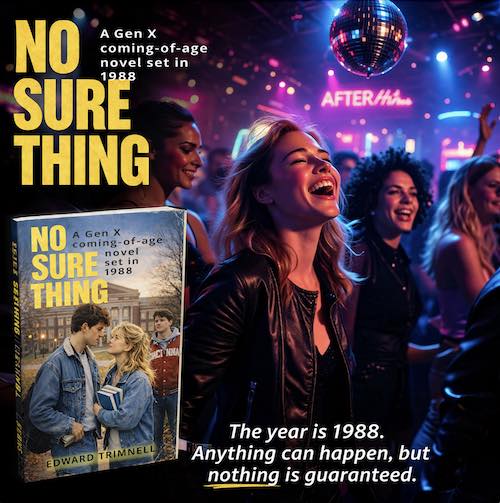
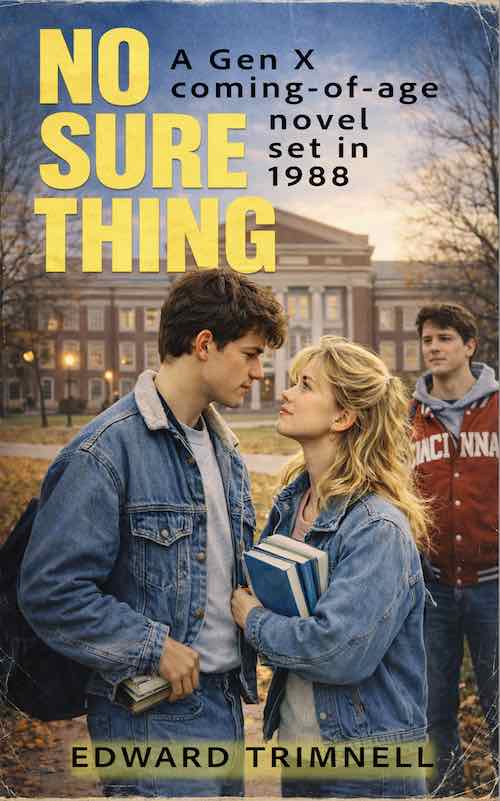
Below is a scene from NO SURE THING: A GEN X COMING-OF-AGE NOVEL SET IN 1988. In the scene below, the main character must jump through numerous hoops to meet an attractive young woman:

NO SURE THING: A GEN X COMING-OF-AGE NOVEL SET IN 1988

CHAPTER 43

Since my hand had previously been stamped, I had little trouble gaining reentry to the Casablanca Club. I walked by the doorman as if I owned the place, flashing him a glimpse of my left hand. He gave me no trouble this time.

Once inside, I got another break: there was no sign of Lance Corporal Evans or his fellow marines.

But where was Sergeant George Tuttle, fearless defender of the law in Cincinnati “for more than thirty  years?”

Maybe I would get lucky there. Maybe the cop had called it a night, or (more likely) been drawn away from the Casablanca Club by other police business.

I only had to walk around for a few minutes before I spotted her: the young woman from the Tangeman University Center. The pretty blonde who had caught my attention that day.

She was standing by herself at the edge of the nearest dance floor. Where were the other young women she had entered with, the ones I had assumed to be her friends? Was she meeting a guy here?

I didn’t know. And in that moment, I didn’t care. It was full speed ahead.

“Hi,” I said, when I got within speaking distance.

She turned toward me. I thought I detected a flash of recognition.

“You go to the University of Cincinnati, don’t you?” I asked.

Strictly speaking, this was a lame question with an obvious answer. The Casablanca Club was located a few blocks from the university, and we were both of university age. Probably half of the patrons here tonight were university students.

But few lines uttered by young men to young women in bars and nightclubs are brilliant. This wasn’t Toastmasters. Nor was I making an argument before Dr. Blevins. I was willing to improvise.

She smiled, but seemed at a loss for words.

“I think we may have spoken briefly in the Tangeman Center. That day you were looking at all the Armed Forces displays.

“More like I spoke briefly,” she said. “The proverbial cat seemed to have gotten your tongue.”

“There are no cats on my tongue now.”

This had to have been the most awkward line a man ever uttered to a woman in a bar. But it did the trick. She laughed.

“I’m Kim,” she said.

“I’m Paul.”

We talked for a few minutes more. I learned that she was a marketing major…common enough at the University of Cincinnati.

This was actually working, I suddenly realized. There was none of the awkwardness and fumbling that I’d felt when trying to talk to Tara and Courtney.

The difference, of course, was that the attraction with Kim was mutual, rather than one-sided. I therefore didn’t have to talk her into anything. All I had to do was go with the flow, be moderately assertive, and not say anything stupid.

But I was also conscious of Scott, who would right now be waiting for me in my car. I was also aware that in my very presence here, I was defying police orders, and breaking a promise I had made to a sergeant in the Cincinnati Police Department.

“I’ve enjoyed talking to you, Kim, but—”

“But now you have to go.”

“Yes. How did you know?”

“Call it intuition. Or maybe that you seem an awful lot like someone in a hurry.”

“I am in a hurry,” I confessed. “My friend is waiting for me at my car. Before I go, though: would you give me your phone number? I’d like to call you sometime.”

She smiled. “That’s usually what people have in mind when they ask for someone’s phone number. They want to call them sometime.”

A few minutes later, I was walking toward the main entrance/exit of The Casablanca Club with Kim’s phone number in my pocket.

She had written it on one of the club’s cocktail napkins, along with her last name. She was Kim Jones.

I was feeling on top of the world, more or less. Wait until Scott heard about this, I thought triumphantly.

I was outside in the parking lot of the Casablanca Club, almost home free, when everything unraveled.

“I thought you’d learned your lesson,” an older male voice declared. “But I guess I was wrong about that, wasn’t I?”

NO SURE THING: A GEN X COMING-OF-AGE NOVEL SET IN 1988 is available at Amazon, Barnes & Noble, Kobo, Google Play and Apple Books.

Killer robots in the factory

“The Robots of Jericho” is one of my early short stories. I wrote this back in 2009.

I spent a lot of years in the automotive industry, and countless hours in automotive plants.

Many of these factories had industrial robots. If you’ve ever watched industrial robots move, you’ll agree that they often appear to be alive.

Of course, I know that industrial robots aren’t really alive and sentient. But what if they were? “The Robots of Jericho” is a story about such a scenario.

“The Robots of Jericho” is available in print and ebook as one of the stories in my Hay Moon short story collection. But you’re welcome to listen to the story in the video below:

Gen X memories: childhood before geo-tracking

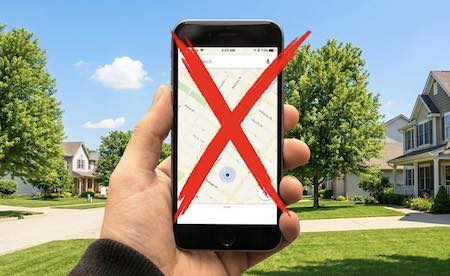
Using various phone apps, many parents now track the movements of their progeny from minute-to-minute. Some parents even track the movements of their adult children. One of my friends can tell you, at any minute of the day, where his two children are. My friend’s children are 26 and 30 years old.

I won’t mince words here. I find all of this geo-tracking to be a little neurotic, not to mention claustrophobic for those who must endure it.

It was different for those of us who grew up in the 1970s and 1980s, of course. At most hours of the day, our parents didn’t know exactly where we were. Oh, sure, they might have had some ideas, in the same way that I know Russia is to the east of me, and Argentina is to the far south. But don’t ask me to give you air travel coordinates. Suburban parents in the 1970s and 1980s relied on similar guesstimates regarding their children’s whereabouts.

During the summer months especially, we took full advantage of this location anonymity. The one thing most every Gen X kid had was a bike. And a bike was a license to travel distances your parents never would have approved of. Some of us planned long quests that would have been worthy of a JRR Tolkien novel like The Hobbit or The Lord of the Rings.

The motivation for these unauthorized trips was often some kind of contraband: alcohol, cigarettes, or firecrackers. Sometimes it was just the thrill of seeing how far your ten speed would carry you in a single June or July morning.

Among adolescent boys, the motivations were often of an amorous inclination. I turned 13 in the summer of 1981. One of my neighborhood friends—I’ll call him Glen—had somehow initiated a running phone conversation with three girls who lived in a neighborhood far from where we lived. Somehow three of us—Glen, me, and one other boy—started talking to the girls, always via landline (the only communication option in those days) and always from Glen’s house.

The girls sounded both pretty and friendly. The girls said they wanted to meet us, but we would have to go to them. And so we planned a bicycle trip to their neighborhood.

Did we ask our parents’ permission? Of course not.

We set off on our bikes one morning around nine a.m. Being randy young males, we eagerly speculated about what might happen at our destination.

When we arrived nearly two hours later, however, the girls were nowhere to be found. Forty-five years after the fact, I’m not sure exactly what happened. We either had the wrong address, or we were duped. Disappointed, we rode back as a particularly hot afternoon settled in.

The lesson I learned from this was: if it seems too good to be true, a little too convenient, then it probably is too good to be true.

But that is the kind of life lesson that you can’t learn on a computer, and certainly not on social media. I’m grateful that I came of age when free-range childhood was still a thing. To grow up without geo-tracking was both a privilege and a blessing.

-ET

1980s tech was expensive, and it didn’t do much

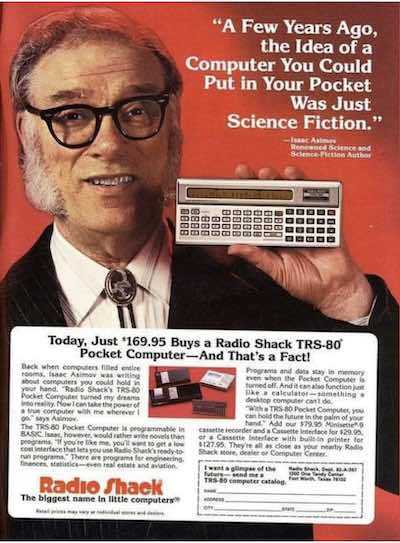
I vaguely remember the TRS-80 Pocket Computer. Introduced in 1980, this little device was manufactured and marketed by the Tandy Corporation/Radio Shack. (Every shopping mall in the 1980s had a Radio Shack.) Science fiction author Isaac Asimov appeared in a series of marketing spots for the gadget.

1980 Radio Shack ad featuring the TRS-80 Pocket Computer and Isaac Asimov

I didn’t own a TRS-80 Pocket Computer, however. The MSRP was $169.95. In present-day money, that’s about $670—the cost of a base-model iPhone.

And of course, the TRS-80 Pocket Computer had a minimal functionality when compared to an iPhone. It couldn’t make phone calls, play music, or take photos. It couldn’t surf the Internet—which didn’t yet exist, anyway.

The TRS-80 Pocket Computer was programmable in BASIC (which couldn’t do much for the average consumer). Other than that, it was basically a glorified pocket calculator.

Herein lies an important realization about 1980s tech: it was very expensive, and it didn’t do much. Even if you could afford it, you usually concluded that you could do without it.

-ET

“Don’t Stop Believin’”: a song with multiple lives 

I was in the 8th grade in 1981-2, when Escape, Journey’s seventh studio album, was the latest thing.

Escape is one of the few rock albums with no duds. Every song is good—if you like Journey’s style of music.

But the best song on the album, perhaps, is “Don’t Stop Believin’”. It is a great song because it is simultaneously specific and universal.

We wonder about the small town girl, and the city boy “born and raised in South Detroit.” What compelled each of them to take “the midnight train going anywhere”?

And at the same time, the song is vague enough that we can each apply it to our individual stories. “Whoa, the movie never ends. It goes on and on and on and on.” My movie has gone on for 44 years since I first heard this song, and counting.

For years, this song instantly took me back to the 1981-2 school year, and the adolescent I was at that time. The song can still do that.

But then a few years ago, I watched The Sopranos from start to finish. (I was about a decade behind everyone else in doing this…the story of my life.) Then, for a long time, I would see the final, iconic scene of The Sopranos when I heard, “Don’t Stop Believin’”.

Most recently, I have discovered First to Eleven’s interpretation of the song. (First to Eleven is a very talented cover band based in Erie, Pennsylvania.)

None of the members of First to Eleven was even born when I heard “Don’t Stop Believin’” for the first time, back in 1981. (They are all very young.) And yet, their music video, and lead vocalist Audra Miller’s performance, put yet another spin on the song for me.

And some people worry—or hope—that AI will replace serious musicians? They base this on the fact (for example) that AI can now reassemble good music into mediocre music. (See my recent post about The Velvet Sundown.)

AI will never be good for anything but mediocrity. Only a human imagination could have come up with “Don’t Stop Believin’” almost half a century ago. And it took human imagination to come up with all these reimaginings of the song since then.

-ET

The bygone, venerable 8-track

Members of my generation lived to see plenty of changes in the ways popular music is consumed. We were born in the golden age of the vinyl album. As adults, many of us are learning to cope with streaming music services.

Throughout most of the 1980s, the audio cassette tape was the most popular means of buying music and listening to it. When I see nostalgic Facebook posts about physical music media from the 1980s, the cassette tape is most often the subject.

But there was another musical format that was already dying out as the 1980s began, but which was actually quite good, by the standards of the time. I’m talking about the venerable 8-track tape.

The 8-track was a plastic cartridge that had dimensions of 5.25 x 4 x 0.8 inches. Like the audio cassette, the 8-track contained a magnetic tape. But unlike the audio cassette, the 8-track was much less prone to kinking and tangling.

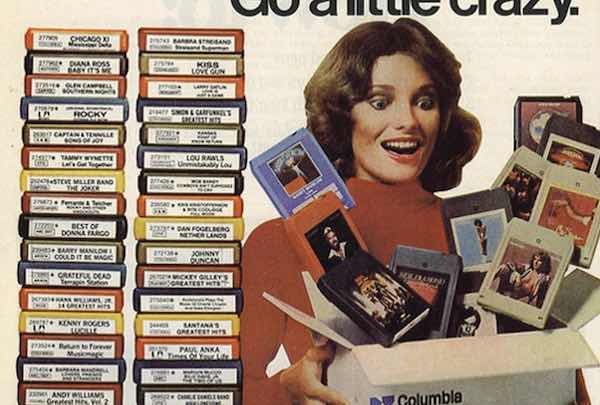
The 8-track was actually 1960s technology. The 8-track took off in the middle of that decade, when auto manufacturers began offering 8-track players as factory-installed options in new vehicles. Throughout the 1970s, 8-track players were popular options on new cars. 8-tracks were further popularized by subscription music services like Columbia House.

Columbia House magazine ad from the 1970s

I purchased my first home stereo system for my bedroom in 1982, with money I had saved from my grass-cutting job. I bought it at Sears, which was one of the best places to buy mid-level home audio equipment at that time. The stereo included an AM/FM radio, a turntable for vinyl records, a cassette deck, and an 8-track player

I quickly discovered that I liked the 8-track format the best, because of its relatively compact size and ease of use. That spring I bought 8-track versions of Foreigner 4, Styx’s Paradise Theater, and the Eagles Live album. All of these produced good sound (again, by the standards of that era), and none of them ever jammed or tangled. I was convinced that I had found my musical format.

It has often been my destiny to jump on a trend just as it is nearing its end. Little did I know that my beloved 8-track was already in steep decline.

8-track sales in the USA peaked in 1978, and began falling after that. The culprit was the slightly more compact, but far more error-prone audio cassette. This was the format that all the retailers were suddenly pushing. By the early 1980s, cassette players were also replacing 8-track players in cars.

I would like to say that I yielded to the march of technological progress, but this wouldn’t be truly accurate. The audio cassette, invented in 1963, was slightly older technology than the 8-track.

I did, however, yield to the march of commercial trends, simply because I had no choice. Nineteen-eighty-three was the year that retailers began phasing out 8-tracks in stores. You could still purchase them from subscription services, but they were disappearing from the shelves of mall record stores and general merchandisers like K-Mart. By early 1984, the venerable 8-track had completely vanished.

In recent years, there has been a movement to resurrect the vinyl record. I’ve noticed no similar trend aimed at bringing back the 8-track. At this point, in the early- to mid-2020s, I may be the only person left on the planet who still fondly remembers this bygone musical medium.

-ET