In the spring of 1980, I was eleven years old going on twelve. I was a huge Star Wars fan, part of the original generation that discovered the movies as kids.
Like many kids of that era, I couldn’t get enough of the Star Wars story. Seeing the movies in the cinema wasn’t enough.
And for that we had Star Wars comics. Marvel put out a big Star Wars edition for the first film in 1977: more or less a retelling of the movie in graphic form, and simplified a little for young readers.
My parents bought me the comic version of the first film in 1977, and I read it from cover-to-cover, many times over. When the comic for The Empire Strikes Back came out in 1980, my parents gave me that, too. I also read this one many times, even though I’d seen the movie!
Thinking about all the hours of pleasure I (and so many other Gen X kids) derived from a single comic book makes me long for simpler times, of course. We did not have as many entertainment options in those days. The Internet was still almost 20 years in the future. Video games, still crude, were only beginning to become a thing.
But there is also something to be said for the unprecedented creative impact and economic power of the Star Wars story in the late 1970s and early 1980s.
The glory had faded a little by the time Return of the Jedi, the third movie, came out in 1983. But between the release of the first and second movies, 1977 – 1980, Star Wars was a cultural colossus. To put it in contemporary terms: combine Taylor Swift with the Super Bowl, and then multiply that by a factor of five.
Looking at that comic, I feel something else, too; and this one is personal. I feel fortunate that I had two parents who loved me, and provided me with more than the basics of food and shelter. As I’ve noted before, I was very blessed in my formative years. I have little to complain about.
I study multiple languages, and I worked for many years as a professional translator. I love foreign languages, and I love learning them.
Nevertheless, I don’t have much interest in the online “polyglot” community, as it has come to exist on social media platforms like YouTube.
Nor will I ever create one of those cringeworthy YouTube videos in which a language learner displays his or her various languages for the virtual claps of fellow language learners.
I am far more impressed with people who combine multilingualism with a full slate of personal and professional interests. Foreign language study should be a part of every well-rounded, well-educated life. But not the sole focus of it…and certainly not an excuse to engage in constant public preening.
This is why I’m genuinely impressed by the linguistic achievements of the late Audrey Hepburn (1929 – 1993). Her first language was Dutch. She also spoke fluent French, English, and Italian. She was proficient in Spanish and German.
Watch the above video, and you’ll see what a natural multilingual she was. You’ll also note that, unlike so many of today’s YouTube polyglots, she did not make a big deal of her attainments. She did not say, “Hey, watch me speak X language now!” Rather, she used the languages she had learned in a situationally appropriate and unpretentious manner.
In those days before a zillion cable channels (let alone the Internet), there was TV Guide.
Launched in 1953, these little weekly magazines would be familiar to anyone from the Baby Boom generation or Generation X. (Some of the older Millennials may have dim early childhood memories of TV Guide, too.)
Each issue of TV Guide contained a listing of the week’s programming, of course. There were also articles in the front of the magazine that were sometimes worth reading. (If you were interested in television and Hollywood happenings, that was.)
The covers, moreover, were often minor works of art. Like this one from 1986, which depicts the cast of Cheers, one of the most popular shows of the 1980s.
TV Guide was always on my mother’s shopping list. It was on everyone’s shopping list. Why? Because without this publication, you would have a hard time knowing what programs were on, on which channels, and at what times.
The magazine was cheaply priced. (The 60¢ May 10, 1986 issue shown above would equate to only about $1.70 in today’s dollars.) But TV Guide was nevertheless essential.
With a shelf life of only one week, these weren’t magazines that anyone saved for posterity. Sometimes, though, one of them would end up beneath a sofa or behind a recliner, only to turn up months later.
TV Guide still exists as a going concern, but it’s a shadow of its former self. The TV Guide website probably gets some traffic, but the stripped-down, printed version of the magazine is no longer the weekly grocery-cart essential it once was. Not in this era of cable, Hulu, Netflix and YouTube. I could not find a copy of TV Guide at my local Walmart, Meijer, or Kroger. The publication now seems to rely on a shrunken, hardcore base of snail-mail subscribers.
Yes, another casualty of our digital age of hyper-abundance. TV Guide’s original mission has become not just obsolete—but impossible, even if someone wanted to attempt it.
Network and cable listings are only a small part of the viewing options nowadays. On-demand is where the real action is…not just on Netflix and Hulu, but on the endless sea of variety that is YouTube. On-demand viewings, loosely organized by search engines, defy the bounds of itemized printed lists.
It would not be incorrect to say that the original TV Guide is a relic of pre-Internet times; but this description would be insufficiently precise. The old TV Guide is a relic of a time when the scope of available programming for a single week was small enough that it could be completely curated, listed, and described in a single publication.
Needless to say, those days are gone; and—barring some cataclysmic change that restarts everything from scratch—those days are gone forever.
Members of my generation lived to see plenty of changes in the ways popular music is consumed. We were born in the golden age of the vinyl album. As adults, many of us are learning to cope with streaming music services.
Throughout most of the 1980s, the audio cassette tape was the most popular means of buying music and listening to it. When I see nostalgic Facebook posts about physical music media from the 1980s, the cassette tape is most often the subject.
But there was another musical format that was already dying out as the 1980s began, but which was actually quite good, by the standards of the time. I’m talking about the venerable 8-track tape.
The 8-track was a plastic cartridge that had dimensions of 5.25 x 4 x 0.8 inches. Like the audio cassette, the 8-track contained a magnetic tape. But unlike the audio cassette, the 8-track was much less prone to kinking and tangling.
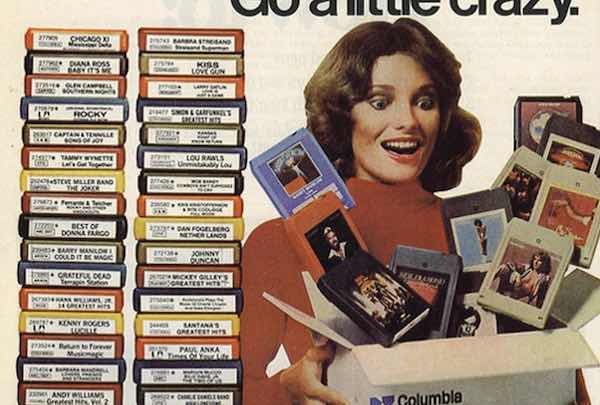
The 8-track was actually 1960s technology. The 8-track took off in the middle of that decade, when auto manufacturers began offering 8-track players as factory-installed options in new vehicles. Throughout the 1970s, 8-track players were popular options on new cars. 8-tracks were further popularized by subscription music services like Columbia House.
Columbia House magazine ad from the 1970s
I purchased my first home stereo system for my bedroom in 1982, with money I had saved from my grass-cutting job. I bought it at Sears, which was one of the best places to buy mid-level home audio equipment at that time. The stereo included an AM/FM radio, a turntable for vinyl records, a cassette deck, and an 8-track player.
I quickly discovered that I liked the 8-track format the best, because of its relatively compact size and ease of use. That spring I bought 8-track versions of Foreigner 4, Styx’s Paradise Theater, and the Eagles Live album. All of these produced good sound (again, by the standards of that era), and none of them ever jammed or tangled. I was convinced that I had found my musical format.
It has often been my destiny to jump on a trend just as it is nearing its end. Little did I know that my beloved 8-track was already in steep decline.
8-track sales in the USA peaked in 1978, and began falling after that. The culprit was the slightly more compact, but far more error-prone audio cassette. This was the format that all the retailers were suddenly pushing. By the early 1980s, cassette players were also replacing 8-track players in cars.
I would like to say that I yielded to the march of technological progress, but this wouldn’t be truly accurate. The audio cassette, invented in 1963, was slightly older technology than the 8-track.
I did, however, yield to the march of commercial trends, simply because I had no choice. Nineteen-eighty-three was the year that retailers began phasing out 8-tracks in stores. You could still purchase them from subscription services, but they were disappearing from the shelves of mall record stores and general merchandisers like K-Mart. By early 1984, the venerable 8-track had completely vanished.
In recent years, there has been a movement to resurrect the vinyl record. I’ve noticed no similar trend aimed at bringing back the 8-track. At this point, in the early- to mid-2020s, I may be the only person left on the planet who still fondly remembers this bygone musical medium.
“The Trooper” appeared on Iron Maiden’s 1983 album, Piece of Mind. Both the song and the MTV video are now regarded as classics.
But when I first saw and heard this, it was just another new song in the MTV lineup.
Not to me, though. I immediately recognized something special about “The Trooper”. I can’t say I predicted that it would become a timeless classic. But I’m not exactly surprised, either.
Yes, of course, there is the hard-driving beat. Also, the juxtaposition of old movie footage with studio clips of the band in the video. (This would become a signature technique for Iron Maiden music videos.)
Even more than all that: this is a heavy metal song about the Crimean War, inspired by Alfred Lord Tennyson’s 1854 narrative poem, “The Charge of the Light Brigade”.
In the early 1980s, heavy metal bands like the Scorpions and AC/DC were singing about the usual, tired topics: sex, parties, and rock-n-roll. Iron Maiden was writing songs about 19th century warfare. And the musical results were pleasing to the ear.
Now, if you don’t think that’s cool, well, I don’t know what to tell you. This is why I’ve been an Iron Maiden fan for over 40 years.
I was poking around on YouTube when I discovered the above trailer. Apparently Max (formerly HBO Max) has created a new screen adaptation of ‘Salem’s Lot, Stephen King’s 1975 novel about vampires taking over a small town in Maine.
I saw the original TV miniseries when it aired back in November 1979. I was 11 years old, in the sixth grade. There were some scenes in the 1979 original adaptation that were genuinely creepy–especially to the 11-year-old me.
When I started reading Stephen King’s novels in 1984, ‘Salem’s Lot was the one I started with. About five years had passed since my viewing of the miniseries. And I was then a sophomore in high school instead of a sixth-grader.
I read ‘Salem’s Lot in about three days. I found the book an absolute page-turner. (I seem to recall doing poorly on a geometry test, because I was reading ‘Salem’s Lot when I should have been studying!)
I’ve reread the book several times since then. From my more critical (and more jaundiced) adult perspective, I can see some flaws that I didn’t notice back then. But no matter. ‘Salem’s Lot is still a humdinger of a story, at the end of the day.
‘Salem’s Lot has a modern (1970s modern, anyway) feel to it. You don’t get the sense that you’re reading a story set in a remote location in 19th-century Europe, like Bram Stoker’s Dracula (1897). ‘Salem’s Lot therefore seems like a story that could happen. (If vampires existed, that is!)
Moreover, ‘Salem’s Lot is a real vampire story. Not a fake, teen girl romance tale masquerading as a vampire story, like that Twilight nonsense. (Don’t even get me started on Stephenie Meyer’s high crimes against the vampire genre.)
The 1970s/80s paperback version of ‘Salem’s Lot that I read in 1984
The new Max film version of ‘Salem’s Lot looks scary, based on the trailer. I will doubtless get around to seeing it a some point, but this is one that can wait, in my case.
‘Salem’s Lot, great story that it is, is one that has been with me for 45 years now, in one form or another. I watched the original TV miniseries at age 11. I read the novel for the first time at age 15. I’m now 56, and I know this story so well that I cannot help anticipating all the major plot points before they occur.
But such are the vagaries of age, and of rereading books, and watching their screen adaptations over decades. If your history with ‘Salem’s Lot is less extensive than mine (and it probably is), you’ll want to rush to the new Max version of it. A younger version of me would have felt the same way.
World War II ended twenty-three years before I was born. But since I grew up hearing about it, World War II was almost living history for me.
All four of my grandparents could tell you exactly where they were, and what they were doing, when they heard the news about Pearl Harbor.
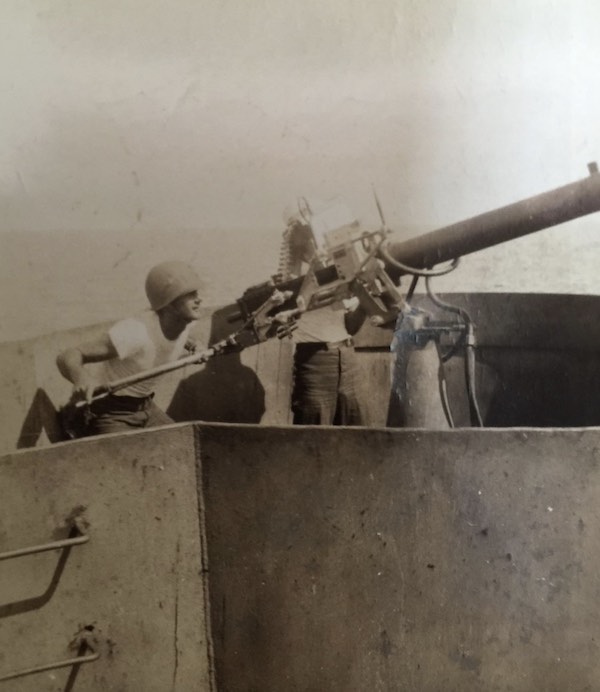
My maternal grandfather, then 19 years old, enlisted in the US Navy the following week. His enlistment led to many combat experiences in the Atlantic. These were stories I grew up with.
My grandfather in the Atlantic Ocean, 1943
In 2024, the ranks of living Americans who can remember December 7, 1941 are growing thin. It was 83 years ago, after all.
In one sense, this is perfectly natural and unremarkable. None of my grandparents could remember the assassination of President Lincoln, or the Battle of Antietam. History moves on, and each new generation has fresh tragedies to remember.
This process of generational forgetting seems to happen more quickly as one grows older. I am sometimes shocked to meet young adults who do not remember 9/11. And then I do the math.
I would like to say that I will remember Pearl Harbor Day in honor of the Americans who died on December 7, 1941. That would be the correct and most patriotic way to put it.
But if I’m being honest, I’ll remember Pearl Harbor Day because it traumatized and moved my grandparents, who told me about it.
Pearl Harbor forever changed the life of my maternal grandfather, in particular. I heard about the war from him. And because of him, World War II will always be living—and secondhand—history for me.
Many years ago, I watched the movie adaptation of Pat Conroy’s 1986 novel, The Prince of Tides. I only recently got around to reading the book.
The 1991 movie stars Nick Nolte as Tom Wingo, a South Carolinian who finds himself a fish out of water in New York City.
Why is Tom Wingo in NYC? His famous sister, poet Savannah Wingo, has just had a psychotic episode. Savannah requires the intervention of psychiatrist Susan Lowenstein, played by Barbara Streisand.
The Prince of Tides movie poster, 1991
The movie revolves around the resultant romance between Tom Wingo and Susan Lowenstein. The movie poster collage even features an image of Streisand and Nolte in a moment of what appears to be post-coital tenderness.
This was done, no doubt, so that Hollywood could bill the movie as a romantic drama, targeted at the then middle-aged Baby Boomer demographic. But this represented a vast departure from the emphasis of Pat Conroy’s long novel.
The novel does include a romantic, adulterous interlude between Wingo and Lowenstein, both of whom are trapped in unfulfilling, ill-fitting marriages. (A very middle-aged Baby Boomer theme.) But most of the novel consists of flashback stories from Wingo’s troubled, colorful childhood.
Tom Wingo, his twin sister Savannah, and his brother Luke were all scarred by their formative years in South Carolina. The 600-page novel is mostly a long series of flashback stories that drive home this point, again and again. This is all that happened to them…This is why Tom Wingo and his siblings went so very wrong…
As a result, The Prince of Tides is less a single novel than a series of loosely connected stories, which Wingo revisits in memory during his extended stay in New York City. Some of these stories are interesting, or at least have the potential to be interesting. Far too many of them, though, come across as random and far-fetched.
For example, there is a subplot in which the Wingo siblings, as adolescents, abduct an albino porpoise from a public aquarium. The elements of this side tale are so improbable as to resemble slapstick.
There is an early flashback story in which the children’s coarse, abusive father, Henry Wingo, is a downed pilot behind German lines in World War II. This story seems rushed, and almost as improbable as the subsequent white porpoise tale.
And then there are the really weird subplots involving miscarried infants and the Wingo siblings’ grandparents. I’ll leave those for the reader to explore on her own, if she decides to read the book.
The Prince of Tides would have been much better if Conroy had written it as a series of books. Or, perhaps, a series of long short stories about the same characters. But the publishing industry of the mid-1980s was focused on delivering thick, standalone novels for the shelves of B. Dalton and Waldenbooks. That’s what The Prince of Tides is, in terms of its packaging. The storytelling suffers as a result.
The Prince of Tides lacks a central narrative drive. Look here! Conroy tells the reader. No—now look over here at this!
Pat Conroy’s novels tend to be hit or miss for me. I loved The Lords of Discipline (1980). I found South of Broad (2009) to be a slog. The Prince of Tides is a novel that I do not regret reading once, but not one that I am ever likely to read again.
Conroy grew up in South Carolina, the son of a harsh military father. Just like so many of his characters. All of his novels, in one way or another, tend to be autobiographical. Conroy seems to be revisiting his own troubled childhood in fiction, again and again.
Self-focused fiction can be both beautifully authentic and numbingly self-indulgent. The Prince of Tides is some of both.
A blast of unseasonable cold has struck Cincinnati for Thanksgiving 2024, but I plan to have a good holiday nonetheless. I may even make it into the gym later today.
I hope that you, Dear Reader, will spend the day with people you love. If half of your friends/relatives voted for Trump, and half for Harris (a statistical likelihood throughout most of the country) dinnertime discussion may be interesting, to say the least.
Keep your cool and try to make the best of it. Remember that politics always change, but Thanksgiving remains the same, coming back year after year.
Just look at the above artwork from Norman Rockwell, 1919. The image is as inviting today as it was 105 years ago.
I love many people who, for whatever reason, don’t see the world through the same lenses I do. You likely do, too; and should.
I shall return on Friday. In the meantime, I hope you have a happy and safe Thanksgiving 2024.
It’s 1978 and Christmas is approaching. That means lots of television ads for McDonald’s gift certificates!
As I recall, these came in denominations of 50 cents and 1 dollar. That was not a fortune even in 1978. (Stagflation, remember!) But in 1978, a single McDonald’s gift certificate of 50 cents or a dollar could at at least buy one menu item. Not like nowadays.
These were advertised as stocking stuffers and X-mas card inserts, not proper gifts. Even in the 1970s, we weren’t quite that parsimonious.
I don’t remember ever buying any of these, let alone receiving any. But McDonald’s really pushed them in television ads in November and December.
In 1989 I was 21 years old and a student at the University of Cincinnati.
I was also deep in the initial phase of my fascination with Japan, its language, and its culture.
Japan would become a lifelong fascination of mine…with some inevitable diminutions. Thirty-five years later, I am no longer quite as enraptured with every aspect of Japan as I once was. But I still spend time each day listening to Japanese-language YouTubers, podcasters, and media broadcasts. If a story about Japan appears in the Western media, I’m usually on top of it.
But back to 1989. Around the same time that I discovered Japan, I also discovered the novels of James Clavell. The two were interconnected, you see. It is impossible to read Clavell and not become interested in the cultures of East Asia. James Clavell’s books fueled my early interest in learning Japanese.
James Clavell
Clavell (1921 – 1994) was a British-Australian man of the World War II generation. He published most of his Asian Saga novels between the early 1960s and the mid-1980s. This was a time when Asian languages and cultures were not widely known in the West, and a certain amount of exoticism, or what is sometimes called orientalism, was par for the course.
Clavell’s work has thusly been critiqued by the nattering nabobs of political correctness. Not all of their criticisms are completely unfair…from the perspective of the third decade of the twenty-first century, that is. But Shōgun, Clavell’s novel about Edo Period Japan, was published in 1975. Almost 50 years ago. In those days, almost no one in the United States bothered to learn anything about Japan, except for the fact that Japan had been our World War II enemy.
Clavell often got the history wrong, too. Shōgun is loosely based on the establishment of the Tokugawa Shogunate in the early 1600s. Clavell captures the big sweep of that historical period, but the names and personalities are largely fictional.
The main character of Shōgun, John Blackthorne, is loosely based on William Adams (1564 -1620), known in Japan as Miura Anjin. Suffice it to say that the real William Adams was not nearly as exciting as Clavell’s creation.
What Clavell brought to the table was the genuine enthusiasm of a Westerner who was trying his level best to understand East Asian culture. He did this imperfectly, to be sure. But his passion for the subject matter was infectious.
Ditto for Clavell’s skills as a storyteller. When he was at his best, Clavell could tell a story that would hold your interest even if you didn’t share his enthusiasm for Asia.
I distinctly remember reading Shōgun in 1989. The novel was already more than a decade old then. Although I was busy with schoolwork and a part-time job, I nevertheless made my way through this 1,110-page potboiler within about two weeks.
That was 35 years ago. I occasionally reread books, provided a.) the book is worth a second reading, and b.) at least 10 years have elapsed since my first reading. Shōgun made the cut on both counts. This time, however, I’m listening to the audiobook—all 52 hours worth.
As noted above, my fascination with Japan, while still extant, doesn’t burn quite as intensely as it did in 1989. Japan was an unknown land of adventure for me 35 years ago. Since 1989, I’ve spent a lot of time in Japan…mostly for business. For me, Japan has become not the land of samurais and geishas, but the land of interminable business meetings and automobile factories. But I still love the place.
James Clavell’s storytelling abilities in Shōgun are just as good the second time around. After 35 years, I still recall some of the book’s major plot points, but enough time has passed that I’m still surprised by much of what I read. I also have the benefit of historical knowledge about Japan. (I knew almost nothing about Japan’s history in 1989.) And yes, I’ve been there now, multiple times.
What about the television adaptations?
The first TV adaptation of Shōgun starred Richard Chamberlain. It ran on NBC for five days in September 1980. You didn’t need any streaming subscriptions or memberships. The show was supported by commercials.
I recall watching the first screen adaptation of Shōgun when it ran, but in 1980 I was 12 years old. I knew next to nothing about Japan, and most of it went over my head.
I’m aware of the streaming FX series which was released this year. A remake was long overdue after 45 years; and the teaser clips I have seen online look promising.
Typical of the streaming era, there is no way to watch the show without buying a subscription to Hulu or Disney+. How I long for the benighted “old days”, when television was mostly free, and far more convenient to watch. But I digress.
I’ll get around to watching the 2024 screen adaptation of Shōgun at some point, I’m sure. In the meantime, I will content myself with this second journey through the book, via audio. I’m a little more than halfway through, and nowhere close to being bored.
The book haul video is a thing on the Japanese corners of YouTube, just as it is among English-language booktubers.
As in English, the Japanese book haul video (and the entire booktuber sector) is dominated by young women. No complaints here, except to point out that men of all ages, in all countries, should read more.
I have not been to Japan for more than a decade now. One thing I really miss about being in Japan is browsing bookstores, and looking for new books to read.
Even with the Internet, the acquisition of Japanese-language reading materials remains something of an ordeal in the United States. The US division of Amazon stocks relatively few Japanese-language titles. The demand simply isn’t there.
At the same time, US-based, independently owned mail-order Japanese bookstores have mostly gone out of business. This is yet another case of the Internet ruining a business model without providing an acceptable substitute.
I recall Sasuga Bookstore of Cambridge, Massachusetts with particular fondness. I purchased many books from them throughout the 1990s and early 00s. (Sasuga closed its doors for good in 2010. 残念でした.)
A quick personal reading note: I’m on volume 6 of 課長島耕作 (Kachou Shima Kousaku). I’m rereading the whole series, which I read for the first time in the mid-1990s.
And yes, I’m reading it in the original Japanese. I was a Japanese language translator throughout much of the 1990s. I started studying Japanese back in 1988.
But if you don’t read Japanese, you can probably find the long-running Shima Kousaku series in English. (I’ve definitely seen it out there.)
People who know about my Japanese-language background often ask me about manga. Do I like it?
Well…yes and no. In general, I don’t care for the (often) sexualized fantasy tropes that comprise so much of the manga sphere. I much prefer the more realistic Japanese manga; and Shima Kousaku is my favorite.
The Shima Kousaku series begins in the 1980s. It follows the journey of a Japanese corporate employee, or salaryman, as he moves up the ladder of his employer, Hatsushiba Electric.
Not much happens in these stories, in terms of high-concept plot. These are basically soap operas, but they’re exceptionally well-done soap operas, with plenty of microtension.
A story doesn’t need zombies and car chases to be enthralling. (Though a story certainly can be enthralling with zombies and car chases; don’t get me wrong.)
The Iran Hostage Crisis of 1979 is one of the first major global events that I remember.
I was 11 years old on November 4, 1979, when Iran’s revolution came to a head, and a mob of student militants overran the US Embassy in Tehran. The student militants took 66 American hostages. 52 of these hostages would remain in Iran until January, 1981.
American hostages in Tehran, Iran in 1979
I followed the 444-day crisis on the news. But being 11 years old, I was sketchy on most of the historical background.
I’ve read a lot more about the crisis since then. I’m presently finishing up the above book, Guests of the Ayatollah: the First Battle in America’s War with Militant Islam, by Mark Bowden.
Bowden’s book includes not only the overarching historical details, but also many individual stories: of the hostages, and others whose lives were impacted.
Definitely worth a read if this is a subject that interests you!