I was poking around on YouTube when I discovered the above trailer. Apparently Max (formerly HBO Max) has created a new screen adaptation of ‘Salem’s Lot, Stephen King’s 1975 novel about vampires taking over a small town in Maine.
I saw the original TV miniseries when it aired back in November 1979. I was 11 years old, in the sixth grade. There were some scenes in the 1979 original adaptation that were genuinely creepy–especially to the 11-year-old me.
When I started reading Stephen King’s novels in 1984, ‘Salem’s Lot was the one I started with. About five years had passed since my viewing of the miniseries. And I was then a sophomore in high school instead of a sixth-grader.
I read ‘Salem’s Lot in about three days. I found the book an absolute page-turner. (I seem to recall doing poorly on a geometry test, because I was reading ‘Salem’s Lot when I should have been studying!)
I’ve reread the book several times since then. From my more critical (and more jaundiced) adult perspective, I can see some flaws that I didn’t notice back then. But no matter. ‘Salem’s Lot is still a humdinger of a story, at the end of the day.
‘Salem’s Lot has a modern (1970s modern, anyway) feel to it. You don’t get the sense that you’re reading a story set in a remote location in 19th-century Europe, like Bram Stoker’s Dracula (1897). ‘Salem’s Lot therefore seems like a story that could happen. (If vampires existed, that is!)
Moreover, ‘Salem’s Lot is a real vampire story. Not a fake, teen girl romance tale masquerading as a vampire story, like that Twilight nonsense. (Don’t even get me started on Stephenie Meyer’s high crimes against the vampire genre.)
The 1970s/80s paperback version of ‘Salem’s Lot that I read in 1984
The new Max film version of ‘Salem’s Lot looks scary, based on the trailer. I will doubtless get around to seeing it a some point, but this is one that can wait, in my case.
‘Salem’s Lot, great story that it is, is one that has been with me for 45 years now, in one form or another. I watched the original TV miniseries at age 11. I read the novel for the first time at age 15. I’m now 56, and I know this story so well that I cannot help anticipating all the major plot points before they occur.
But such are the vagaries of age, and of rereading books, and watching their screen adaptations over decades. If your history with ‘Salem’s Lot is less extensive than mine (and it probably is), you’ll want to rush to the new Max version of it. A younger version of me would have felt the same way.
A down-on-their-luck young couple take advantage of an opportunity to strike it rich at a Southern Indiana casino. Instead they find themselves in the middle of a struggle between two ruthless criminal factions.
Many years ago, I watched the movie adaptation of Pat Conroy’s 1986 novel, The Prince of Tides. I only recently got around to reading the book.
The 1991 movie stars Nick Nolte as Tom Wingo, a South Carolinian who finds himself a fish out of water in New York City.
Why is Tom Wingo in NYC? His famous sister, poet Savannah Wingo, has just had a psychotic episode. Savannah requires the intervention of psychiatrist Susan Lowenstein, played by Barbara Streisand.
The Prince of Tides movie poster, 1991
The movie revolves around the resultant romance between Tom Wingo and Susan Lowenstein. The movie poster collage even features an image of Streisand and Nolte in a moment of what appears to be post-coital tenderness.
This was done, no doubt, so that Hollywood could bill the movie as a romantic drama, targeted at the then middle-aged Baby Boomer demographic. But this represented a vast departure from the emphasis of Pat Conroy’s long novel.
The novel does include a romantic, adulterous interlude between Wingo and Lowenstein, both of whom are trapped in unfulfilling, ill-fitting marriages. (A very middle-aged Baby Boomer theme.) But most of the novel consists of flashback stories from Wingo’s troubled, colorful childhood.
Tom Wingo, his twin sister Savannah, and his brother Luke were all scarred by their formative years in South Carolina. The 600-page novel is mostly a long series of flashback stories that drive home this point, again and again. This is all that happened to them…This is why Tom Wingo and his siblings went so very wrong…
As a result, The Prince of Tides is less a single novel than a series of loosely connected stories, which Wingo revisits in memory during his extended stay in New York City. Some of these stories are interesting, or at least have the potential to be interesting. Far too many of them, though, come across as random and far-fetched.
For example, there is a subplot in which the Wingo siblings, as adolescents, abduct an albino porpoise from a public aquarium. The elements of this side tale are so improbable as to resemble slapstick.
There is an early flashback story in which the children’s coarse, abusive father, Henry Wingo, is a downed pilot behind German lines in World War II. This story seems rushed, and almost as improbable as the subsequent white porpoise tale.
And then there are the really weird subplots involving miscarried infants and the Wingo siblings’ grandparents. I’ll leave those for the reader to explore on her own, if she decides to read the book.
The Prince of Tides would have been much better if Conroy had written it as a series of books. Or, perhaps, a series of long short stories about the same characters. But the publishing industry of the mid-1980s was focused on delivering thick, standalone novels for the shelves of B. Dalton and Waldenbooks. That’s what The Prince of Tides is, in terms of its packaging. The storytelling suffers as a result.
The Prince of Tides lacks a central narrative drive. Look here! Conroy tells the reader. No—now look over here at this!
Pat Conroy’s novels tend to be hit or miss for me. I loved The Lords of Discipline (1980). I found South of Broad (2009) to be a slog. The Prince of Tides is a novel that I do not regret reading once, but not one that I am ever likely to read again.
Conroy grew up in South Carolina, the son of a harsh military father. Just like so many of his characters. All of his novels, in one way or another, tend to be autobiographical. Conroy seems to be revisiting his own troubled childhood in fiction, again and again.
Self-focused fiction can be both beautifully authentic and numbingly self-indulgent. The Prince of Tides is some of both.
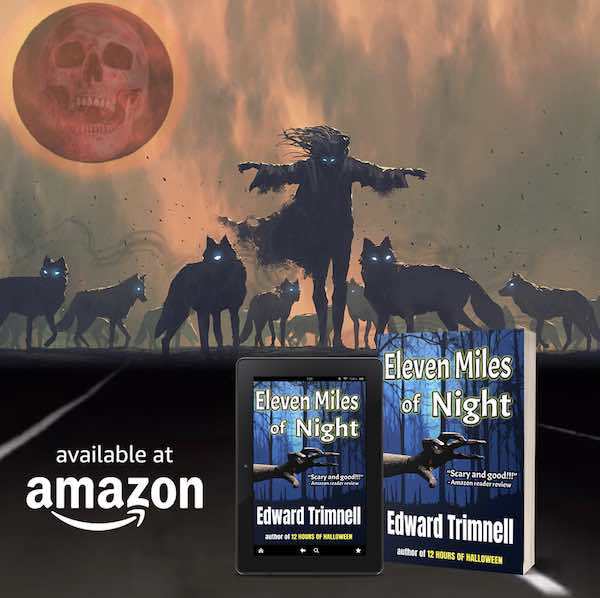
**When walking down lonely roads at night, beware the hellhounds!**
Jason Kelley is a college filmmaker who has accepted a challenge: walk eleven miles down the most haunted road in rural Ohio, the so-called Shaman’s Highway.
If Jason completes his task, he’ll win a $2,000 prize.
But before he reaches his destination, he’ll have to cope with evil spirits, trees that come to life, an undead witch, and packs of roving hellhounds!
A creepy supernatural thriller! Not for the faint of heart!
I’ve barely sampled Isaac Asimov’s fiction. (I own a book of his short stories.) But I caught a few interviews of the late science fiction author on YouTube, and found him to be an interesting character.
I was therefore open to reading his second autobiography, I, Asimov: a Memoir. (The title is a pun on his novel, I, Robot).
I’m finishing the book up now. Isaac Asimov (1920-1992) seems to have been a powerful combination of strong intellect with an engaging personality. Reading his biography, I almost felt as if I knew him. I regretted that I never met him, in fact.
Born in the Soviet Union, Asimov and his parents emigrated to New York when the future author was only three years old. (He notes several times, with regret, that he never learned Russian.)
I, Asimov will be of most interest to fans of his fiction, and to readers who want to learn something of his prolific writing habits. I fell into the latter category.
Asimov wrote or edited more than 500 books in his lifetime. He was certainly prolific. Asimov describes writing in addictive terms. Nothing, Asimov claimed, made him as happy as the time he spent at his typewriter.
Why the emphasis on “typewriter”? Asimov lived well into the personal computer/word processor age, but he preferred working on physical sheets of paper. He eventually acquired a word processor, but he used it mostly for typesetting his manuscripts before final submission.
Asimov did not survive into the age of truly modern word processing software (beginning around 1995). He did not live long enough to experience the Internet or social media, either. One suspects that he would have been an active blogger. (Asimov also wrote thousands of essays, letters, and postcards.)
He did not like to travel, and often turned down speaking engagements that would have required him to leave New York City. On this point I can sympathize with him; I have never enjoyed the logistics of travel, whether by car or by plane.
Asimov was an atheist, but he was not annoying in his atheism. He simply didn’t believe in God, or in a reality beyond the purely material. He was an avowed humanist, and had a strong (if irreligious) sense of right and wrong.
I, Asimov consists of 166 easy-to-read essays, arranged in more or less chronological order. I enjoyed Asimov’s memoir, and this book has made me want to take a deeper dive into his fiction.
These are very good stories, on the whole. I enjoy Benson’s work somewhat more than I like that of his contemporary, M.R. James. Benson’s tales are more lurid, prefiguring the pulp writers of the 1930s and 1940s.
E.F. Benson’s ghost stories influenced H.P. Lovecraft, who influenced Stephen King.
Benson’s stories do follow a pattern, however. A single male protagonist travels to a location where supernatural events are known to take place. Often this is a resort, an old manor, or a guest house.
Strange things happen, and the action builds to a not unpredictable climax. The haunted location is usually the scene of a gruesome murder in the distant past.
So yes, there is a formula, but an entertaining one. If you like ghost stories with an old-fashioned feel to them, you might want to give this collection a try.
In 1989 I was 21 years old and a student at the University of Cincinnati.
I was also deep in the initial phase of my fascination with Japan, its language, and its culture.
Japan would become a lifelong fascination of mine…with some inevitable diminutions. Thirty-five years later, I am no longer quite as enraptured with every aspect of Japan as I once was. But I still spend time each day listening to Japanese-language YouTubers, podcasters, and media broadcasts. If a story about Japan appears in the Western media, I’m usually on top of it.
But back to 1989. Around the same time that I discovered Japan, I also discovered the novels of James Clavell. The two were interconnected, you see. It is impossible to read Clavell and not become interested in the cultures of East Asia. James Clavell’s books fueled my early interest in learning Japanese.
James Clavell
Clavell (1921 – 1994) was a British-Australian man of the World War II generation. He published most of his Asian Saga novels between the early 1960s and the mid-1980s. This was a time when Asian languages and cultures were not widely known in the West, and a certain amount of exoticism, or what is sometimes called orientalism, was par for the course.
Clavell’s work has thusly been critiqued by the nattering nabobs of political correctness. Not all of their criticisms are completely unfair…from the perspective of the third decade of the twenty-first century, that is. But Shōgun, Clavell’s novel about Edo Period Japan, was published in 1975. Almost 50 years ago. In those days, almost no one in the United States bothered to learn anything about Japan, except for the fact that Japan had been our World War II enemy.
Clavell often got the history wrong, too. Shōgun is loosely based on the establishment of the Tokugawa Shogunate in the early 1600s. Clavell captures the big sweep of that historical period, but the names and personalities are largely fictional.
The main character of Shōgun, John Blackthorne, is loosely based on William Adams (1564 -1620), known in Japan as Miura Anjin. Suffice it to say that the real William Adams was not nearly as exciting as Clavell’s creation.
What Clavell brought to the table was the genuine enthusiasm of a Westerner who was trying his level best to understand East Asian culture. He did this imperfectly, to be sure. But his passion for the subject matter was infectious.
Ditto for Clavell’s skills as a storyteller. When he was at his best, Clavell could tell a story that would hold your interest even if you didn’t share his enthusiasm for Asia.
I distinctly remember reading Shōgun in 1989. The novel was already more than a decade old then. Although I was busy with schoolwork and a part-time job, I nevertheless made my way through this 1,110-page potboiler within about two weeks.
That was 35 years ago. I occasionally reread books, provided a.) the book is worth a second reading, and b.) at least 10 years have elapsed since my first reading. Shōgun made the cut on both counts. This time, however, I’m listening to the audiobook—all 52 hours worth.
As noted above, my fascination with Japan, while still extant, doesn’t burn quite as intensely as it did in 1989. Japan was an unknown land of adventure for me 35 years ago. Since 1989, I’ve spent a lot of time in Japan…mostly for business. For me, Japan has become not the land of samurais and geishas, but the land of interminable business meetings and automobile factories. But I still love the place.
James Clavell’s storytelling abilities in Shōgun are just as good the second time around. After 35 years, I still recall some of the book’s major plot points, but enough time has passed that I’m still surprised by much of what I read. I also have the benefit of historical knowledge about Japan. (I knew almost nothing about Japan’s history in 1989.) And yes, I’ve been there now, multiple times.
What about the television adaptations?
The first TV adaptation of Shōgun starred Richard Chamberlain. It ran on NBC for five days in September 1980. You didn’t need any streaming subscriptions or memberships. The show was supported by commercials.
I recall watching the first screen adaptation of Shōgun when it ran, but in 1980 I was 12 years old. I knew next to nothing about Japan, and most of it went over my head.
I’m aware of the streaming FX series which was released this year. A remake was long overdue after 45 years; and the teaser clips I have seen online look promising.
Typical of the streaming era, there is no way to watch the show without buying a subscription to Hulu or Disney+. How I long for the benighted “old days”, when television was mostly free, and far more convenient to watch. But I digress.
I’ll get around to watching the 2024 screen adaptation of Shōgun at some point, I’m sure. In the meantime, I will content myself with this second journey through the book, via audio. I’m a little more than halfway through, and nowhere close to being bored.
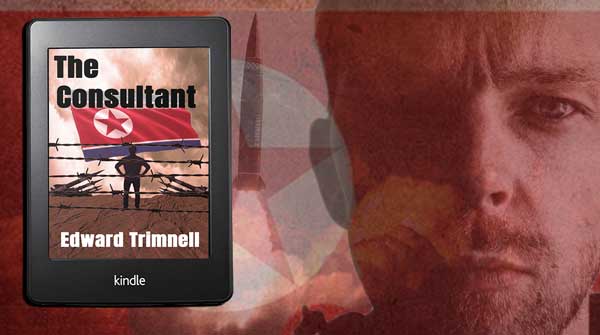
The Consultant is the story of an American marketing consultant who takes a business trip to Osaka, Japan, and talks to the wrong woman in a bar.
One thing leads to another, and he ends up in North Korea.
The story is loosely (I emphasize loosely) based on real events.
The North Korean government has carried out targeted kidnapping campaigns of civilians over the years. Most of the known targets have been South Koreans and Japanese. But there is no reason why an American couldn’t be the target of such a kidnapping. This novel explores that scenario.
The Consultant is a good read for Tom Clancy fans who also like James Clavell…or James Clavell fans who also like a bit of action.
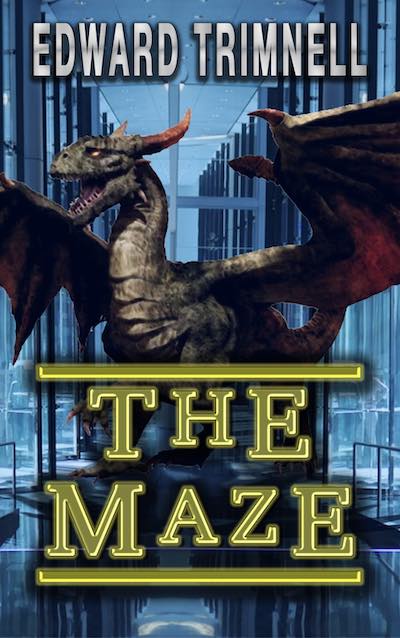
Amanda Kearns assumes that her work-related visit to the Lakeview Towers office complex in Ohio will mean just another sales call.
But she’s very wrong!
Amanda and her two colleagues, Hugh and Evan, step through the wrong door in the vast building’s interior.
On the other side, they find themselves trapped inside the Maze.
The Maze is a labyrinthine parallel universe filled with both supernatural and human menaces.
Killer robots await. Giant, carnivorous birds patrol the skies. Wraithlike beings called “watchers” hunt the unwary.
Also inside the Maze is a ragtag group of ordinary people…who are struggling to free themselves from a demigod tyrant, the Director.
Amanda, Hugh, and Evan must decide: should they join the fight for freedom, or risk all in a gamble to return to their own world?
THE MAZE is a riveting emotional tale wrapped within a fantasy adventure, THE MAZE is sure to appeal to adult readers who fondly recall childhood parallel universe stories like “Through the Looking Glass” and “The Chronicles of Narnia”.
A quick personal reading note: I’m on volume 6 of 課長島耕作 (Kachou Shima Kousaku). I’m rereading the whole series, which I read for the first time in the mid-1990s.
And yes, I’m reading it in the original Japanese. I was a Japanese language translator throughout much of the 1990s. I started studying Japanese back in 1988.
But if you don’t read Japanese, you can probably find the long-running Shima Kousaku series in English. (I’ve definitely seen it out there.)
People who know about my Japanese-language background often ask me about manga. Do I like it?
Well…yes and no. In general, I don’t care for the (often) sexualized fantasy tropes that comprise so much of the manga sphere. I much prefer the more realistic Japanese manga; and Shima Kousaku is my favorite.
The Shima Kousaku series begins in the 1980s. It follows the journey of a Japanese corporate employee, or salaryman, as he moves up the ladder of his employer, Hatsushiba Electric.
Not much happens in these stories, in terms of high-concept plot. These are basically soap operas, but they’re exceptionally well-done soap operas, with plenty of microtension.
A story doesn’t need zombies and car chases to be enthralling. (Though a story certainly can be enthralling with zombies and car chases; don’t get me wrong.)
The Iran Hostage Crisis of 1979 is one of the first major global events that I remember.
I was 11 years old on November 4, 1979, when Iran’s revolution came to a head, and a mob of student militants overran the US Embassy in Tehran. The student militants took 66 American hostages. 52 of these hostages would remain in Iran until January, 1981.
American hostages in Tehran, Iran in 1979
I followed the 444-day crisis on the news. But being 11 years old, I was sketchy on most of the historical background.
I’ve read a lot more about the crisis since then. I’m presently finishing up the above book, Guests of the Ayatollah: the First Battle in America’s War with Militant Islam, by Mark Bowden.
Bowden’s book includes not only the overarching historical details, but also many individual stories: of the hostages, and others whose lives were impacted.
Definitely worth a read if this is a subject that interests you!
I just finished reading Stephen King’s fantasy-horror-adventure novel, Fairy Tale.
This being a recent Stephen King novel, it’s been summarized in detail throughout the Internet, so I’ll stick with the high points here.
Length, scope, and pacing
This is a long book (almost 600 pages).
Fairy Tale begins with a coming-of-age plot, something that Stephen King has always done well. That goes on for about 200 pages before the fantasy part really gets going.
The fantasy portion of the novel takes place in a parallel world called Empis. Fairy Tale is almost like two stories stuck together. Depending on your tastes, that may be a feature, and it may be a bug.
Overall, Fairy Tale takes a long time to get going. The grand finale is a page-turner, but there are long sections of this very long book that are extremely slow-burn, and kind of a slog.
Stephen King’s evolved style
I should provide a bit of context here. Sometime in the late 1980s/early 1990s, Stephen King’s style changed dramatically. In the 1970s and early 1980s, he wrote plot-driven stories that were tightly structured with minimal fat (Stephen King’s well-known aversion to outlining notwithstanding).
I became a rabid King fan based on the early novels: ‘Salem’s Lot, Christine, The Dead Zone, The Shining, etc.
Some of those early books were actually quite long. But you never noticed, because the plots were so engaging.
Later on, King started writing long, meandering novels like Duma Key, Desperation, The Outsider, etc. I first noticed the change in style with It (1986), but the longer, slower storytelling has been a consistent feature of Stephen King’s writing for decades now.
And some fans, I should note, prefer the later style. 11/22/63 is an 850-page fantasy/alternate history tale that was published in 2011. It has a huge fanbase. It left me very lukewarm. Give me Pet Sematary or Cujo any day.
Or better yet, King’s first short story collection, Night Shift.
Among the books that King has written and published since 1990, I have definitely tended to prefer the novellas, short story collections, and short novels. I particularly liked Joyland (2013) and The Girl Who Loved Tom Gordon (1999).
Am I glad I read ‘Fairy Tale’?
Overall, yes. This is still a good book, compared to most of the horror/fantasy novels being published nowadays.
I am admittedly prejudiced, because as an early (since 1984) reader of Stephen King, I always want him to write the kind of book that he might have written in 1978 or 1982. And lo and behold, he rarely does.
That’s rather presumptuous on my part, of course…especially since Stephen King’s longer, less plot-driven style has been a thing for 30 years now.
Some books bring back memories. And so it is for me, with Stephen King’s illustrated novella, Cycle of the Werewolf.
I remember purchasing this book at the B. Dalton bookstore in Cincinnati’s Beechmont Mall in the mid-1980s. I had only recently become a Stephen King fan, and I was working my way through his entire oeuvre, which then consisted of about ten years’ worth of novels and collections.
The copy I bought in the 1980s has long since been lost. I’m glad to see that the book is still available, with the original illustrations from Bernie Wrightson.
You can get a copy of Cycle of the Werewolf on Amazon by clicking here.
I discovered the books of historical novelist John Jakes (1932 – 2023) as a high school student during the 1980s. The television miniseries adaptation of his Civil War epic, North and South, aired in 1985.
North and South was extremely well-done for a network (ABC) television production of the mid-1980s. The cast included Patrick Swayze, Kirstie Alley, David Carradine, Lesley-Anne Down, and Parker Stevenson. The sets were realistic and the production values were high.
After watching that, I decided to give John Jakes’s books a try. I read North and South(1982), plus the subsequent two books in the North and South trilogy, Love and War (1984) and Heaven and Hell (1987).
Then I delved into The Kent Family Chronicles. The books in this long family saga were published between 1974 and 1979. These are the books that really put Jakes on the map as an author of commercial historical fiction.
I emphasize commercial. John Jakes never strove for the painstaking historical accuracy of Jeff Shaara, or his approximate contemporary, James Michener. Jakes’s first objective was always to entertain. If the reader learned something about the American Revolution or the Civil War along the way, that was icing on the cake.
As a result, John Jakes’s novels lie somewhere along the spectrum between literary fiction and potboilers. His characters are memorable and he imparts a sense of time and place. But these are plot-driven stories.
At the same time, Jakes’s plots have a way of being simultaneously difficult to believe and predictable. Almost all of his books have a Forrest Gump aspect. His characters are ordinary men and women, but they all seem to rub shoulders with figures from your high school history classes.
That said, Jakes is one of the few authors whose books pleased both the teenage me and the fiftysomething me. This past year, I started rereading The Kent Family Chronicles, and catching up on the few installments I missed back in the 1980s. I have changed as much as any person changes between the ages of 17 and 55, but I still find these books to be page-turners.
This past week, I started listening to the audiobook version of California Gold. This one was published in 1989, after Jakes’s long run of success with The Kent Family Chronicles and the North and South trilogy.
California Gold is the story of Mack Chance, a Pennsylvania coal miner’s son who walks to California to seek his fortune in the 1880s.
I will be honest with the reader: I don’t like California Gold as much as Jakes’s earlier bestsellers. California Gold is episodic in structure, and the main character is far less likable than some of Jakes’s earlier creations. In California Gold, Jakes indulges his tendency to pay lip service to the issues of the day (in this case: the budding American labor movement and early feminism) through the voices of his characters. Most of these pronouncements are politically correct and clichéd.
Worst of all, California Gold employs sex scenes as spice for low points in the plot. This is always a sign that a writer is struggling for ideas, or boring himself as he writes. When Jakes wrote California Gold, he may have been a little burned out, after writing The Kent Family Chronicles and the North and South trilogy.
California Gold, though, won’t be tossed aside on my did-not-finish (DNF) pile. This is still a good novel. Just not the caliber of novel I’d come to expect from John Jakes. No novelist, unfortunately, can hit one out of the park every time.
I’m a child of the Cold War. I was twenty-one when the Berlin Wall fell in 1989. I well remember the Soviet Union as a topic on the evening news. I grew up with a dark fascination with the USSR. I am always interested in acquiring new books and other materials about it.
I was therefore eager to listen to Anne Applebaum’s book: Gulag: A History. Although she’s recently taken to opining about current events on Twitter, Applebaum is the author of a handful of books on Soviet history.
Gulag, as the title suggests, is focused on the Soviet work/concentration camp system, which often housed political prisoners.
Gulag is a thoroughly researched book. Applebaum draws not only on Soviet-era documents, but also on extensive interviews she conducted with camp survivors.
The book has no ideological ax to grind. Applebaum doesn’t soft-pedal the human cost of the Soviet gulag system. Nor does she endlessly bludgeon the reader with authorial intrusions of shock and disapproval. Applebaum assumes that the reader can make her own moral judgments.
While there are passages about the leadership of the USSR and Kremin-level politics, the emphasis of the book is on the prisoners’ experience. Gulag gives the reader a sense of what it was like to have been an inmate in a Soviet prison camp, as much as any book could.
The only downside to this approach is that the many, many firsthand stories sometimes overload the reader with repetitive details.
I’m listening to the audio version of this book, but the printed version is 736 pages. My guess is that 436 pages could have accomplished the same ends in a more succinct manner.
But no book, either fiction or nonfiction, is perfect. Gulag: A History is a worthwhile read for anyone with a serious interest in Soviet history.