Ebook sales just 7.9% of revenue for Hachette

Hachette, one of the “big five” publishers, reported that ebooks accounted for 7.9% of its global revenue in 2018:

Hachette reported that sales of digital audio rose 30% across its publishing operations and accounted for 2.7% of total revenue, up from 2.0% a year ago. Ebook sales fell in the United States and United Kingdom, but still represented 7.9% of revenue.

One would imagine that the other publishers experienced similar numbers.

Granted, 7.9% is not nothing, but it falls short of expectations..and previous hype. A few years ago, all the pundits were predicting the end of paper, and the triumph of the ebook…So far that hasn’t happened.

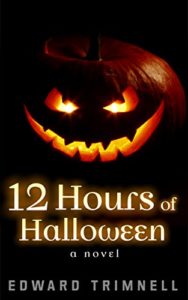
I see similar results in my own books. Since I released the paperback edition earlier this year, 12 Hours of Halloween has been selling almost as many copies in paperback as it does in Kindle.


The end of the ‘Science Fiction and Fantasy Marketing Podcast’

Although most of what I write can be classified as neither science fiction nor fantasy, I’ve been a faithful weekly listener of the Science Fiction and Fantasy Marketing Podcast for about three years now.

Joe Lallo, Lindsay Buroker, and Jeff Poole never fail to provide good insights on the art and business of writing.

This past week, they announced that they would be “taking a few months off”.

That of course leaves the door open for a return. If the history of other podcasts, blogs, and YouTube channels is a guide, however, “taking a few months off” is usually synonymous with quitting for good.

I shall be sorry to see them go. Nevertheless, I can understand if their hearts are no longer in the endeavor.

Sometimes a podcast, a YouTube channel, or a blog simply runs its course… Sometimes for the audience…and sometimes for the creator(s).


Should authors narrate their own audiobooks?

This is a question that has been coming up frequently of late on the various indie author boards.

The question is only natural. Dedicated narrators charge around $250 per finished hour to narrate, edit, and master audio files.

That means $2,700 to $3,300 to convert a 100,000-word novel into an audiobook.

No, those numbers aren’t in Japanese yen. They’re in US dollars.

To be fair to the narrators: Although $250 per hour sounds like a lot, the narrators aren’t necessarily charging the same hourly rates as corporate attorneys, heart surgeons, and high-class call girls.

Notice that I said, per finished hour. That means not only reading the material, but also editing out obtrusive plosive sounds, loud breaths, and overly lengthy pauses. It means mastering the files to make sure they meet certain technical specifications.

According to some estimates, five to ten hours of work can be required to produce a finished hour of audio for an audiobook.

Audiobook production requires a material investment in both hardware and software. There is also something of a learning curve, as sound engineering is both an art and a science. To become competent in sound engineering isn’t quite as difficult as becoming an attorney or a heart surgeon (I won’t speculate about the difficulty of becoming a high-class call girl); but it isn’t exactly simple, either. There are many new concepts to absorb and understand. Unless you have worked with audio at the technical level in the past, all of these concepts will be completely unfamiliar to you.

So hopefully I’ve made clear: No one should be resentful of the narrators who charge $250 per finished hour to deliver store-ready audiobook files.

That said, $2,700~$3,300 represents a significant upfront investment for most indie authors. If you’ve got a backlist of ten books, that means that you could buy a new Toyota Corolla for what it would take to convert your entire library into audiobook format.

It is only natural, then, that some authors are asking the question: Why not just do this myself?

Why not, indeed? This brings us to the debate. There are plenty of reasons for doing it yourself…and for not doing it yourself. I don’t believe that there is an absolute, one-size-fits-all, right or wrong answer to this one. As is so often the case in this life, the only succinct answer is: It depends. 

To begin with, the writer who seeks to produce her own audiobooks will have to be comfortable reading her own work in a very public way. Many writers are painfully shy. I am amazed at the number of writers who are terrified to appear on YouTube or on podcasts. Many are too shy to even post their author photos on Facebook or their Amazon author pages. These authors almost certainly won’t feel comfortable reading their own fiction, and that will show in the results.

Narrating an audiobook is also a unique skill, above and beyond other forms of public speaking. I don’t believe that professional theater training is a prerequisite, but it would certainly help. At the very least, no author should attempt to read his own work for audio without first having listened to hundreds of hours of audiobooks as a consumer. If you don’t like audiobooks, if you aren’t a consumer of audiobooks, then you have no business narrating them. 

And then there’s the investment and technical side, which I’ve touched on above. Some writers embrace technology, others shrink from it. Can you learn about RMS, noise floors, and hard limits as eagerly as you learned about three-act structure? Are you willing to plunk down the money needed to purchase a computer with decent processing power, a high-quality mic, and other equipment? Are you willing to pay for Pro Tools or Adobe Audition software?…Oh, and are you also ready to ascend the learning curve that it takes to competently use them?

In regard to this last point, I would offer one piece of cautionary advice. On writer forums, I occasionally see writers state that they are overwhelmed by Scrivener (a popular non-linear word processing program designed for writers). If you’re overwhelmed by Scrivener, then you probably shouldn’t try to produce your own audiobooks.

(I don’t mean to imply that you’re an idiot, by the way, if you’re overwhelmed by Scrivener….But I do mean to imply that you aren’t very technically inclined if you’re overwhelmed by Scrivener….We all have our own strengths and weaknesses. I can run a six-minute mile; but I can’t make simple free throw shots on the basketball court with any degree of reliability. Know thy strengths, know thy weaknesses.)

That all said, there are plenty of reasons for embarking on self-production…if you have the basic aptitudes and willingness.

One of the big arguments for self-production is this: The job that you hire out might not be any better than the job you could do yourself, with a bit of preparation.

There are few formal barriers to entry to the narrator field. Anyone can hang out a shingle as a narrator nowadays. Many of the narrators you encounter in the marketplace might be only a few steps ahead of you…or possibly a few steps behind you.

Let’s start with the quality of the narration itself. If you’re going to hire Scott Brick (the narrator of most of the Clive Cussler novels, among many other books) then Scott Brick is almost certainly going to do a better job than you. By all means, hire Scott Brick. Scott Brick is not only a consummate professional, he’s a “brand”. (I’m far more likely to consider an audiobook from an unknown author if Scott Brick is the narrator.)

I don’t know what Scott Brick charges per hour, but it’s probably more than $250; and his schedule is likely booked months or years in advance. I am therefore going to assume that you won’t be hiring Scott Brick. You’re going to hire some narrator from the online marketplace, whom you’ve never heard of before.

I’ve listened to many samples from lesser known narrators on the Audible site. Most of them meet a basic level of competence; but the indie author might honestly ask: Is that voice, that quality of narration, worth $250 per hour?

On the technical side, some of the independent narrators seem to be just as tech-averse as the average indie author. Many seem to have backgrounds in acting. When you think of someone who is technically proficient, is a drama major the first person who comes to mind?

It might therefore be easier to just bite the bullet, and learn about RMS, noise floors, etc.

Yes, it’s hard…but not heart surgery hard. It’s more like building-your-own-backyard-deck, or learning-conversational-Spanish hard.

You also have the option of recording and editing the audio files yourself, then hiring out the final mastering—which is not free, but which is far cheaper, in most cases, than $250 per finished hour.

The quandary of whether or not to narrate one’s own audiobooks, then, is a uniquely personal one that every author needs to carefully assess.

Whichever way you go, audiobook production isn’t going to be easy or cheap. Accept that from the get-go, or don’t even start.

The question is: Given your priorities, proclivities, and resources, are you better to sacrifice ease (self-production), or are you better to sacrifice cheapness (outsourcing)?

That’s the decision that you have to make; and whichever one you choose, you’re likely to encounter a bit of buyer’s remorse if your audiobook sales don’t meet your expectations.

Paperbacks, paperbacks

There are now paperbacks available on Amazon for all of my horror and most of my thriller titles.

I’ve been surprised to find that, despite the Kindle being over ten years old now, many readers still prefer to read on old-fashioned paper.

Which is fine with me. I’m rather attached to reading on paper myself.

Check out the paperback edition of 12 Hours of Halloween on Amazon!

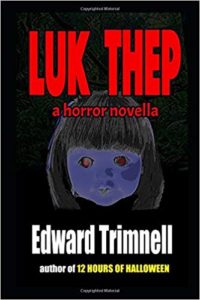
‘Luk Thep’: Get the ebook, dirt cheap, through the weekend!

Through Sunday the ebook version of Luk Thep: a horror novella will be reduced to $0.99.

I wrote this one I after I read this article in The Economist.

Amazon description:

The ‘luk thep’ are the ‘angel dolls’ or ‘spirit dolls’ of Thailand. Ultra-realistic in appearance, some Thais believe that each doll is infused with the spirit of a prematurely departed child. But are all child spirits benevolent?

Jane Hughes is an American executive who is visiting Thailand for a routine business trip. When she sees her Thai colleague’s ‘luk thep’ doll, she has dark premonitions about what is actually inside it. When Jane later receives the same doll as a gift, she begins a ghostly nightmare that will lead to terrifying supernatural encounters on two continents.

From the Author

Excerpt:

(Excerpt from Chapter 5: “This is Lawan.”)

Jane looked closer, and now she saw that the small figure seated in the chair was only a doll, albeit a very realistic-looking one.

“She gave you quite a scare,” Khajee said with good humor. Jane noted Khajee’s use of the personal pronoun. Jane also noted that yes, indeed, the doll had given her quite a scare.

The corporate realm was not a world without fear. The cutthroat competitiveness of the global economy produced a macro-level fear of being downsized, “right-sized” out, or otherwise falling into obsolescence. Jane had not a protectionist bone in her body, but she couldn’t help feeling the occasional twinge of admiration-mixed-with-resentment toward her Asian colleagues: They worked so tirelessly, so efficiently. All of the jobs at TRX Automotive Thailand represented jobs that no longer existed in the United States. How long before her job, too, was outsourced to a more efficient Asian or Latin American rival?

Beneath the macro-level fears was the constant uneasiness about where you stood within the company hierarchy–not just the formal organization chart, but within the ever-shifting hierarchy of senior management favor. This was not simply a matter of doing your job well, but of maintaining the outward perception that you were doing your job well.

Although Jane was single and had no dependents, she had much invested in her career. She knew that despite her undeniable hard work, she was fortunate to be where she was at her age. Jane did not want to lose what she had gained. She wanted to continue moving forward.

Anxiety about such matters occasionally kept Jane up at night. But the fear of the genuinely unknown was mostly alien to her existence. No one ever discussed haunted houses or vampires at a corporate meeting, even during the informal pre-meeting banter. To express an interest in the macabre would be (yet another) way to sideline your career prospects. People would think you were unhinged.

Perhaps that was why Jane was momentarily uncomfortable over her reaction to the doll. She now knew, rationally, that the doll was just a doll. But it made her uneasy, nonetheless.

“It looks very realistic,” Jane said. “Like a real little girl.”

Khajee nodded. “Each one of them is unique. They aren’t cheap.”

Khajee then mentioned the price she had paid in baht, the Thai currency. It was an amount that corresponded to about $800 American dollars.

“A lot to pay for a doll,” Jane blurted out. Then she realized the potential rudeness of her observation. “I–I’m sorry. I didn’t mean anything by that remark.”

But it was a lot to pay for a doll, realistic-looking or not.

“That’s okay,” Khajee said. “But this is a special kind of doll, you see. And I’m not only talking about the way it looks. The doll is called a luk thep. That means ‘angel doll’ or ‘spirit doll’. They perform a ceremony for each doll at the plant where the dolls are made. And then each doll is supposed to be inhabited by the spirit of a deceased child.”

“You mean the doll is–possessed?” Jane asked. Khajee gave a puzzled look in response. “I mean–haunted,” Jane clarified.

“Well, yes,” Khajee replied, after giving the matter some thought. “I suppose that’s one way to look at it, though a Buddhist would see the matter differently than someone from the West, you understand.”

Jane nodded noncommittally. A lapsed Roman Catholic, there were many holes in her knowledge of her own spiritual and religious traditions. She had only the vaguest grasp of Buddhist beliefs.

Didn’t the Buddhists believe in reincarnation? Jane was almost certain that the Buddhists did. Perhaps that would make them more comfortable with the notion of a ‘haunted doll.’

But still, even a Buddhist would have to ask certain inevitable questions. For starters: What kind of a spirit would want to inhabit a doll, and to what purpose?

“It certainly looks realistic,” Jane said, repeating her prior observation, not knowing what else to say.

“Her name is Lawan,” Khajee said, as if correcting Jane. Khajee smiled self-consciously. “Yes. I named her. Most luk thep mothers do. I suppose you’re wondering why an adult woman would want to buy a doll and name it.”

Jane couldn’t avoid an involuntary flinch at Khajee’s description of herself as the doll’s ‘mother’.

“I suppose I would wonder,” Jane admitted.

**

If you think you might like to read Luk Thep, now is a good time to get it. Next week, the price will go back to $3.99. (Still cheap, but not dirt cheap.)


Remembering my childhood “shark phase”

When I was a kid, I went through various phases with hobbies, interests, and obsessions.

One of these was my “shark phase”. For about a year, I read every book about sharks that I could get my hands on.

I still have a passive interest in sharks. Sharks are awe-inspiring creatures. I mean, just think about it: A shark is a fish that, even now, in the 21st century, will eat you if given the opportunity.

My interest in sharks has occasionally shown up in my fiction. (There is a shark story in my Hay Moon short story collection.) And I’m still a sucker for  Shark Week on the Discovery Channel.

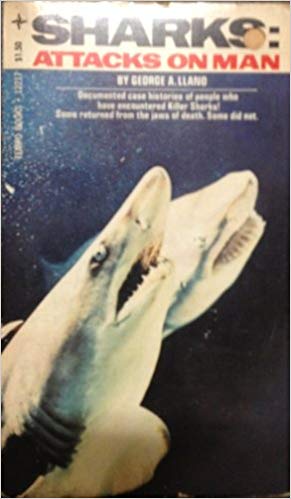
But back to that childhood obsession with sharks. While poking around on Amazon, I recently came across a listing for the book, Sharks: Attacks on Man, by George A. Llano. Published in 1975, the book is long out of print; but there are still some old used copies floating around.

I owned a copy of this book around 1979. I read it and reread it. Included in this slender volume were stories of the Matawan Creek shark attacks of 1916, and the harrowing experiences of the sailors of the USS Indianapolis, who had to contend with man-eating sharks after their ship was sunk by the Japanese.

There are probably better books about shark attacks on the market today (and certainly more current ones). Nevertheless, I’ll always look back fondly on George A. Llano’s Sharks: Attacks on Man, which provided me with many hours of entertainment about forty years ago.


‘Revolutionary Ghosts’ in Kindle Unlimited…for a while, at least!

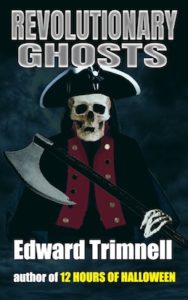
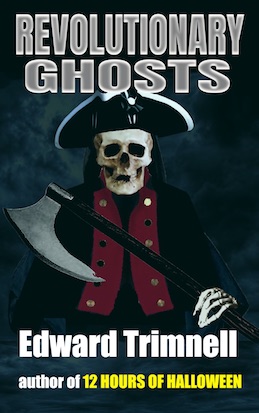
I’ve enrolled Revolutionary Ghosts in Kindle Unlimited for the next 90 days.

Eventually, it will probably be going out to other stores and platforms. For now, though, you can read it for free if you have a Kindle Unlimited membership! I hope you enjoy it.


About Revolutionary Ghosts:

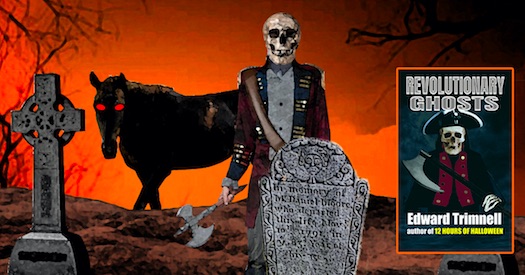
The year is 1976, and the Headless Horseman rides again!

Steve Wagner is an ordinary Ohio teenager in the year of America’s Bicentennial, 1976.

As that summer begins, his thoughts are mostly about girls, finishing high school, and driving his 1968 Pontiac Bonneville.

But this will be no ordinary summer. Steve sees evidence of supernatural activity in the area near his home: mysterious hoof prints and missing persons reports, and unusual, violently inclined men with British accents.

There is a also a hideous woman—the vengeful ghost of a condemned Loyalist spy—who appears in the doorway of Steve’s bedroom.

Filled with angry spirits, historical figures, and the Headless Horseman of “The Legend of Sleepy Hollow,” Revolutionary Ghosts is a terrifying coming-of-age story with a groovy 1970s vibe.


What I’m working on…late January 2019!

The manuscript for Revolutionary Ghosts (which I’ve been serializing here on the site) is done. I’m finishing up some final edits.

Then it goes off to a third-party editor and proofreader.

Revolutionary Ghosts should be available on Amazon by February 1st.

Don’t hold me to that, please…but that’s the plan.

You know how it is with publishing…the best laid plans often change.

‘Revolutionary Ghosts’ update and progress report

I’ve been adding pages of my dark fantasy/horror serial, Revolutionary Ghosts to the site more or less every day. (I did miss a few days during the holidays.)

The online version of the text represents a rough draft (with a brief editing pass for flagrant typos). This version of the book will remain online.

Before Revolutionary Ghosts is published, though (in formats that I’ll be actually charging money for), it will undergo additional editing and proofreading passes.

The basic plot of the story won’t change during the editing phases; but the descriptions may be enhanced, the character dialogue will be tweaked, etc.

Awkward sentence structures (inevitable in any first draft) will be eliminated. I’ll also make sure all the typos are nailed down. (I’m sure a few have slipped by me in the online version.)

E-book, audiobook, and paperback editions of Revolutionary Ghosts will eventually be available–not only from Amazon, but also from Barnes & Noble, Kobo, and Google Play.

You are welcome to read the full text here. (That’s one of the options I had in mind when I decided to post it online, after all.)

You might alternatively choose to merely sample it here, and await the fully edited, finalized versions in the stores. (They won’t be expensive. Don’t hold me to this: But the ebook version will probably retail at $3.99.)

I plan to have retail versions of the book available no later than March 1st.

How you read Revolutionary Ghosts is up to you. In any case, I hope you enjoy the story.


Are New Year’s resolutions really worthwhile?


It’s that time of year again. The time of setting New Year’s resolutions—or not.

Since I belong to a gym, I approach January 1st with mixed feelings. On January 2nd, I know that my gym will be overrun with hordes of new members. They will fill the parking lot, take up locker space, and wander aimlessly around the exercise floor, as they struggle to master the nuances of the pec fly machine and the StairMaster.

The New Year’s resolutions members, we call them. Roughly half of them will be gone by Valentine’s Day. By the Ides of March, two-thirds will have fallen by the wayside. By Tax Day, they will be a shadow herd, less than ten percent of their original number.

This is, to a major extent, how fitness facilities make their money: They sell scores of memberships that go unused after a few months. The owners of every gym know that the year-end, that time of New Year’s resolutions, is the prime time for such sales. Because so many people make New Year’s resolutions that they quickly abandon.

This raises a natural question: Are New Year’s resolutions even worthwhile? Or should we go into the default mode of post-modern cynicism, and assume that New Year’s resolutions, too, aren’t what they’re cracked up to be?…Another residual cliché of a bygone age.

Yes, New Year’s resolutions do have a notoriously high failure rate. And yes, the New Year’s resolution has become something of a cliché. I’m going to submit to you, however, that the New Year’s resolution is still a very worthwhile undertaking.


Consider the significance of January 1 as a juncture for clearing the decks, hitting the reset button, starting over.

The first day of January is a completely arbitrary date, from a scientific, mathematical perspective. Theoretically, you could start afresh on any day of the year. Why not March 10th? Or May Day? Or Thanksgiving?

(I’ve occasionally tried to start afresh on my birthday. This hasn’t worked well at all—at least partly because my birthday falls in the humdrum, dog days of August.)

The entire world has earmarked January 1 as a new beginning. The way we designate time subtly changes, as the year is altered by a single digit. The New Year is hyped in the media, and practically everywhere else.

I’m often a cantankerous contrarian. But even I know when to go with the flow. Even though you could theoretically start afresh on any given day of the year, there is a great deal of cultural momentum behind New Year’s Day. Why not use it in your favor?


New Year’s Day, in fact, has a semi-spiritual status in some Asian cultures. The Japanese celebration of Christmas is purely secular (Christians are a small minority in Japan); and the Japanese don’t recognize Hanukkah at all. But the New Year bears a special significance within the animist beliefs of Japan’s native Shintoism.

In Japanese corporate settings, there is the bonen-kai, or “forget the year party”. Held in late December, these are occasions for putting the previous year firmly in the past, so as to facilitate a fresh start in the New Year. New Year’s Day in Japan is a time for visiting friends and loved ones—much like Christmas Day in the West.

Speaking of corporate settings: Even though many companies end their fiscal years on October 31st or July 31st for accounting purposes, most use the New Year as a time to rally employees, suppliers, and customers for a new set of goals. Why not do the same, at an individual level?


New Year’s resolutions become more important as we grow older. Children, teens, and very young adults rarely set New Year’s resolutions, and with good reason. Their lives are already focused on change and transformation.

When you are in school, after all, there is a natural progression built into the transition from one grade—and from one major level of education—to the next. Your life is going to change whether you want it to or not. The process is going to kick you forward.

The setting of new goals, likewise, is built into the process. Many of these goals are predetermined. You don’t really have a choice about the goal of moving from the fifth grade into the sixth, or graduating from high school.

As an eighteen year-old high school graduate, you’ve got to do something next. If you’ve been blessed with caring parents and other conscientious adult authority figures, you’ll have no shortage of advice. But either way, you can’t remain in high school. The only way to go is forward…toward something.

After we become entrenched in the adult world, however, that systemic forward progression no longer pushes us along. In its place arises an inertia that encourages us to fall into ruts. The external trappings of this year might not vary much from those of the previous year, or the year before that. Change is quite often something that has to be initiated from within, versus accommodated from without.

And this is how we get “stuck”—in any number of ways.


I recognized signs of this pitfall in my own life in the mid-1990s, as I passed the midpoint of my twenties. I was five years removed from college, and about ten years removed from high school. I was just another working adult, and I could already sense myself falling into ruts.

So in 1995, I began two new habits.

The first of these was the setting of annual, quarterly, and monthly goals. I set goals in all areas of my life: financial, physical, social, professional, and “skills” (areas of knowledge that I wanted to improve or acquire).

I also began keeping a daily record of my activities. Nineteen ninety-five was still a largely analog world, so I used a paper-based system: I acquired a “business diary”, and used this for my daily records: accomplishments, setbacks, challenges met and overcome, memorable events, etc. Nothing fancy or too elaborate. Just something to give me a bird’s-eye view of the year the following December, when it would be time to set the next year’s goals.

I’ve been following this practice for twenty-four years now. I still have my 1995 diary, as well as my diaries for all the years in between. It’s interesting to see how my goals and priorities have changed since the Clinton era.

I’m naturally nostalgic (most conservatives are); but you don’t have to be obsessed with your personal auld lang syne in order to benefit from such a system. It is as focused on the future as it is on the past.

And the pivotal day of that system is New Year’s Day, January 1st, when I set aside one diary and open a blank one.

All those pages—twelve months of time.

A lot can happen in a year. A lot can be accomplished in a year. That is as true for me today, at age fifty, as it was on January 1, 1995, when I was twenty-six. But at age fifty, I probably rely more on this tangible reminder of what the New Year means.

That word tangible is important, by the way. I would encourage you to record your annual plans (and results) in a written, paper format.

I know: iPhones and Word files and “the cloud”. Fiddlesticks. Holding a year in your hand, in a single bound document, makes that year more psychologically substantial. This will be true on both January 1st and December 31st. And it’s definitely true later on, when you’re looking back on long-past years. Use a physical diary to both plan and record your personal year.

The past 24 years of my life.

Back to the gym. I know that the bulk of the New Year’s resolution members will come and go by March 15, because I’ve seen them come and go so many years in the past.

Likewise, I have fallen short on many of my New Year’s goals. So will you—unless you set goals that are unambitious (and therefore, uninspiring).

That said, the past twenty-four years have taught me that my New Year’s planning has a direct and proportional impact on the success of each subsequent year. This is why I maintain the practice, and probably always will, until the day when my New Years are no more.

‘Red Sparrow’: quick review

I’ll just come out and admit it: I can’t get enough of the Cold War. Part of this is nostalgia, of course. I make no secret of the fact that I consider the culture of the latter half of the 20th century to be far superior to what the 21st century has produced so far. And if you lived in the United States, the Cold War was the dominant geopolitical reality of the late 20th century.

Or maybe I’m fascinated with that old enemy, the Ruskies. Islamic terrorists I simply want to see annihilated. Kill ’em all, and let Allah sort ’em out. But the Russians are intelligent and innovative enough to be interesting, even if they aren’t always likable and almost never trustworthy.

My Cold War fascination undoubtedly played a role in my enthusiasm for The Americans, the Cold War spy drama that ran on FX from 2013 to 2018. I suppose, too, that I was a naturally receptive audience for Red Sparrow (2018) , a movie about a Russian ex-ballarina who is recruited into “sparrow school”, where the comely are trained to be ruthless, to use their sexuality in the service of the Russian state.


Note that I said “Russian” and not “Soviet”. Red Sparrow is set in the Putin era. Russia’s new leader-for-life isn’t directly portrayed in the film, but he is constantly referred to as “the president” (the same disingenuous title used for Saddam Hussein during his long, dictatorial reign in Iraq).

The Russia depicted in Red Sparrow is appropriately cold, snowy, grim, and brutal. Within the first ten minutes of the movie, you will be tempted to turn up your house’s thermostat. You’ll also be thankful that you live in the United States (or in some other Western democracy)–and not there.

(Another personal aside here: My grandfather spent a year in the USSR during WWII. His U.S. Navy duties also took him to Syria, Egypt, and a host of other places that most Americans wouldn’t eagerly visit in 2018. The only place he described in negative terms was Russia. As he put it, “the asshole of the world”. Not only did he hate the weather, but the Soviet soldiers were uniformly unfriendly, and ordinary citizens were afraid to even look at Americans, lest they be accused of treason. But to be fair, this was during the Stalin era.)


Jennifer Lawrence stars in Red Sparrow as Dominika Egorova, a Russian ballerina who supports her mother on her dancing income, until her career is ended by an injury. Dominika is then approached by her uncle, Ivan, who heads the Russian SVR. Ivan has a job for her.

I don’t want to summarize the whole plot for you. But suffice it to say that Ivan is creepy and evil. He also has incestuous designs on his niece. Through a series of carefully orchestrated circumstances, Ivan closes off Dominika’s options until her only real choice is to dedicate her life (and her body) to the service of the Russian state.

There’s much more to the movie, of course; and the real fun begins when Dominika starts interacting with her American CIA adversary, Nate Nash (played by Joel Edgerton). Nash and Dominika have an affair. (Of course: If a Cold War-era spy movie has a pretty female Russian operative and a CIA male agent, they must have a sexual liaison.)

Speaking of sex: There is a lot of it in Red Sparrow. In this case, however, it really is integral to the plot, as Dominika has been trained to use sex as a weapon of espionage.


A word about Jennifer Lawrence. Jennifer Lawrence is one of those Hollywood types with whom I have a love-hate relationship. On one hand, she is a complete idiot when she opens her mouth about political matters–something she’s been doing increasingly in recent years.

On the other hand, she is a brilliant actress. I became aware of her years ago, when I saw one of her first movies, Winter’s Bone.  In that movie, Lawrence convincingly became an impoverished Missouri teenager. She is just as convincing as a Russian ex-ballerina-turned-secret-agent. You don’t have to like Jennifer Lawrence’s off-screen behavior (and I for one, don’t), but you have to admire her mastery of her craft. (Now–if she would only just stick to that craft, and spare us the moonbat political activism.)


Dominika is understandably bitter about her mistreatment at the hands of her uncle and her native country. She is therefore ripe to be turned by Nash, who recruits her as a double agent. But has Dominika truly turned? The viewer can’t be sure. As the plot of Red Sparrow evolves, you aren’t sure if you’re watching a movie about doomed Russian patriotism, an espionage double-cross tale, or a classic revenge story. It’s worth the two hours and twenty minutes it takes to watch Red Sparrow in order to find out.

The rebooted Magnum PI: mini-review

If you’ve been watching CBS in recent years, you’ll have noticed that many of the network’s top programs are reboots of shows from the 1970s and 1980s: MacGyver, S.W.A.T., Hawaii Five-O.

Now you can add a new one to the list: Magnum PI.

I’ll admit: I was a skeptic. The 1980s coincided with my high school and college years. I didn’t watch much television during that decade. But I did make time for Magnum PI. The original Magnum, starring Tom Selleck, is one of my favorite television programs from my youth.

I was sure that CBS would make a mess of the remake.

I was wrong. The new Magnum PI is just as fun and entertaining as the original.

I’m a conservative, and all conservatives are naturally nostalgic. We tend to believe that things were better in the old days, that previous versions of things were better than the new and updated ones. In this vein, there was a part of me that would have loved to have seen Tom Selleck star in the 21st-century reboot of Magnum. (Selleck presently stars in Blue Bloods, another  CBS staple, as the patriarch of an NYPD family.)


But another part of me knows that would have been ridiculous. Tom Selleck is very fit for his age, but he’s now in his seventies. The starring role in Magnum PI is one for an actor in early middle age: 35 to 45.

CBS has cast Jay Hernandez as Thomas Sullivan Magnum. And while Hernandez brings his own style and interpretation to the role, he pulls it off with as much flair as Selleck did before him.

The new show more or less ports the characters and the basic premise over from the original: with some necessary changes. In the original show, Magnum and his sidekicks (TC and Rick), were Vietnam War vets. In the 2018 reboot,  they’re veterans of the wars in the Middle East.

There is one fairly major character change: In the 1980s version, Higgins, the majordomo of the Hawaiian estate where Magnum lives (off the largess of the never seen Robin Masters) was played by British actor John Hillerman. In the reboot, Higgins is still British, but Higgins is a woman (Perdita Weeks).

Conservatives like me are supposed to hate it when rebooted shows arbitrarily change the genders of characters. I don’t necessarily hate this practice in a knee-jerk sort of way, but I’m always skeptical of it, often with good reason. (The reimagining of Boomer and Starbuck as female characters in the rebooted Battlestar Galactica produced uneven results.)  But in the case of Magnum PI, the distaff version of Higgins works perfectly. I think–sorry, Mr. Hillerman–that I even like the Perdita Weeks interpretation of Higgins better.

The show includes lots of fun details that were crucial to the 1980s Magnum, like the dogs Zeus and Apollo, and Magnum’s habit of thinking aloud to the audience. TC and Rick (Stephen Hill and Zachary Knighton) don’t get much character development. But then, they were little more than affable sidekicks in the original version.

The Magnum PI reboot is as good as any purist could have asked for, 38 years after the start of the original series (and 30 years after it went off the air).

Sometimes the networks botch things, but sometimes they hit home runs, too. The new Magnum PI is a home run

A Column of Fire, by Ken Follett (mini-review)

I just finished reading Ken Follett’s mammoth historical novel, A Column of Fire.

The novel opens in 1558, just as the reign of the Catholic Queen Mary is coming to an end. Mary has reversed England’s Protestant shift, which began when her father, Henry VIII, decided that he couldn’t make due with one wife and a mistress.

Mary, who is also known to history as “Bloody Mary”, occasionally burned Protestant dissenters, and this is depicted in one of the opening chapters of A Column of Fire. Hence the name of the book.

This is the opening historical backdrop. The hero of the novel is Ned Willard, who is a young man in love as the story opens. The object of Ned’s affections is Margery Fitzgerald. Ned’s affections are returned, but—of course—there is a problem.

Margery hails from a devoutly Catholic family that has prospered under the reign of Mary. Through the connivances of Margery’s fanatically papist brother, Ned loses Margery to Bart, a member of the local Catholic nobility.

And so Margery enters into a loveless marriage with Bart (who is an uncouth, insensitive, and blundering brute), while Ned goes off, forlorn, to seek his fortune in London.

Ned is a lukewarm Protestant who abhors the intolerance of Mary’s reign. Ned longs for a monarch who will allow the British people to worship freely (or as freely as possible, according to 16th-century standards of “freedom”.)

Just as Ned is reeling from the loss of Margery, Mary dies. Elizabeth takes the throne. A chance connection to Sir Francis Walsingham (principal secretary to Elizabeth) enables Ned to enter the service of the Crown. Ned is greatly impressed with the young queen. With the option of a married life with Margery closed off, Ned devotes himself to the service of Queen Elizabeth I, and the implementation of her (initially) tolerant ideals.

There is a lot more to A Column of Fire, of course. This is a 900-page book, after all. There is also a storyline set in France, where Protestants are a minority in an officially Catholic country. Still another set of characters has adventures in Spain and the New World. (All of the storylines converge before the end of the book.)

The overarching theme of A Column of Fire is the religious strife that gripped Europe in the aftermath of the Protestant Reformation. As noted above, the story opens with anti-Protestant burnings in England. Follett later weaves into his plot the St. Bartholomew’s Day Massacre in Paris, and the Gunpowder Plot of 1605. The book covers around half a century. (Ned Willard is in his eighties in the final chapter.)

I loved this book. I have read almost everything that Ken Follett has written to this point, and A Column of Fire is hands-down my favorite.

I like stories with complex twists and turns, and physical threats; and A Column of Fire has all that in spades. There are sea battles, and opposing rings of Catholic and Protestant spies.

The majority of readers seem to agree with me. A Column of Fire is highly rated both on Amazon and Goodreads.

But even a really good book has its flaws. Most of the criticisms of A Column of Fire come from one of two angles, which I’ll address briefly.

Ken Follett seems to harbor a secret desire to be an author of Harlequin romance novels. Almost every movie, novel, and television series has a love interest (or multiple love interests), and I’m not suggesting that this, in itself, is in any way a drawback.

Follett, however, tends to go overboard on his sex scenes.

Now, before you ask, I’m no prude. I’m a fifty-year-old, very heterosexual man with right-leaning libertarian tendencies. I have an equal loathing for leftwing political correctness, and anything that smacks of goody-two-shoes censorship.

That said, there is only so much detail that I need when an author describes a romantic coupling. To be blunt about it: Once the author has described the male protagonist’s erect penis, or the heroine’s moist nether regions, the author has given me more detail than I actually need.

Follett does this on multiple occasions (and in more than a few of his novels). There are some lacunae that an author should trust readers to fill in for themselves.

Secondly, A Column of Fire has something of an anti-Catholic bias. Almost every Catholic character is portrayed as a bloodthirsty fanatic, an amoral schemer, or a deluded simpleton.

(This may be a thing with baby boomer British authors who write historical fiction, as I’ve noticed a similar tendency in the historical novels of Bernard Cornwell.)

These flaws, however, are minor ones. On balance, A Column of Fire is a great read.

A final word before I end: You’ll appreciate A Column of Fire far more if you already have a basic knowledge of European history in general, and the Protestant Reformation in particular. But then, if you don’t already have some interest in history, then it’s unlikely that you’ll be strongly attracted to this book.