The world before CNN: less information and fuller lives

Ted Turner passed on May 6 after a long, busy life. While his enterprises were numerous, he is best remembered for the Cable News Network, aka CNN, which launched on June 1, 1980.

Most of us did not get CNN right away. Even middle-class households were slow to adopt cable. Americans really did believe that we could exist with access to only four or five television stations in those days.

My parents purchased a cable subscription with CNN included in 1982. For many years, CNN included a partner channel called CNN Headline News. The idea was simple: all the major headlines in thirty minutes.

CNN has become controversial in recent years, depending on one’s political sentiments. President Trump has repeatedly referred to the network as “fake news.” Early on, CNN was mostly apolitical and mostly dedicated to reporting the news in an objective manner. There were no significant controversies like that back then.

On the contrary, pretty much everyone believed that there was something amazing about CNN. Prior to that, if you wanted to watch the news, you had to tune in right around dinnertime. The local news ran from 6:00 to 6:30 p.m., and the national news ran on each major network afterward.

Either that or (gasp!) read the newspaper. Most Americans had longer attention spans in those days, and actually didn’t mind reading the newspaper, but that’s another topic for another day.

I watched CNN sporadically during the 1980s, but I was a high school kid for most of that period. My CNN obsession began in 1989, with the Tiananmen Square Massacre in Beijing. About a year after that came the first Gulf War. For both events, I was tuned in to CNN multiple times throughout the day.

Bad things happened before CNN became common in American homes. There were wars, government scandals, and troubling international events like the Tehran hostage crisis of 1979 to 1981.

Although I was a kid then, I don’t believe that most American adults ignored national and global problems. There was, however, a commonly held belief that attention was best directed closer to home. Plenty of Americans were dismayed at Nixon’s corruption, or Carter’s bumbling, but there was generally less outrage about the news.

Maybe this was because there were fewer news broadcasts to consume. (And this was long, long before the internet or social media). This made faraway events, including events taking place in another American city, genuinely remote.

It’s also worth noting that in 1980, almost all American adults of childbearing age were married. Most had children. Their personal lives were full and demanding.

This is another way in which 2026 is far removed from 1980. Nowadays, only about a third of young American adults are married, and even fewer have children.

Perhaps that makes it easier to sell them on the notion that the news is more important than their daily lives, that events in Washington DC are more urgent and pressing than events taking place in their living rooms.

Sadly, for all too many Americans in 2026, that is genuinely the case.

In 1980, it usually wasn’t.

-ET
Jennifer Big Eyes: generational name patterns

I was born in 1968. I did not go to school with a single boy named Ryan.

Thirty-odd years later, I was in the workforce. I met a lot of younger men (born in the mid- to late-1970s) named Ryan.

This was odd. Where had all these Ryans come from? And where had they been before, during my childhood, teens, and twenties?

The mid-1970s surge of boys named Ryan is an example of how generational naming patterns can turn on a dime. From the 1950s through the end of the 1960s, the following male given names were much more popular for newborns in the United States:

  • Mike/Michael
  • David
  • John
  • Mark
  • Scott
  • Steve/Steven
  • Kevin
  • Jeff/Jeffrey

The sudden (and relatively short-lived) increase in American babies named Ryan can be partly attributed to two factors: the popularity of the actor Ryan O’Neal (1941-2023), and the debut of the soap opera Ryan’s Hope in 1975. So if you’re an Xennial man named Ryan, it’s likely that you owe your name to a soap opera. The popularity of the name Ryan tapered off in the mid-1980s, right around the time that the soap opera’s ratings started to decline.

My name, Edward, was uncommon among boys my age. I was named after my father. Over the years, I have heard various explanations for the reason my father was given this name. None of them are entirely satisfactory. Edward is certainly not a family name for our clan, in any meaningful sense.

When I was a kid, I would sometimes meet adults who delighted in telling me about Mister Ed, the 1960s sitcom that featured a talking horse of the same name. They would then imply that I might have been named after the sitcom’s eponymous equine.

Despite my youth, I was quick to disabuse them of such notions. (Oh, the traumas that children had to endure at the hands of adults, before the advent of the “self-esteem” craze.)

My mother was born in 1946. She was named Linda—like more than a million other women born in that era. Linda was a much overused name during the Baby Boomer birth years. Linda was, in fact, the second most popular name for newborn girls during the 1940s, according to the Social Security Administration’s online database.

Throughout my life, I have met many Boomer women named Linda. I have never, so far as I can remember, met a woman my age or younger named Linda; but I don’t doubt that they exist.

When I try to think of any Linda who doesn’t have Baby Boomer associations, the only one who comes to mind is Linda Barrett, the fictional sexpot of Fast Times at Ridgemont High (1982).

But once again, there are Baby Boomer connections. Even though Fast Times at Ridgemont High is regarded as an early Gen X movie, the movie’s director, Amy Heckerling, born in 1954, is solidly in boomer territory. (Heckerling is closer in age to my parents than to me.) I think it’s safe to say that the name “Linda” belongs entirely to the Baby Boom generation.

The most popular girls’ name in the 1940s was Mary. Mary was my maternal grandmother’s name. She was born in 1922. I have never met a woman my age or younger named Mary, either. I have met some Mary Jo’s who were born in the 1960s and 1970s, but never a plain old Mary. Once again, I am sure that they exist; but they are comparatively rare.

Kayla is a girl’s name that came out of nowhere in the 1990s. One never encountered the name when I was a kid. I began meeting Kaylas around 2010, just as the first girls given that name were reaching early adulthood. I have nothing against the name Kayla, but what’s wrong with its more traditional analog, Katie?

Among Gen X girls, Jennifer is the most popular name, hands down. Jennifer was already becoming popular when I was born, in the late 1960s. But Jennifer really surged in popularity in the early 1970s. It is the most common name for American girls born in that decade.

This is why there are so many 50-something women nowadays named Jennifer. Jennifer Aniston (born in 1969) is just one drop in that vast ocean of Jennifers.

I went to school with more Jennifers than I can count. Later in life, I met many more who were just a few years younger than me (born in the first half of the 1970s).

I seem to have been surrounded by Jennifers from the very beginning. My mother informed me that when I was a newborn, the couple living in the apartment unit next to my parents had a two-year-old girl named—lo and behold—Jennifer.

The girl had especially wide, blue eyes. She was also fond of staring at adults, according to my mother’s telling. My mother therefore nicknamed her Jennifer Big Eyes. Over the years, Jennifer Big Eyes has come up in conversation from time to time.

Jennifer Big Eyes would now be, I would guess, in her early 60s. I don’t believe my mother ever knew her full name. I have no idea where she would be nowadays, or if she is even still alive. After that many years, anything is possible. But I do hope that Jennifer Big Eyes is still out there somewhere, and that she is doing well. One more Gen X Jennifer among so many.

-ET

Homeschooling: the wrong solution to a real problem

A large number of school levy issues were on the ballot throughout Ohio this past Tuesday. Most of them were rejected by voters. Reading the comments on Facebook, I noted that those who voted against the levies were largely unapologetic.

There is a general dissatisfaction throughout America with public schools: their management, their methods of (taxpayer) funding, and the instruction that is taking place within them.

This dissatisfaction with public education has fueled a concomitant rise in homeschooling. When I was a kid, during the 1970s and 1980s, one never met anyone who was homeschooled. (Fewer than 1% of Gen Xers receive their education this way.) But nowadays it seems that every other young adult one meets is the product of homeschooling. Every young couple with children is at least talking about educating their kids at home. The percentages rise as the neighborhoods become whiter and more affluent.

I understand the dissatisfaction with twenty-first-century public schools. It seems that no news day is complete without a fresh report of some weirdness being taught in public schools, or some flagrant example of teacher misconduct.

And yet…I had a very different experience in the 1970s and 1980s. I attended both public and working-class Catholic schools, both at the grade school and high school levels. I received an excellent education. And while I liked some of my teachers better than others, almost all of them were intelligent adults who were deeply committed to their calling.

What happened, then? Sometime during the mid-1980s, one began hearing the catchphrase, “if you can’t do, then teach”. The careerism of the 1980s taught young people that teaching was a second-rate profession. If you were smart, if you were a capable student, then you didn’t want to be a teacher. No, that simply wouldn’t do. You had to be an attorney, a CPA, or a CEO.

Another important trend occurred during the Gen X growing-up years: a decline in the number of capable young women entering the teaching field.

As recently as the 1970s, teaching was considered a top career choice for the most capable young women. While some of my teachers were male, they were disproportionately female. Many of my female teachers were absolutely brilliant. My junior high science teacher, a woman named Mrs. Tierney, was as knowledgable as many college professors.

That all began to change in the 1980s, with the rise of “girl power”, and the idea that the brightest young women must compete in all traditionally male careers. The result was more intelligent young women working in law and finance, but fewer intelligent young women becoming math and science teachers.

Did society benefit most from more intelligent young women entering law firms…or from more intelligent young women entering the field of education? I’m going to let you draw your own conclusions on that one. (I don’t want to deal with the hate mail.)

What I will say is that there are trade-offs to all societal changes. Forty years ago, we began subtly denigrating the teaching profession (“if you can’t do, then teach”) and we began telling young women that they were passively accepting the patriarchy if they didn’t go toe-to-toe with their male classmates in the corporate boardroom.

Forty years have come and gone since all of those trends began. The excellent teachers who provided my education during the 1970s and 1980s are all retired. After casting the teaching profession as a second-rate career choice for four decades, many people are shocked to discover that—lo and behold—the field is now populated by mostly second-rate people. (In one of their Freakonomics books, Steven Levitt and Stephen Dubner documented the decline in teacher IQ within my lifetime.) Many parents are also shocked to discover that a disproportionate number of those teachers are left-wing ideologues who shouldn’t be trusted with anyone’s children. But that tends to go along with the second-rate thing.

And now many of those affluent white suburbanites have decided that public schools must be abandoned wholesale. Parents who once believed that a teaching career was beneath them have decided that they should take a break from their law firms and corporate offices to…educate their children at home. Can no one see the irony here?

I reiterate: I experienced public, industrialized education during the 1970s and 1980s. It really isn’t that bad when the right adults are in charge. The problem is that the right adults are no longer in charge, because the right adults are off doing other things. Among those other things (note irony once again) is now homeschooling their kids, because they no longer trust the people working in education.

I am grateful that I wasn’t homeschooled. I loved my mother dearly, but she would not have been capable of teaching me Spanish and algebra at home. In my experience, very few parents are well-equipped to provide competent instruction beyond the fifth- or sixth- grade level. Teaching at the junior high level and above really is a task that is best left to trained professionals.

The proof is in the pudding. I’ve met many of these young adults who were homeschooled in recent years. Most of them are nice enough, but there are noticeable gaps in their knowledge and social development. I would not have wanted to trade places with them.

Another important factor is the socialization and people skills that the organized educational experience provides. I was neither the captain of the football team nor the most popular kid in my school. But my high school experience was anything but four years of living hell. In fact, I rather enjoyed it.

More germane to our discussion here, my school years taught me about friends, enemies, rivals, and conflict management. These are skills that many screen-bound Gen Z young adults sorely lack. 

The solution to the crisis in public education is not for a million concerned parents to isolate their children and retreat behind suburban walls. The solution is for a million concerned parents to become involved and take back their public schools.

This is not like trying to take back the national government. Education is still largely managed at the local level. It is possible for organized groups of adults to bring about substantial changes.

This would be a lot more beneficial (for their children, most of all), and practical, than for every parent to try to become a do-it-yourself calculus teacher.

-ET

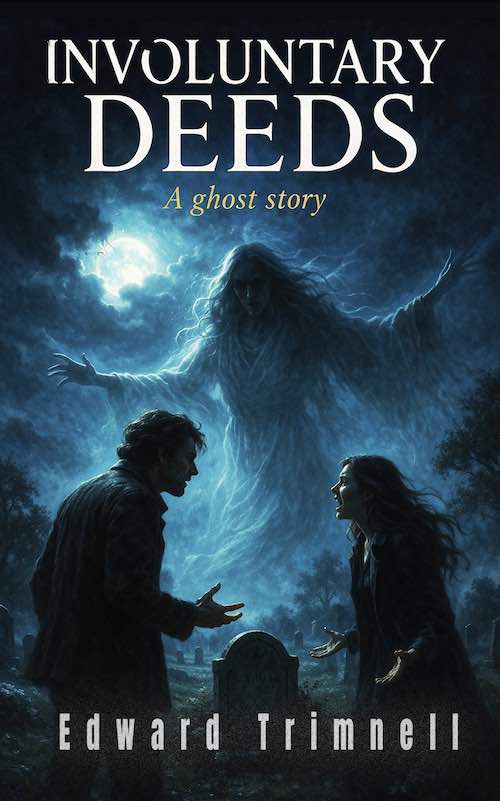
Involuntary Deeds: a new supernatural/psychological horror novella

A married woman in the suburbs develops a sudden and inexplicable interest in graveyard photography. Her husband wonders what’s going on with her.

But what secrets is her husband hiding?

Such is the setup of Involuntary Deeds, my new supernatural/psychological horror novella. The novella is set in Clermont County, Ohio, about twenty miles east of Cincinnati.

**View it on Amazon**

Involuntary Deeds is presently available on Amazon. It will be rolled out to the other major retailers (Kobo, Barnes & Noble, Google Play, and Apple Books) in the coming weeks.

Amazon description:

Some crimes don’t stay buried.

Pam Vance never cared about cemeteries—until the day she couldn’t stay away from them.

What begins as a strange new hobby quickly turns into something else. An obsession. A need to photograph graves she’s never seen before… places she feels drawn to.

Her husband, Robert, knows something is wrong.

Then the warnings begin.

The ghost of a Revolutionary War soldier appears to Robert with a message he can’t ignore: stay away.

But Pam won’t stop.

Because one grave is calling to her—that of a sixteen-year-old girl who died in 1991. A death long forgotten.

But not by Robert.

As the past closes in, a truth buried for decades begins to surface—pulling the living and the dead toward a confrontation that can no longer be avoided.

‘Involuntary Deeds’ is a novella for fans of classic ghost stories in the tradition of Peter Straub, Shirley Jackson, M.R. James, and E.F. Benson.

1980s coming-of-age college drama

Read NO SURE THING in Kobo Plus. Also available for purchase at Amazon, Google Play, Apple Books, and Barnes & Noble

No Sure Thing: a Gen X coming-of-age novel set in 1988 is now available in Kobo Plus.

Kobo Plus is Kobo’s version of Kindle Unlimited. I’ve been moving some titles in there on an experimental basis.

Kobo Plus, like Kindle Unlimited, will inevitably be swamped with trashy, sexually explicit romance novels. (Unfortunately, that’s probably already the case). But at least Kobo Plus does not require exclusivity. So I’m willing to give it a try for now.

No Sure Thing, like the title suggests, is a coming-of-age novel in a distinctly Gen X setting. While the novel is not autobiographical in any significant way, many of the characters and conflicts presented therein are based on people and situations that I observed myself during the 1980s. So it is authentic, if nothing else.

While there are several “love plots” in the book, this is not a romance novel in any traditional sense. If that’s what you’re looking for, look elsewhere.

But not all of the teen movies of the 1980s followed the traditional romance script. Consider the endings of Risky Business and The Last American Virgin. These were much more disillusionment plots than by-the-numbers romance plots (even though the romance element was heavily used in marketing both films).

Fast Times at Ridgemont High, despite the sex and comedy, also had several unmistakable disillusionment plots: Stacy learned the consequences of reckless sexual experimentation; Brad learned the pitfalls of hubris.

As noted above, No Sure Thing is available at all the major online bookstores.

-ET

AI slop and genre slop: the most pessimistic view possible, and reasons for optimism

David Van Dyke Stewart is waxing pessimistic about the state of indie publishing. In his view, indie publishing is so threatened by AI slop and genre slop that it is no longer worth doing anymore.

He announces in the video below that he intends to “step away” from indie publishing. He’s even flirting with the idea of unpublishing some of his existing novels, because he does not want to be associated with some of the ridiculous excesses that we now see in indie publishing.

A part of me fully sympathizes. As I’ve written previously, I can hardly stand to enter indie writing groups on Facebook anymore. 90% of the authors participating in such spaces are now writing shifter romances, reverse harem—and similarly ridiculous books adorned with man chests. Then there are the dogs and cats solving mysteries, the witch cozies, etc. It is possible for one to feel ridiculous by association.

As for AI…yes, that is a problem of an entirely different magnitude.

And yet…I remain optimistic, if not in the short run, then at least in the long run.

Why? Because I’ve seen this movie before. I remember almost twenty years ago, how everyone was predicting that the entire internet would be taken down—not by AI, but by content farms.

For those of you who don’t remember (or who are a little fuzzy) on the history, content farms were junk sites that were hastily written to maximize clicks in Google search results, and thereby maximize AdSense income. For a few years they represented a real threat to the integrity of the internet.

But the content farms eventually went the way of the pterodactyl. Google changed its algorithm. Search engine users became more discriminating, and learned to recognize query results that led to content farms. The economic incentive for the content farms went away.

That’s what I expect to happen with AI slop (and—to some degree—genre slop). How long can it remain profitable to turn out template-driven trashy romance novels, for instance? Even for the voracious porn/romance readership?

And once you throw AI into the mix, the race to the unprofitable bottom is inevitable. I look for the genre slop writers, and the AI slop producers, to eventually be driven out by their own excesses.

One irony here is that AI slop and genre slop have a mutually destructive, symbiotic relationship. Template-driven, repetitive genre novels are the easiest to produce with various AI programs.

What does concern me is that before it all goes away, it will completely undermine the Kindle Unlimited ecosystem. This is a real threat in the short- to mid-term.

But I don’t look for AI and genre slop to take down indie publishing as an industry. As long as the internet has existed, there have been both outright scammers and individuals who seek to maximize profit by turning out low-effort, repetitive content. That problem is not going to go away. One bag of tricks will simply be replaced by another.

The rest of us will soldier on. As for David Van Dyke Stewart, I hope that he soldiers on, too. I haven’t read any of his novels; but I have watched some of his YouTube content. He strikes me as a thoughtful fellow. 

-ET

The smut factor: why I’ve more or less abandoned online writers’ groups

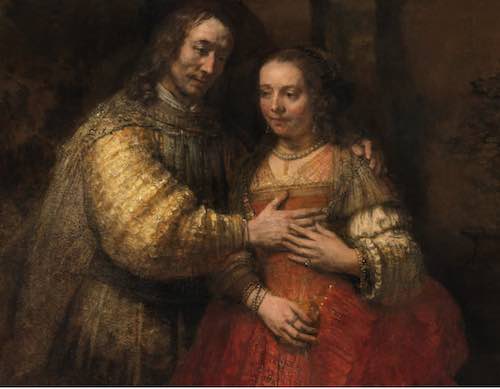
The Jewish Bride, by Rembrandt

One of you asked me the other day which online writers’ group I recommend. Many of these groups exist on Facebook.

Ten years ago I would have been able to heartily recommend several of them.

Today, there are none that are very useful to me. Here’s the problem.

Over the last five years, the online writers’ groups have become inundated with writers of “spicy” (i.e., sexually explicit) romance and outright erotica (i.e., even more sexually explicit material).

Now let me be clear here. I am no prude. Oh…far, far from it. I am quite sure that some of my off-hours activities would shock and/or offend the prudish among you.

But there is a limit to how much I enjoy talking about sex, writing about sex, and creating stories around it. My tolerance for that sort of thing is fairly limited.

I don’t like sex stories for the same reason I don’t like pornographic videos: watching other people have sex is a bit like watching other people eat.

Similarly, talking about sex is like talking about eating. I eat lunch every day. But I don’t wish to spend more time discussing my lunch than I spend actually eating it. I have a similar approach to matters of the bedroom. Some of these writers and their readers need to spend less time with their noses in books, and more time with living, breathing people. (Nothing cures a chronic preoccupation with sex like a little of the real thing.)

From a business perspective, the marketing of romance/erotica has much more to do with the marketing of OnlyFans or other pornographic material than it does with traditional book marketing. A person who picks up a Michael Connelly novel is not responding to the same motivations as a person who watches pornographic videos, or who reads pornographic stories.

No ill will for all the “spicy” romance and erotica writers out there, mind you. But they’ve made the online writing space more or less useless for everyone else, with their sheer numbers.

-ET

Chernobyl + 40 years

In the spring of 1986, many Americans were following events in the Soviet Union. The new man in the Kremlin was Mikhail Gorbachev, a young (by Soviet standards) leader who was eager to reform the Soviet system. Gorbachev also sought better relations with the West.

I was a senior in high school in 1986. I was interested in the Soviet Union, too. I was old enough to remember the final Cold War tensions of the late 1970s and early 1980s: the Soviet invasion of Afghanistan, the downing of KAL 007. But now, a new world seemed to be in the making.

Then, on April 26, there was a major nuclear accident at Chernobyl, in an area of the Soviet Union then commonly known as “the Ukraine”.

The Kremlin tried to cover it up (of course). The Kremlin had covered up similar disasters in the past (including one at a biological weapons facility in a remote part of the USSR). But this was too big to conceal.

Chernobyl would be in the news for months—years—afterward. The problem still hasn’t gone away completely.

In retrospect, the Chernobyl disaster (which sprung from Soviet ineptitude) was the first sign that Western optimism about the USSR in the mid-1980s was misplaced.

Forty years have passed since then. The former Soviet lands are still the source of mostly bad news. Case-in-point: the war between Russia and Ukraine, now in its fifth year.

-ET

Draft 2 Digital, AI slop, and the evil necessity of publishing fees

Draft 2 Digital is a company that provides indie authors and small publishers with a single interface for “wide” distribution of ebooks to a host of online retailers. The company has historically taken a small percentage of sales revenues in exchange for its services.

But in recent years, AI slop has invaded and overwhelmed the publishing world. There is now an entire online ecosystem of low-content and junk content churned out by AI writing tools. This “book spam” is clogging up online bookstores and retailers with content that no one is ever going to buy in any meaningful quantity. And with AI tools, the book spammers can do this at scale.

To make matters worse, there is also now an ecosystem of YouTube and TikTok hucksters, teaching others how to “make millions!” with these techniques. This is like the content farm problem of the 00s, but exponentially larger.

Draft2Digital has addressed the problem in a number of ways. Some time ago, the company announced that it will no longer handle nonfiction titles covering topics that are low-hanging fruit for spammers (exercise, cryptocurrency, diet, and various New Age subject matter).

D2D also announced that it will begin charging a $20 set-up fee for new accounts, along with a $12 per year account maintenance fee for any publishers who earn less than $100 per year.

In other words, less than $8.33 per month.

Needless to say, there are people kvetching about this on the Internet. As for me, I am 100% in favor of it.

This is not because I want to see more fees for their own sake. But rather because something needs to be done about the sheer volume of online garbage.

And when I use terms like “online garbage”, I’m not talking about stories and books that don’t suit my taste. Hey, if someone has labored over their billionaire, reverse-harem cowboy hockey player romance novel, and they want to publish that, let them go for it. (Although to be perfectly honest, I would prefer that they didn’t. The romance genres have become as trashy as Pornhub in recent years. But I digress.)

I’m talking, rather, about the low-content and extremely low-effort books produced, often with AI tools, for the sole purpose of manipulating bookstore algorithms and exploiting subscription services like Kindle Unlimited. No one benefits from the presence of that—including the authors of billionaire, reverse-harem cowboy hockey player romance novels.

A modest per-book monthly or annual nuisance fee would prune the sheer volume of junk that is accumulating on online bookstores. (Listen to Mal Cooper’s video below.)

I know the nature of the internet. There are people out there who believe that anything on the Internet should always be free, no matter what it is, and no matter what costs are associated with it, simply because it’s on the Internet. That’s an argument that goes back at least 25 years, to the original debates over file-sharing and NAPSTER.

But AI slop threatens to undermine, if not destroy, indie publishing. Online retailers and distributors will never have the manpower to meticulously vet every title. In lieu of that, per-title maintenance fees may be a necessary evil for combating AI slop.

-ET

A story for summer: “The Wasp”

It is not quite summer, if you want to get technical about it. Summer will not officially begin until Sunday, June 21, 2026.

We are still in April. The schools won’t let out for another six weeks. 

But the mercury here in southern Ohio will hit 85 degrees today. That’s close enough for me.

The above is one of my early short stories, “The Wasp”. I wrote it back in 2009, and it was first published in my short story collection, HAY MOON AND OTHER STORIES.

This is very much a summertime story. It’s also based my lifetime loathing of wasps. I can handle spiders, snakes, and other creepy-crawlers (to a point, anyway). I love honeybees.

But I absolutely despise wasps.

As the old German proverbs goes, “God made the bee, but the devil made the wasp.”

-ET

Social interactions in the 1980s were a different game completely

In the 1980s, there was no social media and no dating apps. We didn’t even have email.

If you wanted to meet someone new, there was usually only one way to go about it.

You had to approach them in person, and strike up a conversation.

Below is a scene from NO SURE THING: A GEN X COMING-OF-AGE NOVEL SET IN 1988. In the scene below, the main character must jump through numerous hoops to meet an attractive young woman:

NO SURE THING: A GEN X COMING-OF-AGE NOVEL SET IN 1988

CHAPTER 43

Since my hand had previously been stamped, I had little trouble gaining reentry to the Casablanca Club. I walked by the doorman as if I owned the place, flashing him a glimpse of my left hand. He gave me no trouble this time.

Once inside, I got another break: there was no sign of Lance Corporal Evans or his fellow marines.

But where was Sergeant George Tuttle, fearless defender of the law in Cincinnati “for more than thirty  years?”

Maybe I would get lucky there. Maybe the cop had called it a night, or (more likely) been drawn away from the Casablanca Club by other police business.

I only had to walk around for a few minutes before I spotted her: the young woman from the Tangeman University Center. The pretty blonde who had caught my attention that day.

She was standing by herself at the edge of the nearest dance floor. Where were the other young women she had entered with, the ones I had assumed to be her friends? Was she meeting a guy here?

I didn’t know. And in that moment, I didn’t care. It was full speed ahead.

“Hi,” I said, when I got within speaking distance.

She turned toward me. I thought I detected a flash of recognition.

“You go to the University of Cincinnati, don’t you?” I asked.

Strictly speaking, this was a lame question with an obvious answer. The Casablanca Club was located a few blocks from the university, and we were both of university age. Probably half of the patrons here tonight were university students.

But few lines uttered by young men to young women in bars and nightclubs are brilliant. This wasn’t Toastmasters. Nor was I making an argument before Dr. Blevins. I was willing to improvise.

She smiled, but seemed at a loss for words.

“I think we may have spoken briefly in the Tangeman Center. That day you were looking at all the Armed Forces displays.

“More like I spoke briefly,” she said. “The proverbial cat seemed to have gotten your tongue.”

“There are no cats on my tongue now.”

This had to have been the most awkward line a man ever uttered to a woman in a bar. But it did the trick. She laughed.

“I’m Kim,” she said.

“I’m Paul.”

We talked for a few minutes more. I learned that she was a marketing major…common enough at the University of Cincinnati.

This was actually working, I suddenly realized. There was none of the awkwardness and fumbling that I’d felt when trying to talk to Tara and Courtney.

The difference, of course, was that the attraction with Kim was mutual, rather than one-sided. I therefore didn’t have to talk her into anything. All I had to do was go with the flow, be moderately assertive, and not say anything stupid.

But I was also conscious of Scott, who would right now be waiting for me in my car. I was also aware that in my very presence here, I was defying police orders, and breaking a promise I had made to a sergeant in the Cincinnati Police Department.

“I’ve enjoyed talking to you, Kim, but—”

“But now you have to go.”

“Yes. How did you know?”

“Call it intuition. Or maybe that you seem an awful lot like someone in a hurry.”

“I am in a hurry,” I confessed. “My friend is waiting for me at my car. Before I go, though: would you give me your phone number? I’d like to call you sometime.”

She smiled. “That’s usually what people have in mind when they ask for someone’s phone number. They want to call them sometime.”

A few minutes later, I was walking toward the main entrance/exit of The Casablanca Club with Kim’s phone number in my pocket.

She had written it on one of the club’s cocktail napkins, along with her last name. She was Kim Jones.

I was feeling on top of the world, more or less. Wait until Scott heard about this, I thought triumphantly.

I was outside in the parking lot of the Casablanca Club, almost home free, when everything unraveled.

“I thought you’d learned your lesson,” an older male voice declared. “But I guess I was wrong about that, wasn’t I?”

NO SURE THING: A GEN X COMING-OF-AGE NOVEL SET IN 1988 is available at Amazon, Barnes & Noble, Kobo, Google Play and Apple Books.

iOS 26 bugs and my old guy instincts

You all know me, or a version of me: I’m one of those stick-in-the-mud older/middle-age people who refuses to upgrade to the latest version of whatever operating system happens to be relevant.

I do this for the reason that most older people are skeptical/cautious: experience. In 2009, Microsoft destroyed my PC with an automated upgrade of the Windows XP operating system. Trust us, Microsoft said. Enable those automated updates. And I, like a fool, believed them.

I’ve since become a Mac user. Apple has yet to outright destroy any of my devices with an upgrade. But they’ve rendered several of them less usable, slower, or buggier.

I’ve therefore adopted a policy over the last five to ten years: one operating system per device. (This isn’t as radical as it sounds; I upgrade my devices at reasonable intervals.) My expectation to the tech companies is: Get it right the first time.

I purchased my iPhone 16 Plus last spring. The factory-installed iOS was 18.

I was planning to keep that. It worked. Then I read numerous online reports from the “techies” about how essential it was to upgrade. Iranian and Russian agents could exploit my current iOS, hack my phone, and steal all my data.

So I upgraded to iOS 26.4.1 last week. I’ve got a fancy new “liquid glass” display, and lots of new emojis that I’ll never use.

But CarPlay no longer works. (CarPlay worked perfectly, every time, on iOS 18.) YouTube videos freeze and error out. These are both documented flaws that have been discussed on Reddit and in other online venues.

Two observations from all this. First, this demonstrates yet again that our over- reliance on digital technology is a weakness as well as a convenience. I know young people who can’t read a map, write in cursive, or maintain their composure during a voice call, all because they’ve been hobbled by reliance on tech. But what happens when the machines glitch?

Secondly, I’m disappointed at Apple’s shoddiness. I’m an indie author, and I feel guilty if I release a $4.99 ebook with a handful of typos in it. But most of us paid close to a grand for our iPhones. Apple is a $350 billion company. Tim Cook, Apple’s CEO, earns $74 million per year in total compensation. Am I asking too much, when I humbly request that Apple not break CarPlay and destabilize YouTube when they release an update that I am told I must have?

I’m sure—or no, scratch that—I hope that Apple will eventually fix these bugs, along with the other ones I have yet to discover.

In the meantime, I wish I would have listened to my old guy instincts last week, and stayed on iOS 18.

-ET

1932: supernatural zombie horror in rural Ohio

My maternal grandfather, born in 1921, grew up in rural Adams County, Ohio. He told me so much about that time and place, that I sometimes feel as if I lived it all myself.

“Hay Moon” is a short story set in rural Ohio in the summer of 1932. My grandfather never told me a story like this, filled with supernatural forces and the undead. But his real-life accounts of his childhood years helped me add a realistic flavor to the tale, if I say so myself.

You can listen to the story here, or on my YouTube channel (where you’ll find lots of additional audio content).

You can purchase this story as part of my Hay Moon and Other Stories collection. If you like my approach to historical horror, consider The Rockland Horror historical horror series, which is also available in a five-volume boxset on Kindle.

-ET

1980s college fiction: new cover reveal

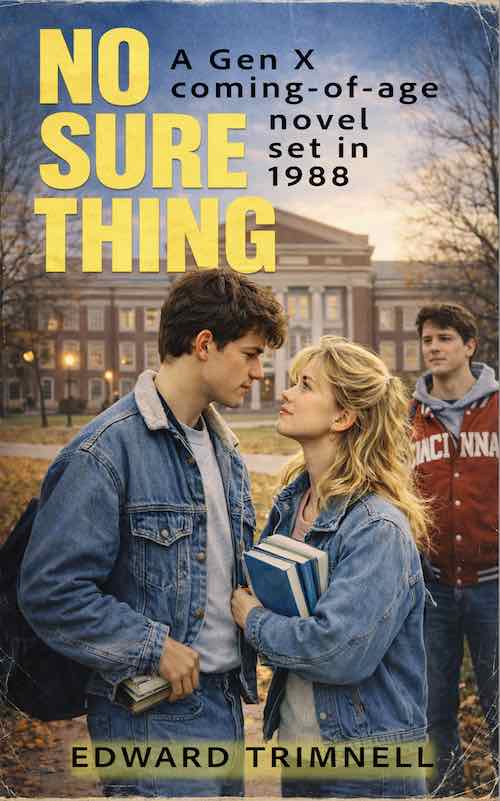
NO SURE THING has a new cover. The setting is a modified image of the University of Cincinnati campus, which I attended in the late 1980s.

Who should read NO SURE THING? You’ll enjoy this book if you fondly remember teen and young adult movies of the 80s. The book is based on a number of ideas I’ve been kicking around for years, but it really crystalized when I rewatched Risky Business, the 1983 film that made Tom Cruise a household name.

NO SURE THING is available at Amazon, Google Play, Kobo, Barnes & Noble, and Apple Books.

-ET

I met a famous poet, I asked a stupid question

People occasionally ask me what I like in the way of poetry. When this happens, I hem and haw around, and try to change the subject. I might suggest the lyrics of Neil Peart, the drummer and chief songwriter for the Canadian rock band Rush.

But that’s a non-answer. Neil Peart mostly wrote song lyrics, which are distinct from—though closely related to—poetry that is meant to be read from a page, rather than performed as music.

The sad fact is: a lot of contemporary American poetry is not very good. Regular readers will know that I’m fond of trashing the twenty-first century. But the decline of English-language verse began far back in the last century. By the time I was born (1968), English-language poetry was already in decline.

Most of it seems to fall into one of two camps. At one extreme, there is sappy love poetry that imitates the late Rod McKuen. At the other extreme, there is slam poetry, which devolved from the rantings of Allen Ginsberg.

But not all is doom and gloom. Richard Wilbur (1921-1997) was a twentieth century poet who wrote verse as the English language gods intended it to be written. That is: with discipline and structure, and focused on concretes rather than abstractions.

Here’s a sample of Wilbur’s classic poem, “Advice to a Prophet”:

“When you come, as you soon must, to the streets of our city,   

Mad-eyed from stating the obvious,

Not proclaiming our fall but begging us

In God’s name to have self-pity,

Spare us all word of the weapons, their force and range,   

The long numbers that rocket the mind;

Our slow, unreckoning hearts will be left behind,   

Unable to fear what is too strange.

Nor shall you scare us with talk of the death of the race.   

How should we dream of this place without us?—

The sun mere fire, the leaves untroubled about us,   

A stone look on the stone’s face?…”

That is great stuff. I loved these lines when I first read them, back in the mid-1980s. And I love them still.

I briefly met Richard Wilbur in 1987, when he was a guest speaker at Northern Kentucky University, where I was a student. I was already a moderately enthusiastic fan by this point. I asked him a question or two during the Q&A session— probably dumb questions. But hey, I was nineteen years old at the time.

If you are interested in poetry at all, then you should read Richard Wilbur’s poems. The best way to do this is by purchasing his omnibus collection, Collected Poems 1943-2004: Pulitzer Prize and National Book Award Winner―Sixty Years of American Verse. I purchased this volume a few years ago. It is well worth whatever Amazon is charging for it nowadays.

-ET