Homeschooling: the wrong solution to a real problem

A large number of school levy issues were on the ballot throughout Ohio this past Tuesday. Most of them were rejected by voters. Reading the comments on Facebook, I noted that those who voted against the levies were largely unapologetic.

There is a general dissatisfaction throughout America with public schools: their management, their methods of (taxpayer) funding, and the instruction that is taking place within them.

This dissatisfaction with public education has fueled a concomitant rise in homeschooling. When I was a kid, during the 1970s and 1980s, one never met anyone who was homeschooled. (Fewer than 1% of Gen Xers receive their education this way.) But nowadays it seems that every other young adult one meets is the product of homeschooling. Every young couple with children is at least talking about educating their kids at home. The percentages rise as the neighborhoods become whiter and more affluent.

I understand the dissatisfaction with twenty-first-century public schools. It seems that no news day is complete without a fresh report of some weirdness being taught in public schools, or some flagrant example of teacher misconduct.

And yet…I had a very different experience in the 1970s and 1980s. I attended both public and working-class Catholic schools, both at the grade school and high school levels. I received an excellent education. And while I liked some of my teachers better than others, almost all of them were intelligent adults who were deeply committed to their calling.

What happened, then? Sometime during the mid-1980s, one began hearing the catchphrase, “if you can’t do, then teach”. The careerism of the 1980s taught young people that teaching was a second-rate profession. If you were smart, if you were a capable student, then you didn’t want to be a teacher. No, that simply wouldn’t do. You had to be an attorney, a CPA, or a CEO.

Another important trend occurred during the Gen X growing-up years: a decline in the number of capable young women entering the teaching field.

As recently as the 1970s, teaching was considered a top career choice for the most capable young women. While some of my teachers were male, they were disproportionately female. Many of my female teachers were absolutely brilliant. My junior high science teacher, a woman named Mrs. Tierney, was as knowledgable as many college professors.

That all began to change in the 1980s, with the rise of “girl power”, and the idea that the brightest young women must compete in all traditionally male careers. The result was more intelligent young women working in law and finance, but fewer intelligent young women becoming math and science teachers.

Did society benefit most from more intelligent young women entering law firms…or from more intelligent young women entering the field of education? I’m going to let you draw your own conclusions on that one. (I don’t want to deal with the hate mail.)

What I will say is that there are trade-offs to all societal changes. Forty years ago, we began subtly denigrating the teaching profession (“if you can’t do, then teach”) and we began telling young women that they were passively accepting the patriarchy if they didn’t go toe-to-toe with their male classmates in the corporate boardroom.

Forty years have come and gone since all of those trends began. The excellent teachers who provided my education during the 1970s and 1980s are all retired. After casting the teaching profession as a second-rate career choice for four decades, many people are shocked to discover that—lo and behold—the field is now populated by mostly second-rate people. (In one of their Freakonomics books, Steven Levitt and Stephen Dubner documented the decline in teacher IQ within my lifetime.) Many parents are also shocked to discover that a disproportionate number of those teachers are left-wing ideologues who shouldn’t be trusted with anyone’s children. But that tends to go along with the second-rate thing.

And now many of those affluent white suburbanites have decided that public schools must be abandoned wholesale. Parents who once believed that a teaching career was beneath them have decided that they should take a break from their law firms and corporate offices to…educate their children at home. Can no one see the irony here?

I reiterate: I experienced public, industrialized education during the 1970s and 1980s. It really isn’t that bad when the right adults are in charge. The problem is that the right adults are no longer in charge, because the right adults are off doing other things. Among those other things (note irony once again) is now homeschooling their kids, because they no longer trust the people working in education.

I am grateful that I wasn’t homeschooled. I loved my mother dearly, but she would not have been capable of teaching me Spanish and algebra at home. In my experience, very few parents are well-equipped to provide competent instruction beyond the fifth- or sixth- grade level. Teaching at the junior high level and above really is a task that is best left to trained professionals.

The proof is in the pudding. I’ve met many of these young adults who were homeschooled in recent years. Most of them are nice enough, but there are noticeable gaps in their knowledge and social development. I would not have wanted to trade places with them.

Another important factor is the socialization and people skills that the organized educational experience provides. I was neither the captain of the football team nor the most popular kid in my school. But my high school experience was anything but four years of living hell. In fact, I rather enjoyed it.

More germane to our discussion here, my school years taught me about friends, enemies, rivals, and conflict management. These are skills that many screen-bound Gen Z young adults sorely lack. 

The solution to the crisis in public education is not for a million concerned parents to isolate their children and retreat behind suburban walls. The solution is for a million concerned parents to become involved and take back their public schools.

This is not like trying to take back the national government. Education is still largely managed at the local level. It is possible for organized groups of adults to bring about substantial changes.

This would be a lot more beneficial (for their children, most of all), and practical, than for every parent to try to become a do-it-yourself calculus teacher.

-ET
Draft 2 Digital, AI slop, and the evil necessity of publishing fees

Draft 2 Digital is a company that provides indie authors and small publishers with a single interface for “wide” distribution of ebooks to a host of online retailers. The company has historically taken a small percentage of sales revenues in exchange for its services.

But in recent years, AI slop has invaded and overwhelmed the publishing world. There is now an entire online ecosystem of low-content and junk content churned out by AI writing tools. This “book spam” is clogging up online bookstores and retailers with content that no one is ever going to buy in any meaningful quantity. And with AI tools, the book spammers can do this at scale.

To make matters worse, there is also now an ecosystem of YouTube and TikTok hucksters, teaching others how to “make millions!” with these techniques. This is like the content farm problem of the 00s, but exponentially larger.

Draft2Digital has addressed the problem in a number of ways. Some time ago, the company announced that it will no longer handle nonfiction titles covering topics that are low-hanging fruit for spammers (exercise, cryptocurrency, diet, and various New Age subject matter).

D2D also announced that it will begin charging a $20 set-up fee for new accounts, along with a $12 per year account maintenance fee for any publishers who earn less than $100 per year.

In other words, less than $8.33 per month.

Needless to say, there are people kvetching about this on the Internet. As for me, I am 100% in favor of it.

This is not because I want to see more fees for their own sake. But rather because something needs to be done about the sheer volume of online garbage.

And when I use terms like “online garbage”, I’m not talking about stories and books that don’t suit my taste. Hey, if someone has labored over their billionaire, reverse-harem cowboy hockey player romance novel, and they want to publish that, let them go for it. (Although to be perfectly honest, I would prefer that they didn’t. The romance genres have become as trashy as Pornhub in recent years. But I digress.)

I’m talking, rather, about the low-content and extremely low-effort books produced, often with AI tools, for the sole purpose of manipulating bookstore algorithms and exploiting subscription services like Kindle Unlimited. No one benefits from the presence of that—including the authors of billionaire, reverse-harem cowboy hockey player romance novels.

A modest per-book monthly or annual nuisance fee would prune the sheer volume of junk that is accumulating on online bookstores. (Listen to Mal Cooper’s video below.)

I know the nature of the internet. There are people out there who believe that anything on the Internet should always be free, no matter what it is, and no matter what costs are associated with it, simply because it’s on the Internet. That’s an argument that goes back at least 25 years, to the original debates over file-sharing and NAPSTER.

But AI slop threatens to undermine, if not destroy, indie publishing. Online retailers and distributors will never have the manpower to meticulously vet every title. In lieu of that, per-title maintenance fees may be a necessary evil for combating AI slop.

-ET

TERMINATION MAN: Corporate HR represents your employer, not you

TERMINATION MAN is the story of Craig Walker, a management consultant who specializes in “removing” problem employees through entrapment and techniques of “social engineering”.

TERMINATION MAN is fiction, but it is based on my experience in the automotive industry. The novel’s premise also has a basis in HR practices.

“Managing out” is a common corporate HR practice. When an employee is “managed out”, her situation is made so unpleasant or unsustainable that she will effectively fire herself, and voluntarily resign. This saves the company hassle and expense on multiple levels.

TERMINATION MAN is an embellishment of the managing out practice, of course. But the principle exists, and all HR professionals are familiar with it.

Another thing to remember: corporate HR is not your friend. Corporate HR does not represent you. Corporate HR represents your employer, the company.

This doesn’t mean that corporate HR reps are automatically sinister, venal, etc. (Most are not.) But you should never forget who pays their salaries. (Hint: not you.)

-ET

**View TERMINATION MAN ON AMAZON**

The end of MTV (1981 – 2025)

December 31st marked not only the end of 2025, but also the end of MTV (1981 – 2025).

As I explain in the video below, I was one of MTV’s young fans back in the early 1980s.

MTV was a brilliant mechanism for content marketing. Suburban teens like me would discover new bands on MTV. Then we would go to the local mall and purchase the albums.

I discovered many of my favorite bands on MTV, including Def Leppard.

-ET

**View NO SURE THING: A GEN X COMING-OF-AGE NOVEL SET IN 1988 on Amazon**

1980s tech was expensive, and it didn’t do much

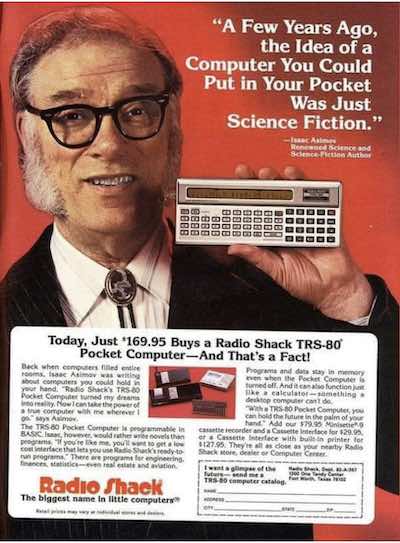
I vaguely remember the TRS-80 Pocket Computer. Introduced in 1980, this little device was manufactured and marketed by the Tandy Corporation/Radio Shack. (Every shopping mall in the 1980s had a Radio Shack.) Science fiction author Isaac Asimov appeared in a series of marketing spots for the gadget.

1980 Radio Shack ad featuring the TRS-80 Pocket Computer and Isaac Asimov

I didn’t own a TRS-80 Pocket Computer, however. The MSRP was $169.95. In present-day money, that’s about $670—the cost of a base-model iPhone.

And of course, the TRS-80 Pocket Computer had a minimal functionality when compared to an iPhone. It couldn’t make phone calls, play music, or take photos. It couldn’t surf the Internet—which didn’t yet exist, anyway.

The TRS-80 Pocket Computer was programmable in BASIC (which couldn’t do much for the average consumer). Other than that, it was basically a glorified pocket calculator.

Herein lies an important realization about 1980s tech: it was very expensive, and it didn’t do much. Even if you could afford it, you usually concluded that you could do without it.

-ET

The comparative joys of old (1980s) movies

I have been watching some old movies from the 1980s recently. Some have been movies that I saw, but have long since forgotten. Others are iconic films of that era that I never got around to seeing when they were current.

For example, I recently wrote a post about Mystic Pizza (1988). Last night I watched Risky Business (1983). I will have a post about Risky Business soon.

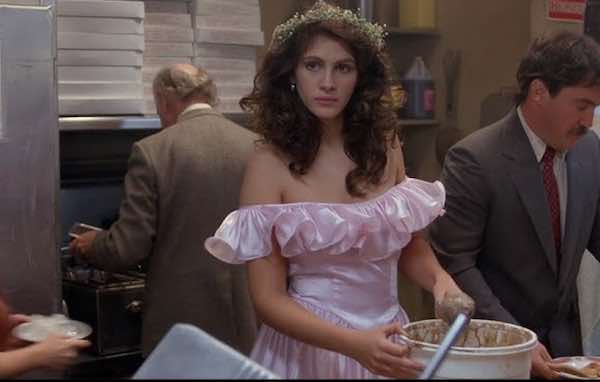
A scene from Mystic Pizza (1988)

One thing I’ve noticed is that many films created in 1980-something as disposable teen comedies were actually pretty good. In 1985, did anyone imagine that people in 2025 would still be talking about The Breakfast Club? Fast Times at Ridgemont High (1982) has been recognized by the American Film Institute for its merits.

Another thing I’ve noticed is the diversity in movies from that bygone era. In 1985, an original movie, properly executed, could make a lot of people rich. But the economics of the 21st-century box office encourage conservatism and a tiresome emphasis on franchise films. Continue reading “The comparative joys of old (1980s) movies”

Stephen King’s ‘The Outsider’ in Kindle Unlimited

While poking around on Amazon this morning, I noticed that the electronic version of Stephen King’s 2018 novel, The Outsider, is now available in Kindle Unlimited (KU). This means that subscribers to Amazon’s Kindle Unlimited program can read the electronic version of the book for free.

(Note: At least for now. Kindle Unlimited terms run for a period of 90 days. So if you’re reading this post a year from now, The Outsider may or may not be in KU.)

Amazon launched its Kindle Unlimited program more than a decade ago. Since its inception, there have been arguments for and against the program.

On one hand, Kindle Unlimited is to books what Netflix is to movies. KU thereby allows subscribers to discover new books and authors for free (aside from the KU subscription fee).

On the other hand, Kindle Unlimited requires books to be exclusive to the Amazon platform. (More on this shortly.) This creates a “network effect” that arguably disadvantages other stores like Apple Books and Kobo.

Another concern with Kindle Unlimited is that it tends to be skewed toward certain kinds of genre fiction, like romance, urban fantasy, and space opera. In the past, critics of the program (mostly book reviewers) have complained that Kindle Unlimited doesn’t contain enough titles from bestselling, household-name authors.

Well, you can’t get any more household-name than Stephen King. If a Stephen King title is available in Kindle Unlimited, then the program has all the bona fides it needs. 

There is one important catch, however. And this quibble comes (mostly) from the perspective of an independent author/publisher like me.

The Outsider is still available on other platforms, like Kobo and Apple Books. (I checked.) Stephen King’s title is not subject to the normal rules of KU exclusivity.

This is an important exception. If I place a book in Kindle Unlimited, I have to agree to make it exclusive to Amazon (not available anywhere else) for a period of 90 days. This means that readers can’t find it on other platforms, and I can’t sell it on other platforms during the Kindle Unlimited enrollment period.

So Stephen King gets different, more preferential treatment at Amazon than I do. I’m neither outraged nor surprised. Having spent many years in the corporate world, I know how the corporate world works.

As someone once told me, many years ago: “Rank and status have perks.” At the time, we were discussing the egalitarian implications of reserved parking spaces for top managers in the company parking lot. The corporate world is far from egalitarian. It would be naive to think that book publishing and retailing are “special” in this regard. Business is business.

On the contrary, I might benefit from this. The placement of The Outsider in Kindle Unlimited will bring new horror fans into the subscription program. After they’re done reading The Outsider, some of them may read one of my horror novels, like 12 Hours of Halloween, Revolutionary Ghosts, or Kuwa 6226. They may even give my historical horror series, The Rockland Horror, a try.

Yes, that was a little self-promotional plug, tongue-in-cheek though it was. Like I said: Business is business.

-ET

View KUWA 6226 at Amazon!

1980: a shave with your Egg McMuffin?

This is a promotional ad that McDonald’s ran in 1980. Breakfast customers were given a free Bic razor with the purchase of any breakfast entree.

1980 McDonald’s print ad

I don’t specifically remember this promotion, and my guess is that it didn’t last long. This is also one that you’re unlikely to see repeated in the twenty-first century. Clearly the ad appeals to one specific gender. (And in 1980, no one disputed the notion that there were only two.) But as we all know, women eat pancakes, too. So what’s going on?

My mother worked outside the home in 1980; but that was the very beginning of the Boomer-led “working woman” trend of the 1980s. The McDonald’s marketing folks probably figured that men would comprise the main market for fast-food breakfasts, presumably on their way to work.

-ET