Hey, I’ve got a new horror series coming out. The first book will hit Amazon later this week, in all likelihood. (It is in the final proofreading stage.)
Here’s a little about the series:
Origins of the story: The Evil Dead in a haunted house
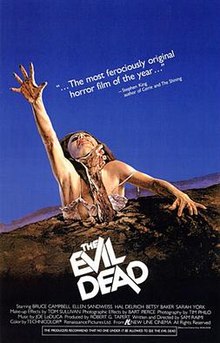
One of my all-time favorite horror films is Sam Raimi’s cult classic, The Evil Dead (1981).
The Evil Dead (just in case you’re one of the rare horror fans who hasn’t seen the film) follows a simple setup and plot:
A group of college students decide to spend a weekend in a cabin in rural Tennessee. One of them discovers a copy of the Sumerian Book of the Dead, along with a tape recorder. Both items were left in the cabin by an archeologist—who has apparently met a bad end.
And, of course, the college students throw caution to the wind, and tamper with both items. Because that’s the sort of thing people always do in horror movies.
Hijinks ensue. Evil spirits are roused, and they take over the college students one-by-one, transforming each of them into homicidal zombies.
I loved The Evil Dead, even though I recognized some of its flaws.
What flaws? you ask. The characters are cardboard cutouts, for one thing. Also, there is Raimi’s fondness for blending black humor with horror. The combination mostly worked in The Evil Dead. It detracted from some of his subsequent horror films.
But flaws aside, The Evil Dead was truly a powerful film, especially for the early 1980s. I recall watching it for the first time back in the summer of 1983. I watched a VHS rental copy of The Evil Dead, on the Zenith television in my parents’ living room. (I was 14 or 15 at the time.) For a full 85 minutes, my eyes were glued to the television screen. The rest of the world receded into the background. Only good storytelling can do that.
My concerns and storytelling style are different from Raimi’s. I like more character development; and I don’t like comedy-horror. But I loved The Evil Dead, nevertheless. I’ve long known that I would someday write a story of my own that would take The Evil Dead as its inspiration.
* * *
One day during the long, turbulent summer of 2020, I decided that I wanted to write a book that might best be described as “The Evil Dead inside a haunted house”. Basically, I was aiming for a story that captured the spirit of Raimi’s 1981 movie, without ripping it off.
I wrote an initial story that more or less followed the plot line of the 1981 movie. It was set in the present day. But as mentioned above, I didn’t want to rip off Raimi. I swapped out the claustrophobic Tennessee cabin of The Evil Dead for a big, old house in Southern Indiana. Like all haunted houses, this one had a backstory. (Haunted houses are usually haunted for a reason, after all.)
As I began writing the book, though, I discovered something: The backstory was much more than a backstory. The house had a long, horrific history—as did the people who lived (and died) there.
I realized that one story simply wasn’t going to get the job done.
So I scrapped my original manuscript, and went back to the drawing board.
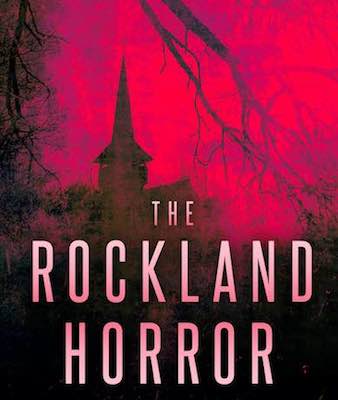
Instead of starting the story in the present day, I decided to go back to the very beginning, to the origins of The Rockland Horror.
That is where Book One begins…
A total of nine books have been planned out, and are in various stages of writing and development. When completed, The Rockland Horror saga will cover the horrific history of one cursed house from 1882 through 2020.
Kristen Clarke, Biden’s nominee to head the DOJ Civil Rights Division, penned a 1994 letter to the Harvard Crimson, stating that African Americans have “superior physical and mental abilities”.At the time, Clarke was an undergraduate at Harvard, and the president of the university’s Black Students Association.
Clarke based her letter on…race science.
Here are some excerpts from the letter:
“One: Dr Richard King reveals that the core of the human brain is the ‘locus coeruleus,’ which is a structure that is Black, because it contains large amounts of neuro-melanin, which is essential for its operation.
“Two: Black infants sit, crawl and walk sooner than whites [sic]. Three: Carol Barnes notes that human mental processes are controlled by melanin — that same chemical which gives Blacks their superior physical and mental abilities.
“Four: Some scientists have revealed that most whites [sic] are unable to produce melanin because their pineal glands are often calcified or non-functioning. Pineal calcification rates with Africans are five to 15 percent [sic], Asians 15 to 25 percent [sic] and Europeans 60 to 80 percent [sic]. This is the chemical basis for the cultural differences between blacks and whites [sic].
“Five: Melanin endows Blacks with greater mental, physical and spiritual abilities — something which cannot be measured based on Eurocentric standards.”
Obviously, this is complete hooey, dressed up in the sort of pseudo-scientific language that passes for erudition at places like Harvard.
Obviously, the mainstream media would be shrieking, Twitter would be exploding, if a white nominee to any senior federal government post had made similar claims about whites, based on “race science”.
Nevertheless, I’m of two minds on this one.
Clarke’s age is not available online, but her Wikipedia entry states that she graduated Harvard in 1997. Backing into the numbers, this would mean that she was about 19 years old when she wrote the above words.
Kristen Clarke
Most people don’t reach full adulthood until they are about halfway through their twenties. (This is why I would be in favor of raising the voting age, rather than lowering it, but that’s another discussion.)
This doesn’t mean you should get a blank check for everything you do when you’re young, of course. But there is a case to be made that all of us say and think things during our formative years that will make us cringe when we look back on them from a more mature perspective.
This is certainly true for me. I was 19 years old in 1987. I am not the same person now that I was then—both for better and for worse.
Secondly, let’s acknowledge environmental factors. Being a student at Harvard is likely to temporarily handicap any young person’s judgement and intellectual maturity. Even in 1994, Harvard University was a hotbed of pointy-headed progressivism and insular identity politics.
Clarke was also involved in the Black Students Association. There was a Black Students Association at the University of Cincinnati when I was an undergrad there during the late 1980s. Members of UC’s BSA were known to write whacko letters like the one above. Most of them, though, were nice enough people when you actually talked to them in person. They just got a little carried away when sniffing their own farts in the little office that the university had allocated for BSA use.
What I’m saying is: I’m willing to take into account that 1994 was a long time ago. A single letter from a 19-year-old, quoting pseudo-academic race claptrap, shouldn’t be a permanent blight on the record of a 47-year-old. And I would say the same if Kristen Clarke were white, and had taken a very different spin on “race science”.
We all need to stop being so touchy about racial issues, and so preoccupied with them. That goes for whites as well as blacks, and vice versa.
I’m willing to give Clarke a fair hearing, then. But I’m skeptical. Her 1994 Harvard letter isn’t an automatic disqualifier; but it’s a question that needs to be answered.
I’m also skeptical of Biden. Biden may be a feeble old man; he may be a crook. He is not particularly “woke” at a personal level. In fact, some of his former positions on busing and crime suggest that he’s anything but “woke” on matters of race.
Yet Biden is now head of a Democratic Party that is obsessed with race. This means that Biden may try to overcompensate, by filling his government with race radicals. This recent selection supports that concern.
Given the time that has elapsed between the present and 1994, given Kristen Clarke’s age at the time, I want to hear what she has to say in 2021 before I outright condemn her as a hater or a looney. But this recent personnel selection doesn’t make me optimistic about the ideological tilt of the incoming Biden administration.
Krampus, Dickens, and what I saw on Christmas Eve, 1976
Merry Christmas, everyone!
Yes, I know this has been a lousy year. It’s almost over, though.
Christmas is generally a festive holiday, but there are some macabre Christmas traditions, too. And they didn’t necessarily begin with this very macabre year of 2020.
Consider, for example, the Dickens tale, A Christmas Carol. This is one of my holiday favorites. Who can forget the Ghost of Christmas Yet to Come, which reminds us of the Grim Reaper? Or, for that matter, Marley’s ghost?
Krampus and St. Nicholas
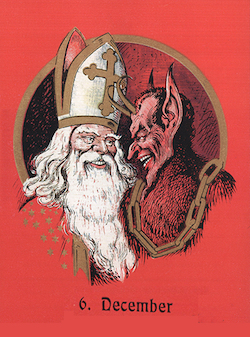
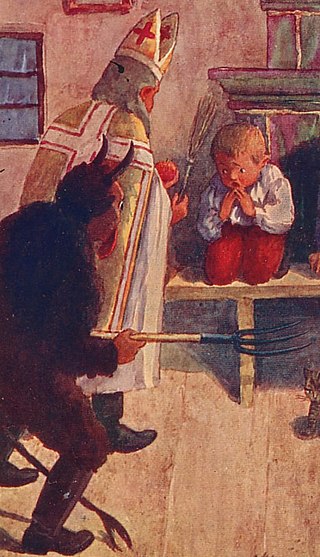
In some parts of Europe, Christmas includes the Krampus, a horned creature that incorporates both Christian and pre-Christian (pagan) traditions. In Germanic folklore, the Krampus works in conjunction with St. Nicholas, rewarding children who have been good, and punishing those who have been bad.
Let me tell you about something that happened to me on Christmas Eve many years ago…in 1976.
I was at my grandparents’ house in the suburbs of Cincinnati, Ohio. The family had just had our Christmas Eve dinner—Grandma’s turkey, stuffing, and mashed potatoes. (My grandmother also used to prepare a festive gelatin salad made with raspberry Jell-O, diced nuts, sliced carrots, and Cool Whip. (I realize that might not sound very tasty, but it was.))
Anyway, I had just left the table for a call of nature. This took me to a hallway in another part of the house.
There in the semidarkness of the hallway, I saw the shadow of a small, gnomish creature. It was right there, within lunging distance of me, cast on the wall.
I was startled—though not necessarily in mortal terror. Being eight years old in 1976, I ran back into the dining room, and told the adults.
There was something in the hall!
They accompanied me back to the hallway where I’d seen the unusual shadow. Needless to say, it was gone.
But there had been something there. I know there was.
My grandparents lived in that house for the rest of their lives. I was close to my grandparents, and visited them often, well into my adult years.
I never saw anything there resembling that gnome shadow figure again. Nor did I ever see any other other strange phenomena in the house.
But I know that something made a brief visit there on Christmas Eve, 1976.
A bad elf, maybe? I don’t know. But like I said, I saw something.
Most writers tend to change over time. Stephen King’s most recent offering, If It Bleeds, is quite distinct from his early breakout novels like Carrie, ‘Salem’s Lot, and The Shining. If It Bleeds is almost like a book from a different author.
King is one of the best-known examples of writers who’ve changed, but there are many others.
***
I haven’t been writing and publishing for as long as Stephen King, of course. But I’ve been at it for about a decade now, and that’s long enough for my story interests and narrative style to undergo significant changes.
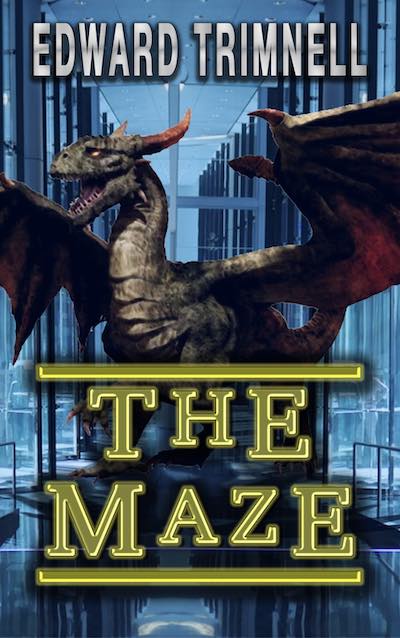
Relatively early in the game, I wrote and published a short story collection, along with three novels: Blood Flats (2011), Termination Man (2012), and The Maze (2013).
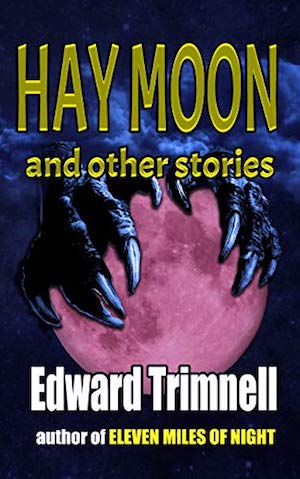
The short story collection, Hay Moon and Other Stories, has remained on Amazon since 2011. Readers have liked it, and it sells fairly well, as short story collections go.
But the aforementioned novels were a different matter. These are all standalone novels, and in a mix of genres. A marketing nightmare. Although reviews were generally positive, sales languished.
***
These three novels are all long books, well in excess of 100K words. (Blood Flats is about 180K words). This past year I decided that it would be a good idea to take the books off the market for a time, give them a thorough reread, and decide if they needed to be altered, republished as originally written, or scrapped.
I’ve written so much in the intervening years, that rereading these books was a bit like reading three books written by another person. I remembered the general plots of each novel, of course; but I had also forgotten huge swaths of the stories.
I was pleasantly surprised to find out that all of these novels are, well…pretty darn good.
I subjected these books not only to an author’s reread, but also to an external proofread. A handful of typos were found and corrected (though not many).
I’ve rereleased these books and put them back in Kindle Unlimited. Here they are, with Amazon links and descriptions:
Blood Flats:Lee McCabe is on the run from the law, mafia hitmen, and rural meth dealers. A gun-blazing chase through the badlands of Kentucky.
Termination Man:Sex, lies, and corporate conspiracies! A workplace thriller for fans of John Grisham and Joseph Finder.
The Maze:Three ordinary people step into an alien world of magic and nonstop danger. A modern-day parallel world fantasy with the soul of a thriller!
***
If the above story descriptions appeal to you, then I think you’ll like each of these books. And you can presently read them for free in Kindle Unlimited.
The music of Ozzy Osbourne has long been one of my guilty pleasures. I’m from the Ozzy generation, you might say. I hit adolescence in the early 1980s, perfect timing for Ozzy’s three breakout albums: Blizzard of Oz (1980), Diary of a Madman (1981) and Bark at the Moon (1983).
By the time I graduated from high school in 1986, Ozzy Osbourne’s musicwas already becoming somewhat predictable and repetitive. Or maybe I was just getting older?…Who knows? But anyway—if you were around in the early 1980s and into rock music, you’ll surely remember the energy of those first few albums. They were really something.
Ozzy Osbourne was always more of an entertainer than a technical musician. From the beginning of his solo career, the former Black Sabbath frontman effected this macabre persona, which was uniquely appealing to 13-year-old boys, circa 1981. Then there was the thing about him biting the head off a dove at a meeting with CBS record executives. (He was intoxicated at the time.)
By the early 2000s, Ozzy Osbourne’s style of music was long past its expiration date. The singer pivoted—to reality TV. From 2002 to 2005, MTV aired The Osbournes. Each episode of The Osbournes was basically a day-in-the-life with the singer and his family. I caught about fifteen minutes of one such episode, and immediately knew that The Osbournes wasn’t for me. I’m not a big fan of reality TV to begin with, and I found Ozzy’s two teenage children, Kelly and Jack, somewhat annoying.
I was therefore a bit skeptical when I tuned into my first episode of The Osbournes Want to Believe, which now airs on the Travel Channel. But the The Osbournes Want to Believe is actually not too bad…if you’re willing to accept it for what it is.
The Osbournes Want to Believe presents a new spin on the well-traveled paranormal investigation/ghosthunting TV genre. This show doesn’t feature parapsychologists and professional skeptics, breaking down videos of shadowy figures and independently moving objects. Here, instead, you watch and listen as three members of the Osbourne family give their take on such matters.
Son Jack serves as the host of the show. Yes, I found him annoying 18 years ago; but he’s now 35 and actually pretty good as a television host.
Ozzy Osbourne, meanwhile, is a shadow of his former self. To quote his Wikipedia entry, Ozzy “has abused alcohol and other drugs for most of his adult life.” In 1978, he unapologetically told a journalist, “I get high, I get f***ed up … what the hell’s wrong with getting f***edup? There must be something wrong with the system if so many people have to get f***ed up … I never take dope or anything before I go on stage. I’ll smoke a joint or whatever afterwards.”
The singer is now in his early seventies, and his decades of substance abuse are readily apparent. Ozzy is always likable, and at times genuinely witty; but he seems constantly on the verge of falling asleep. If not for his reputation, Ozzy could be mistaken for Joe Biden giving an unscripted press conference. (Sorry! I couldn’t resist.) No one need wonder, though, why Jack serves as the show’s moderator. Ozzy would not be up to the task.
Sharon Osbourne, of The Talk, is perfectly lucid and endlessly chirpy. Nor is she exactly unlikable. But—like the class clown of everyone’s school days— she tries too hard to turn every remark into a joke. Her humor doesn’t always miss the mark; but it rapidly wears thin because it just never stops.
The overall tone of the show is informal and conversational. The set looks like a room in one of the homes owned by Osbourne. Watching The Osbournes Want to Believe gives you the sense that you’re sitting around with this oddball family, watching these weird videos of weird happenings.
The Osbournes Want to Believe is not cutting-edge television; but it isn’t trying to be. And although I’m not an expert on such matters, it doesn’t appear to be cutting-edge in the field of paranormal research, either. Most of the commentary—however witty and occasionally funny—is purely speculative and anecdotal.
This show seems to be yet one more attempt to cash in on the Ozzy Osbourne brand. That brand was launched more than 50 years ago, when the first Black Sabbath album hit the record stores in 1970.
How long can the Ozzy brand go on and continue to make money? Probably for as long as Ozzy can be dissuaded from completely obliterating himself with drugs and alcohol.
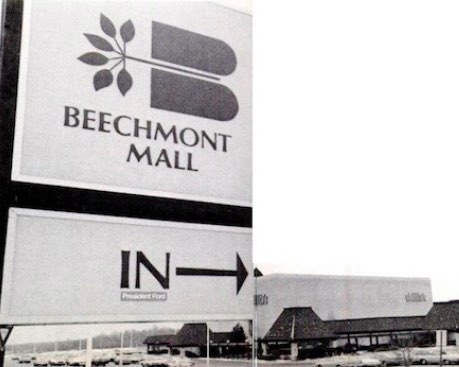
The other day, quite on a whim, I shared the above photo for my personal Facebook tribe, which consists disproportionately of former high school and grade school classmates. (I am 52 years old, and I was recently reunited on Facebook with a fellow who sat behind me in our third grade classroom. But that’s another story for another time.)
The above is the entrance to Beechmont Mall, on the east side of Cincinnati, Ohio. Beechmont Mall was opened in 1969, the year after I was born; and the above photo is from circa 1973. Beechmont Mall was a fixture of my childhood and adolescent years.
Beginning around 2000, Beechmont Mall was gradually dismantled, and replaced with an outdoor monstrosity now known as Anderson Towne Center. Twenty years later, what is left of Beechmont Mall would be virtually unrecognizable to a time traveler from 1970, 1980, or 1990.
Beechmont Mall was a place of wonders. There were bookstores, a record shop, and several well-stocked department stores. During the holiday season, there were elaborate Christmas displays.
Anderson Towne Center’s main draw is a Kroger grocery store that vaguely resembles a state correctional facility. We used to hang out at Beechmont Mall. No one wants to hang out at Anderson Towne Center.
I posted the above photo in my personal Facebook feed without expecting too much reaction. To be honest, I’d realized that with last month’s election and all, I’d been posting too much partisan political content there. I wanted to lighten the tone a bit.
I didn’t expect many reactions…maybe a like or two. But the photo got lots of likes. Almost immediately, my old friends and classmates began typing comments, detailing their fond memories of Beechmont Mall.
I wasn’t the only person who missed Beechmont Mall. Not by a long shot, as it turned out.
If you didn’t grow up on the east side of Cincinnati between 1970 and 2000, Beechmont Mall and the above photo mean nothing to you. I get that. This is my nostalgia, not necessarily yours.
But beyond the little corner of America where I grew up, there was a Golden Age of the American mall, between roughly 1970 and 1999. This is evidenced in the films of the late 20th century. Consider the centrality of the mall used in Fast Times at Ridgemont High (1982), and other Reagan-era teen movies.
The local mall was a place to people-watch and to be seen. It was a place to go to dinner with your parents. (But you didn’t want to be seen by any of your classmates on those outings, because going to dinner with one’s parents was just so uncool, no matter how much you loved them.) The mall was a place to spend your grass-cutting or babysitting money on the latest album from Def Leppard or AC/DC. I bought many Stephen King novels at Beechmont Mall’s two bookstores, B. Dalton and Waldenbooks.
Many of us had our first jobs at the local mall, too. I worked for a time at the Woolworth at Beechmont Mall. This was a Woolworth store built on the original model, complete with a little diner inside the store. The Woolworth had a unique, mid-2oth century environment. It was a time capsule of sorts even in 1985. I enjoyed working there.
By the time we entered our early twenties and college/working life, the magic of the local mall had faded for most of us. But the mall was a good place to be a kid or a teenager in the 1970s, 1980s, or 1990s.
The American mall can’t be replaced by today’s impersonal outdoor shopping centers. Nor can it be replaced by Amazon, even with free 2-day shipping.
Opening mall scene in Fast Times at Ridgemont High (1982)
Approximately one hour later, they arrived at their destination, about five miles south of the Columbus metro area. It wasn’t what Evan had expected.
The scenery here was still rural. There were plenty of cornfields, high and dark green in their late summer lushness. On the far, flat horizon, Evan could see a scattering of barns, and even a grain silo.
Following the directions generated by the Camry’s GPS system, Evan guided the car off the interstate at the designated exit.
“Is this it?” Evan asked, doubtful.
“This is it,” Hugh affirmed.
In the rearview mirror, Evan saw Amanda glance up at him, mildly annoyed.
The exit took them around a long, sloping curve that dead-ended in a two-lane highway. The android voice of the GPS told Evan to turn right.
“That’s Lakeview Towers over there,” Hugh said, pointing in that direction. Evan made the right turn; and as the Camry traversed the rural highway and crested a small hill, the office complex called Lakeview Towers came into view.
The glass-plated, ultramodern architecture looked more than a little out-of-place here in the middle of the Ohio countryside. True to its name, Lakeview Towers consisted of four towers that must have been ten or twelve stories high. The towers were connected by a series of shorter segments that were perhaps three stories in height each.
“It’s big,” Evan observed.
“Yes,” Hugh said. “It’s big.”
Evan kept driving.
How many office suites would there be in Lakeview Towers? Hundreds, at least. A lot of space to rent this far south of Columbus, Evan thought.
They continued to approach at about thirty miles per hour. Lakeview Towers seemed to grow even larger as it drew closer.
This was only an optical illusion, Evan decided. Down at the exit, the structure had been partially obscured by the topography. As they came upon the entrance to the main parking lot, though, Evan found himself growing more impressed by the scale of the office complex. The morning sunlight glinted off the glass-plated columns.
Evan saw a massive shadow pass over one of the glass columns. It was fleeting—as if something huge were flying by overhead.
He looked up through the Camry’s windshield. A shadow that large could only have been cast by a low-flying airplane.
Or a very, very large bird.
But Evan saw nothing unusual in the blue sky above the two-lane access road.
The shadow came from a cloud, he concluded.
Returning his attention to the road, Evan turned into the parking lot. The immaculately manicured “campus” (as it was now trendy to call corporate facilities) was filled with plenty of green space between the parking areas. A pair of artificial ponds dominated the weed-free lawn opposite the main entrance. In the middle of each pond was a water jet.
Evan also noticed a small gaggle of white geese distributed between the two bodies of water. This was a good place for the birds, he figured: There would be no hunters to disturb them here.
Had a goose cast that shadow? Evan wondered. No. Impossible. No way a goose could throw a shadow like that.
Then he recalled what he had concluded: The shadow had been cast by a puffy white cumulus cloud. There were plenty of those in the sky today.
Fortunately, there were plenty of open parking spaces, too. Evan found a space located reasonably close to the main entrance, adjacent to the two ponds, and parked.
Before killing the engine, he looked at the dashboard clock: It was 8:37 a.m. They had time to spare before the appointment, even with factoring in the time needed to set up the projector for the PowerPoint presentation.
Evan stepped out of the car, then leaned down to smooth his tie and his white dress shirt in the driver’s side exterior mirror. The right breast of the shirt bore a monogrammed “MSS”, and the logo for Merlesoft Software Systems—a generic computer motif.
Hugh and Amanda exited the vehicle as well. Finding the key fob in his pocket, Evan pressed the button that opened the trunk automatically. He reached down to lift the projector out of the trunk.
That was when Amanda pounced.
***
“Did you remember to include a slide containing the timeline of the four quotations we submitted?” Amanda asked, not quite casually.
Evan stared back at her, nonplussed. He had remembered everything, or so he had thought. He had spent hours preparing the PowerPoint slides, and additional hours preparing himself to deliver a flawless sales presentation.
But he had not thought to include a slide depicting the timeline of the quotations.
He could easily imagine what Amanda wanted: A visual representation not only of the successive changes in pricing, but also something that summarized the technical change points. This would demonstrate how Merlesoft had recommended cost-effective changes to the original specifications provided by Rich, Litchfield, and Baker.
It wasn’t a bad idea; but it was the one thing he hadn’t thought of—and the one thing that Amanda saw fit to remember, less than thirty minutes before game time.
“No, Amanda,” he said, pausing with his hand on the handle of the projector’s carrying case. “I didn’t think to include a slide showing the timeline of the quotations we submitted.”
As soon as the words were out of his mouth, Evan realized that he had delivered them flippantly. This hadn’t been his intention. He had meant to express the idea of, “I see what you’re getting at, but no—I forgot!”
That admission would be bad enough; it would add to the long list of black marks against him. This was a list that Amanda Kearns maintained, he was certain, in one form or another.
But now it was clear that Amanda perceived his words as a challenge to her authority, the one infraction that any manager at Merlesoft despised more than anything else.
“Don’t think that I don’t hear the resentment in your voice, Evan. I wouldn’t have to ask you this sort of thing, if only you would think of it yourself.”
Evan felt a wave of anger and resentment suddenly surge through him. Amanda was addressing him as if he were a slacker, a ne’er-do-well. The truth was that he had thought of many things. He just hadn’t thought of that particular thing—the one thing that she had chosen to ask about.
And in all the sales presentations prior to this one, he had never prepared a visual timeline of the quotations. Early quotations, in fact, were generally regarded as irrelevant. Final sales presentations usually focused on the most current quotation.
He now saw what Amanda was doing to him: She was using the process of elimination to trip him up. She had rigged the game so that he would inevitably lose it. There was no way for him to win in a situation like this.
Finally his temper snapped. “Do you want me to create the slide right now? I have my laptop computer back here.”
“Evan,” she replied with an air of calm superiority. “We both know that there’s no time for you to do that, when we have to meet with the client in a matter of minutes. My point was that it should have been done earlier.”
That was when Hugh intervened.
“Whoa, whoa,” he said, gently squeezing Evan’s arm and interposing himself between Amanda and him. “There’s no time now, buddy. She’s right about that. Let’s just focus on doing the best we can with the presentation we’ve got now. We can talk about next time later on. As it stands right now, we’re going to be on in about fifteen minutes.”
Evan nodded silently, allowing himself to be mollified by Hugh.
Amanda, too, allowed this to be the last word about the matter—for now. (There would doubtless be further recriminations later—especially if an order from Rich, Litchfield, and Baker failed to materialize.) Evan noted (and not for the first time) that Amanda sometimes allowed Hugh to exert a subtle form of authority, as long as he didn’t step on her toes in the process.
Loaded up with gear and presentation materials, they walked toward the double doors that formed the front entrance of the Lakeview Towers office complex. Evan could see their reflections bobbing in the glass face of the building.
He again recalled the vague warning that Hugh had given him while they were sitting in the McDonald’s—or the warning that Hugh had tried to give him.
And then something else happened.
***
Evan saw a reflection in the glass of the front entranceway. The reflection was distorted by the glass, the sunlight, and the angle; but it was unmistakably there.
And it was very close to the three of them.
It was a large, winged beast—not quite a bird, and not quite a mammal or a reptile. A brown-toned monstrosity that might have been covered with fur, or maybe with scales.
It flew behind and past them near ground level. In that fraction of an instant, Evan discerned a tapered snout filled with long, jagged teeth. A stout body topped by two batlike wings.
And then, behind the beast, a long tail, twitching back and forth as the creature swooped low toward the earth.
A second later, it was gone.
Evan whirled around, nearly dropping the load in his arms. He clutched the projector just as it was about to slip away from him.
When turned around, Amanda looked straight at him.
“Something wrong, Evan?”
There was plenty wrong. That had been no ambiguous shadow, prone to a half-dozen explanations and interpretations. That had been something—if only evidence of his own overstressed mind, now subjecting him to paranoid delusions.
“No,” Evan told Amanda. “Nothing’s wrong.”
“Well, then,” she said icily, “what say we keep going?”
***
Evan was still shaken, but he turned back around and kept going.
Don’t try to process that now, he told himself. That thing you just saw—you can think about thatduring the long drive back to Cincinnati.
And it was just your imagination, anyway, right?
Sure. That was all it had been.
They pushed through the entranceway. Evan exercised extra caution so as not to drop anything.
Once again, he imagined the projector slipping out of his hands and crashing to the floor. Then the whole sales presentation would be ruined, all because of his momentary blunder, his failure to anticipate. The resultant recriminations would be unbearable.
Even worse than that reflection he had just hallucinated in the glass.
The lobby was state-of-the-art, contemporary office chic. There was wall-to-wall, low-pile grey carpeting. Soft, frameless chairs in the waiting area. Strategically spaced, abstract paintings.
The three of them headed immediately to the wood-paneled security enclosure, where two security guards—a heavyset woman and a rather frail-looking older man—sat beneath soft cove lighting.
Amanda motioned for Hugh and Evan to complete the sign-in procedures before her. She wanted to check the messages on her phone before signing in, apparently.
She likely wanted to check for messages from Oscar, Evan thought.
While Evan and Hugh were pinning on their temporary access security badges and waiting for Amanda to finish with the security guards, Hugh pulled him aside and said discreetly:
“Stick with me while you’re here. And don’t talk to any other security guards you might happen to see here. Only these two at the front desk are okay.”
Once again Evan found himself wondering if Hugh was suffering from some sort of a delusion, or possibly setting him up for an elaborate practical joke.
What I just saw, that was my imagination, he reminded himself. The power of suggestion. There was nothing real to it. Couldn’t have been.
“You’re really serious about wanting me to not wander off in this building, aren’t you?” Evan asked.
He smiled in an attempt to break the tension of the quarrel with Amanda, and the imagined reflection in the glass. He needed to calm the butterflies in his stomach. He often felt a slight degree of nervousness just before a big client pitch, but his jitters were now approaching a terminal level. Too much to think about.
And Hugh was making it worse.
“Are you going to tell me what this is all about?” Evan asked, hoping for some levity in return. Maybe Hugh would break the joke now. Because this had to be a joke.
“Evan,” Hugh said, his voice low and deadpan. “You saw something, didn’t you? Just now, as we were coming in.”
Evan felt his heart leap again.
“Did you—?”
“That’s not important,” Hugh replied. “I don’t have the time to explain this to you now. But if we make it out of here okay, then I promise you I will.”
“What the hell are you talking about? ‘If we make it out of here okay’?”
“Maybe nothing more than my imagination, buddy. But maybe something. In any case, safety is the best policy. Just remember what I said.”
Evan opened his mouth to ask another question. Then Amanda appeared, her temporary visitor badge pinned to her blouse.
“Are you ready, gentlemen?”
“We’re ready,” Hugh said, answering for both of them. “Follow me. I’ve been here before, after all.”
***
Evan and Amanda followed, as Hugh led them down a hallway adjacent to the lobby, toward the law firm’s first-floor office suite.
Evan was conscious of the combined weight of the portable projector and his laptop. Amanda was carrying her briefcase, and a satchel that contained the handout materials for the presentation.
Hugh, meanwhile, was carrying only his attaché case. Given his heart condition, neither Evan nor Amanda would have expected him to carry anything more.
They passed by a number of office suites, Hugh leading the way. Each office suite was enclosed behind a stately wooden door. There were windows on both lateral sides of each door. This made it possible for Evan to look into thesuites. He saw comfortable-looking office settings with modern office furniture, but no people.
Strange that there were no people. How much vacant space was there in Lakeview Towers? It seemed that most of the complex was vacant.
Miles and miles of space, Evan thought, for no reason that he could fathom.
On and on forever…
A wave of unexpected dizziness hit him. He nearly stumbled at one point, as he felt abruptly light-headed. He feared that he would drop the projector—for real this time. He experienced a moment of genuine panic, a sense that he was about to faint.
Then he quickly recovered and righted himself. As suddenly as the odd feeling had come upon him, it was gone now.
Since he was walking behind both Amanda and Hugh, neither of them had noticed, he was glad to see.
What’s wrong with me?
He detected a faint whiff of something unpleasant in the air. It was a burnt, sooty smell—not exactly organic, but not exactly chemical, either. Perhaps it was this odor that had made him suddenly dizzy. It might be the result of a problem with the ventilation system here.
Evan felt almost himself again when they finally arrived at the door with the decorative brass plaque that read: “Rich, Litchfield, & Baker, Attorneys at Law.”
A receptionist was stationed immediately inside the suite. Her desk was in the center of a small waiting room. The receptionist—a young, redheaded woman who caught Evan’s eye—informed them that they could proceed directly down the rear hallway to meeting room 1A—the law firm’s media room.
Meeting room 1A contained a large oblong oak table, surrounded by about a dozen high-backed, leather-padded chairs. The attorneys had spared no expense to make their office space attractive, it seemed. At the far end of the room, Evan spotted the roll-down screen that he would use to project the PowerPoint presentation.
Being careful not to make direct eye contact with Amanda, he went about setting up the projector and connecting it to his laptop. Luckily, there were plenty of electrical outlets in the room, and he had brought extra lengths of extension cord.
Hugh had warned him not to talk to any other security guards. Now why would Hugh say something like that? What did he mean? Evan could have asked him—if not for Amanda’s hovering presence.
Evan had just finished setting up the equipment for the presentation when the lawyers filed in. Introductions were made.
Evan was still feeling a bit light-headed, and he was still more than a little angry at Amanda. He was also dreading the inevitable follow-up confrontation that would surely result from today’s exchange with his boss. When they returned to the Merlesoft office, there would surely be hell to pay—in one form or another.
But now he had a job to do. He would spite Amanda Kearns by doing it to the best of his abilities.
***
“First, I want to thank all of you for taking the time to hear Merlesoft’s presentation today,” Evan began.
He was the only one standing in the darkened room. Seated closest to the projection screen around the oblong table were four attorneys from Rich, Litchfield, and Baker. They were joined by the firm’s accountant, and an information systems person. Finally, Amanda and Hugh were seated toward the back, behind all the client representatives.
The first PowerPoint slide featured an image of Rich, Litchfield, and Baker’s logo alongside an image of the Merlesoft logo. The idea was to suggest that the two companies were in an ad hoc union of sorts.
This was a standard bit of sales psycho-strategizing. The idea was to spin the (hopefully) imminent purchase order as a partnership—not a transaction. Then the client representatives wouldn’t feel that they were on the receiving end of a sales pitch. Even though it was very much a sales pitch.
While not exactly sinister, the whole thing seemed vaguely duplicitous. I’m no more a salesperson than a software guru, Evan thought.
Nevertheless, he launched into the presentation, clicking through the slides with the projector’s remote control. He had studied his lines so much in advance that he was almost able to run on autopilot. This was a good thing—as the dizziness that he had briefly experienced in the hallway was now returning with a vengeance.
And once again he was aware of that peculiar smell. The odor might best be described as a mixture of gasoline fumes and burning vegetable matter.
The smell was all around him now, as if it were coming through the air ducts.
The dark room and the soft glare of the projection screen began to shift before his eyes. He knew that his voice was wavering, because everyone in the room had turned their attention away from the screen at the front of the room. They were looking at him—no doubt wondering what was wrong.
That was a question that was acutely troubling him, as well. The partially illuminated faces around him began to shift, to melt into the darkness. When he tried to read the slide that was currently projected up on the screen, the words ran together.
I’ve got to get out of this room, he thought. Something’s wrong with me.
Then an additional complication arose. He was acutely aware of the large breakfast that he had eaten—the one that was supposed to give him energy to concentrate on his presentation. It was churning and bubbling in his stomach, threatening to erupt and spill out onto the meeting table.
To pass out before a roomful of customers would be bad enough. To upchuck in front of clients would be an unmitigated disaster.
Evan made a snap decision. He placed the projector remote on the table between Hugh and Amanda. One of them would have to take over.
“You’ll have to excuse me,” he announced to the room. “I’m afraid that I’m going to be sick.”
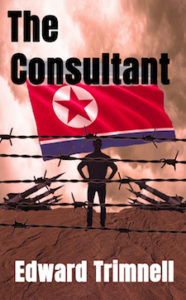
I’ve enrolled The Consultant in Kindle Unlimited for 90 days… so those of you who are members can read it for free.
Paperback also available. Audiobook version coming soon!
The most oppressive regime on earth has taken you prisoner. And they have a mission for you!
Barry Lawson is an American marketing consultant traveling on business to Osaka, Japan. After striking up a conversation with a woman in a bar, he agrees to accompany her back to her apartment.
But the mystery woman is not who she seems. Days later, Barry wakes up in a cell in North Korea.
He discovers that the North Korean government has abducted him for a specific purpose. The North Koreans don’t plan to ransom him. They want him to work for them.
But Barry is determined to escape—whatever the cost.
His allies are a Japanese abductee, and a beautiful American woman who understands the North Koreans, and speaks their language.
With a U.S.-North Korean summit fast approaching, a coup plot shakes the very foundation of the Pyongyang regime. Barry chooses this moment to make a desperate dash for freedom. But he and his fellow escapees risk death at every turn.
The Consultant is a thriller ripped from real-life headlines, with unforgettable characters and nonstop action!
Sometimes old novels need to be be updated in various ways. I recently rereleased Blood Flats with a new cover. I also corrected a few typos that had made it through when the novel was originally published in 2011.
This was my first novel, but I think it’s a pretty good one, nonetheless. (I reread the entire book in September, and I was frankly surprised at how much I enjoyed the story, huge chunks of which I had forgotten over the past decade.)
Blood Flats is the story of Lee McCabe, a former marine who returns to the fictional Hawkins County, Kentucky after serving in Operation Iraqi Freedom. Lee is framed for a drug-related double homicide that he did not commit. He goes on the run, pursued by local meth dealers, mafia men from Chicago, and law enforcement officers with a variety of motives.
I wrote most of this book in 2010, and the events would have occurred in 2009. You’ll therefore notice some differences in the way that cell phones work, for example. Other than that, though, this is a modern story set in the modern world.
Which brings me to the influences for Blood Flats. There were two novels that strongly influenced this book: Cormac McCarthy’s No Country for Old Men, and Larry McMurtry’s Lonesome Dove.
No Country for Old Men might best be described as a period noir crime novel, set in 1980. Lonesome Dove is a long western epic, set in the 1870s.
While writing Blood Flats, I had in mind the bleakness of the McCarthy’s book, and the long, epic journey of Lonesome Dove. The plot of Blood Flats isn’t similar to either of the books that influenced it; but I like to think that some of the moods and themes are similar.
This is my way of saying: If you like No Country for Old Men and Lonesome Dove, you’ll probably like Blood Flats.
Blood Flats is a long book. It isn’t quite as long as Lonesome Dove (about 900 pages). Blood Flats, though comes in at 180,000 words. This makes it about twice as long as the standard 90K-word commercial novel.
Two couples—one idealistic, one criminal. A ruthless Mexican drug kingpin. A fortune in heroin and cash. They all come together one night at a casino called Venetian Springs, in a high-stakes gamble that only a few of them will survive.
Preview Chapters:
Part I: Tuesday
Chapter 1
Mark Baxter was determined that he and his wife, Gina, were going to crack the nut of their household budget.
Laid out on the kitchen table before them were a pile of bills, a desktop calculator, and a yellow legal pad.
Mark had drawn a line down the center of the top sheet of the legal pad, dividing it into two vertical columns. In the lefthand column, he had tallied up their monthly take-home pay. They were both second-year teachers at Ambrose E. Burnside High School, a school in the Indianapolis Public Schools district.
In the righthand column he had listed their expenses: mortgage payments on the house, their college loans, groceries, utilities, and everything else.
The total on the left was only slightly larger than the total on the right.
That was a problem.
Gina, moreover, wasn’t paying attention. That was another problem. Her brown eyes kept darting to the open doorway between the kitchen and the rear hallway. She was twirling a length of chestnut brown hair between two fingers.
Gina had been distracted of late—and not just because of their perilous household finances. Mark knew part of the reason for her distraction; but he suspected that there was also something that she was keeping from him.
Why would Gina be looking toward the rear hallway?
The rear hallway of the house terminated at the back door. Gina was probably thinking about the intruder again.
Mark didn’t believe in the intruder, and Gina did.
That was yet another problem.
In recent weeks, Gina had become convinced that someone was entering their house during the daytime hours, when they were both teaching classes at the high school.
She claimed to notice that some items in the house were slightly awry, as if an outsider had been rifling through them. Closet and cupboard doors were left ajar at unfamiliar angles.
Or so Gina had claimed.
Mark had taken his wife’s concerns seriously—at first. He checked all exterior doors and windows for any sign of a break-in or tampering.
And he had found nothing.
Mark also pointed out that the supposed burglar had not taken any of their few possessions that were actually worth stealing: the laptop they used jointly, the antique brooch that Gina had inherited from her Grandma Tortelli, etc.
Even the cigar box, the most obvious target for a thief, had been left intact. This was the old Dutch Masters box that they kept atop the dresser in their bedroom. It always contained between fifty and a hundred dollars of emergency cash.
Any self-respecting thief would have taken the cigar box, Mark observed.
But the thief had not taken the cigar box, nor anything else—so far as either of them could ascertain.
Mark therefore concluded that there was no thief, no intruder.
“Earth to Gina,” Mark said. He waved his hand from side to side in the air, as if trying to rouse her from a trance.
“I heard something,” Gina said. “At the back door.”
“Oh, no. Don’t tell me that one of the problem students at Burnside has followed us home again.”
She didn’t laugh at the obvious joke. She flinched, in fact.
Mark wondered: Was one of the students at the high school in fact bothering her? Was that her problem?
“I’m telling you, Mark, I heard something back there.”
The damn intruder again. Mark rarely spoke a cross word to Gina, but he was getting fed up with talk about the nonexistent burglar. Whatever else was going on, there was no evidence that anyone had been inside their house.
“Gina,” he said gently, “I don’t think—”
And then Mark heard it, too.
Chapter 2
It was the sound of someone rattling the back door. Exactly what Gina had said, more or less.
Mark stood up. Gina started to stand, too.
“Where are you going?” they both asked, more or less simultaneously.
“I’m going to check the back door, of course,” Mark said.
“I’m going with you!”
Mark had a sudden mental image: an intruder—a real one, this time—pointing the muzzle of a gun in his wife’s face.
He didn’t want to go there.
“No. You stay here. I’ll take care of this.”
He exited the kitchen and entered the back hallway before Gina could offer further protest.
Speaking of guns, Mark didn’t own any.
Not that he had any principled objection to them. Indiana, after all, was a Second Amendment state.
Mark had grown up in Merrillville, in the northwest corner of the Hoosier State. Merrillville was within the orbit of the progressive-minded, gun-controlling megalopolis of Chicago. But both Mark’s father and his grandfather had been outdoor sportsmen. By the time he was twelve years old, Mark had been comfortable handling firearms.
Mark and Gina had purchased their first home in an inner-city neighborhood. Though most of their neighbors were decent, working-class people, the neighborhood was far from perfect. There were predatory elements. It wasn’t uncommon to hear sirens on a Friday night. Just a few weeks ago, the Indianapolis police had broken up a drug den not three blocks away.
Once or twice Mark had toyed with the idea of buying a gun. It would have been easy. No state official in Indiana would deny a gun permit to a school teacher with a spotless record.
In the end, though, he had judged a gun to be an unnecessary expenditure, given their financial state. Moreover, he’d never really believed that he needed one.
Until now.
The back hallway was flooded with the sunlight of a late March afternoon. The back door was a plain wooden door with a four-pane window.
Mark could see no man-size shadow lurking in the window, but who knew what might be outside?
He strode forward and grabbed the knob, twisted it, and pulled the door open.
As he stepped out into the cool sunshine, he tensed his muscles for a fight. He stood on the back stoop, and looked to his right and then to his left.
No one there.
The spring-loaded back door slammed shut behind him. From a few blocks away, he heard the air brakes of a school bus.
They had a small back yard, and there were not many places to hide. There were two maple trees, but their trunks were not thick enough to conceal an adult. There was a large bush that had only begun to bud. Mark could look right through it.
No one there.
At the very back of the yard, there was a high wooden fence. It belonged to the property behind them.
Could someone have rattled their back door, and then run across the yard and climbed over the fence?
Only if the prowler happened to be a very fit U.S. Navy SEAL, Mark figured. And even a SEAL would be challenged by that fence.
He had undoubtedly heard something. Both of them had. But the evidence was right here—or rather, it wasn’t here. Mark had no choice but to conclude that there was no one in their back yard.
After giving the yard a final look (there was not much to look at), Mark turned and opened the back door, to go back inside.
And he saw Gina, standing there with a butcher’s knife.
Gina was holding the knife aloft, as if preparing to meet an attacker.
“What are you doing?” Mark asked, indicating the knife. He stepped inside the house, exercising care to stay away from the tip of the blade. He recognized the knife from one of the drawers in their kitchen.
“I wanted you to have backup.”
Mark involuntarily smiled. His wife was no milquetoast.
“What did you find?” she asked.
“Nothing.”
“Really?”
“Really,” he said. “I checked. There’s no one back there.”
“But we both heard a sound at the back door.”
“We did,” Mark allowed. He had been thinking about that. “Sounds carry inside the city. All these houses. The echoes bounce around. While I was out there, I heard a school bus jam on the brakes a few streets over. It sounded like it was right on top of me.”
“But there was no one out there?”
“No. Say, could you put that knife down?”
She relaxed, and lowered the knife.
Mark wasn’t completely satisfied with his own explanation, about the sounds carrying. But it was time to put this talk about prowlers aside. They needed to get back to those two columns of numbers on the legal pad.
“Anyway,” he said, “let’s resume our discussion of the budget.”
“What about—”
Then the doorbell rang. At the front of the house.
“I’ll get it,” Gina said.
“And you’ll scare the hell out of the Girl Scouts—or whoever it is—with that knife. I’ll get the door. Wait for me in the kitchen, okay?”
With visible reluctance, she relented.
“Be sure to look through the peephole before you open the door,” she called after him.
Chapter 3
Mark didn’t use the peephole, though—even though he figured that Gina was probably right.
It was a sunny Tuesday afternoon. Children were still arriving home from school for the day.
If we have to be afraid under those circumstances, Mark thought, then what’s the point of having a house?
He pulled the front door open. The person on the front porch wasn’t exactly threatening, but he was nothing Mark would have expected, either.
He was about the same age as Mark and Gina—probably in his mid- to late twenties. He had a mop of reddish blond hair, and a scraggly beard of the same color.
He wore a rumbled blue blazer over his lanky frame. Mark saw threads dangling from the cuffs.
His trousers—a shade of blue that didn’t match the blazer—were too long.
Mark glanced down at the man’s feet: He was wearing mud-stained tennis shoes that had once been white.
“How can I help you?” Mark asked.
The stranger flashed Mark a smile, revealing several gaps where there should have been teeth. Mark was immediately reminded of documentaries he had seen about drug addicts, how narcotics destroyed their teeth.
“No,” the stranger said. “The question is: How can I help you? Joe Johnson’s the name, and credit counseling’s my game!”
Mark was on edge now.
Only a few minutes ago, he and Gina had been discussing their household budget. Then the sounds at the back door.
And then this guy shows up, claiming to be a credit counselor.
But nothing about him added up. Mark might be a high school history teacher, but he had had his share of interaction with professionals in the finance industry: banking officers, loan agents, and the like.
None of them were anything like this Joe Johnson.
Then there was the fact that Joe Johnson sounded suspiciously like a made-up name.
“Were you at my back door just now?” Mark asked, getting right to the point.
“Me?” Joe Johnson said, pointing a finger at his sparrow chest.
“You’re the only one on my porch right now.”
“Absolutely not,” Joe Johnson said, shaking his head.
Mark didn’t entirely believe him. But there was no way to prove the matter, one way or the other.
“Okay,” Mark said—though it wasn’t okay. “What can I do for you?”
“I’m a personal credit counselor!” the odd-looking man said.
Mark listened to about a minute of the spiel. None of it made sense, really.
A personal credit counselor? Seriously? This guy?
Whoever this Joe Johnson really was, whatever his game was, there was no way Mark was going to let him within a stone’s throw of his and Gina’s finances.
“I’m sorry,” Mark said, interrupting him, “but I’m really not interested.”
Mark had expected that that would be the end of the matter. Like Gina—he was no milquetoast. In high school, about a decade earlier, Mark had played both football and baseball. He’d been in his share of fisticuffs. Few men tried to bully him.
And he could have knocked this Joe Johnson off the porch without even trying, had he been so inclined.
But Joe Johnson, for his part, wasn’t quite ready to call it a day.
“If I could just come inside,” he said, “and talk to you and the missus.”
Now Mark’s hackles went up again—just when he had been ready to dismiss Joe Johnson as a harmless flake.
“I didn’t say anything about a wife,” Mark said. “And no, you can’t come inside.” Mark’s tone wasn’t exactly hostile, but he was done playing nice.
Joe Johnson seemed flustered again. “A guy living in a house like this,” he stammered, “in this neighborhood…I figured you’d be married.”
Mark considered that. Possible. But he was done with this discussion, nevertheless.
“Thanks anyway. But I’m not interested.”
“Could I at least get you to take a card?”
Mark didn’t want a business card from this man. But Joe Johnson was already reaching into the front pocket of his rumpled blazer.
Anything to get rid of him at this point, Mark thought.
“Okay. I’ll take one of your cards.”
Mark reached out and took the proffered business card.
Then Joe Johnson spun on his heels, and walked away.
Mark watched him depart. He couldn’t help it. There was so much about the man in the shabby blue blazer and soiled tennis shoes that didn’t add up.
Joe Johnson made quick steps up their walkway to the main sidewalk, where he made a sharp right turn.
Then he kept walking. He didn’t turn at the house next-door, nor the house after that, either.
Yet another thing that didn’t add up. If Joe Johnson was working door-to-door, then he would have stopped at at least one of those other houses.
But Joe Johnson wasn’t doing that.
He just kept walking. His pace seemed to accelerate the farther away he got, in fact.
So the door-to-door man wasn’t an actual door-to-door man. Joe Johnson—or whoever he was—had come into the neighborhood for one purpose: to call on Mark and Gina Baxter.
Most unusual.
Mark looked down at the business card in his hand. It was printed on plain white card stock:
Joe Johnson
Credit Counselor
There was a telephone number, which—Mark would have been willing to bet—connected to an over-the-counter burner phone. Also a Yahoo email address.
No company name. No website. No logo.
It simply didn’t add up. None of it.
When Mark walked back into the kitchen, he found Gina sitting at the table. She was looking at the legal pad, the numbers that governed their lives and future.
“Who was that?” Gina asked.
“No one.”
She made a face. “Come on. It was someone.”
Mark crumpled up the business card and tossed it into the trash container beside the refrigerator.
“Just a salesman,” he said. “I got rid of him. Anyway, let’s get back to the budget.”
Chapter 4
One hundred and eighty miles north of Indianapolis, in an alley on the South Side of Chicago, Vic Torino knelt over the body of Alina Wells.
The young woman had been dead for about eight hours, based on the information that law enforcement had so far.
Beside Vic was Sgt. Dennis Haskel, of the Chicago Police Department. Haskel was also kneeling over the body.
The alley was blocked off by two squad cars of the CPD, and two uniformed officers.
“I knew she was your CI,” Sgt. Haskel said, “which is why I called you.”
Vic nodded without replying. Alina Wells had indeed been working for Vic as a CI, or confidential informant. She had been helping him gain an inside hold on Tony Mendoza’s criminal organization. But that was all over now.
Vic had seen many corpses; but when you had known the person, it was different. Alina Wells’s body was clad in a pair of faded, ratty jeans, and a shirt with red and white horizontal stripes. Both of her feet were bare. Her clothes were soaked by the previous night’s heavy rain.
Vic couldn’t help wondering about Alina’s final moments…And to think that she had been talking about turning her life around, the last time Vic had met with her.
Alina’s face, preternaturally pale with death, was framed by the helmet of her blonde hair, also rain-soaked. Alina Wells had been twenty-four years old, though her heroin habit had made her look considerably older…even while she was still alive.
Vic drew one palm over the top of his bare head, wiping away a sheen of cold rain droplets. The previous night, a Canadian front had descended on Chicago from Lake Michigan, bringing in the chilling rain and near freezing temperatures.
So much for springtime, Vic thought. The rain was only now tapering off to a spittle. Vic was an Arizona native, and he often swore that he would never get used to the weather in Chicago.
“Thanks,” Vic finally said to Sgt. Haskel, “for the phone call.”
Vic Torino was a twenty-year veteran agent of the U.S. Drug Enforcement Administration. People often said that Vic was built like a fireplug. He had a swarthy complexion, an immaculately shaved head, and a thick black mustache.
Vic looked down into Alina’s lifeless face. He wasn’t responsible for her death—not directly, at least—but her involvement with him might have been a contributing factor.
“She probably OD’d,” Haskel speculated, without much emotion. Haskel, like Vic, was a longtime veteran of law enforcement. He had seen his share of bodies in alleyways, no doubt.
“She probably did OD,” Vic agreed. “But I think she had some help.”
Sgt. Haskel shrugged. “We’ll see what the coroner says.”
Vic stood up. There was nothing more he could do for Alina now (as if he had ever really done anything for her, he thought). Alina would leave the alley in a van of the Cook County Medical Examiner. There would be no ambulance, of course.
He thanked Sgt. Haskel again, and made his way out of the alley. The CPD would handle the crime scene from here.
Vic had to contact his other confidential informant—Rosita Cruz. She was the only one he had left now.
Before he departed, he took one last look at Alina Wells’s lifeless body, and silently swore revenge on Tony Mendoza.
Chapter 5
On his way back to his office, Vic sent a text message to Rosita Cruz. He told her only that he had an urgent need to see her.
He sent the message using a texting app, which would not be traceable to his DEA phone. Rosita was involved in various illicit acts of commerce to support her habit, just as Alina Wells had been. It would not be unusual for her to get such a message from an unidentified, apparently male, contact.
Vic’s office was located on the tenth floor of the Kluczynski Federal Building in the downtown Chicago Loop. He shared an office space with two dozen other DEA agents. There was nothing to complain about here, though; his desk afforded him a view of Lake Michigan.
When he reached his desk, Vic was still reeling from the news about Alina Wells, the sight of her body in the alleyway.
He couldn’t yet prove it, but he knew that Tony Mendoza was behind her death. This was not the first time that a confidential informant associated with Tony Mendoza had conveniently died.
Vic had been tracking the Los Angeles-based drug kingpin for the past year. Tony Mendoza and his organization controlled a sizable portion of the heroin that found its way to Chicago, and from there to more than a dozen other cities in the Midwest, including Indianapolis, Detroit, and Cincinnati.
Mendoza had ties to the Sinaloa Cartel, one of the brutal syndicates that controlled the narcotics trade in Mexico. But the domestic drug market within Mexico wasn’t worth that much. El Norte was where the real action was. The Mexican cartels all existed to serve the U.S. market, which was many times wealthier, and many times hungrier for illicit drugs.
And so it was with Tony Mendoza. He divided his time between California and various points in Mexico. He had an alibi for all those trips, of course: His parents had both been born in Mexico, and he had many ties south of the border.
DEA agents in Los Angeles, in coordination with officers of the LAPD, had acquired warrants, and carried out at least two searches of Mendoza’s Bel Air residence in recent years. They had found nothing. Tony Mendoza was smart enough to isolate himself from the actual merchandise and violence of the drug trade.
Likewise, the Chicago branch of the DEA and the Chicago PD had busted plenty of street-level dealers who ultimately got their heroin from Tony Mendoza. But none of these arrests had served to build a case against the California drug baron. None of the street-level dealers had even been in the same room as Tony Mendoza. Their heroin supplies came through a complex network of middlemen.
Vic needed to land someone high enough in the organization to have a direct, provable connection to Tony Mendoza.
He had thought that Alina might get him closer to such a person. But now Alina was dead, and he was back to square one.
Vic’s desk phone buzzed. He picked it up.
“Vic. Ah, I see you’re back in the office.”
Ralph Morris—his new boss. Morris had been transferred to Chicago from Washington only two months ago. He and Vic were already locking horns—over a variety of things, but especially Tony Mendoza.
“What can I do for you, Ralph?”
“Could you come into my office, Vic?”
“I’ll be right in,” Vic said, terminating the call.
He stood up from his desk. It was shaping up to be a very bad day, indeed.
Chapter 6
Ralph began by grilling Vic about Alina Wells. He, too, had heard about her death from sources in the Chicago P.D.
“I understand exactly what you’re trying to do,” Ralph said. “You’re trying to get the big score. There’s a lot more glory to be had in taking down a continental drug baron than there is in taking down dozens of smalltime dealers. I get it. But sometimes our work involves dismantling networks piece by painstaking piece. You need to learn that.”
“What are you saying, Ralph?”
But he already knew what Ralph was saying—or at least he had a very good idea.
“I’m saying that you screwed the pooch, Vic. That’s what I’m saying.”
Ralph waited a few beats for Vic to react. When Vic remained silent, he went on.
“No, Tony Mendoza didn’t personally murder your CI. Someone at the street level in his organization did. Obviously. And had you taken down that person weeks ago, Alina Wells might still be alive. Also, as an added bonus, there’d be one less drug dealer on the streets of Chicago.”
Vic felt his frustration rising, but he held it in check. They’d had this conversation before. Nevertheless, he did feel compelled to present his side of the argument—again.
“If I—if we—take out Tony Mendoza, then we take away a double-digit percentage of the heroin supply for the Midwest. That could be a pretty big thing.”
“For a while,” Ralph countered. “The Sinaloa Cartel is a very resourceful outfit. They’ll find another Tony Mendoza in a matter of weeks, if not days.”
Vic had no ready answer for that. Moments like this forced Vic to wonder if he wasn’t giving in to his own vanities.
His pursuit of Tony Mendoza had become personal. A certain degree of that was inevitable in law enforcement, but if you took that impulse too far, it could cloud your judgement.
“I want you to refocus,” Ralph said. “Concentrate on wrapping up the local dealers. Let the LA office focus on Tony Mendoza. If we bust him anywhere, we’re going to get him in LA. That’s where he spends most of his time, after all.”
“I’m working with another CI,” Vic said. “She’s going to get me an inside contact in Tony Mendoza’s organization. At the upper levels. Then we can take the whole network down.”
Ralph was obviously not impressed. After all, Vic had made this promise before.
“You have another week,” he said. “Then you shift your strategy: to reeling in the Chicagoland dealers.”
Chapter 7
Three hundred miles southeast of Chicago, and one hundred miles southeast of Indianapolis, fifty year-old Jim Garrett sat behind the wheel of his maroon 1981 Monte Carlo.
The car was parked in the rear parking lot of a truck stop on I-75, just south of Cincinnati, right over the Ohio River and the Kentucky border.
It was a chilly day in Cincinnati with sleet. The sleet clouded the windshield of the Monte Carlo, but Jim sat there with the engine turned off. Sometimes the engine light came on when the car idled for too long.
On the seat beside Jim was a Glock 19 semiautomatic pistol.
Jim Garrett was unusually fit for a man of fifty. While in prison he had acquired the habit of lifting weights. There was little to do in prison but pump iron.
Jim was tall and lean. He had long, salt-and-pepper hair, and a thick horseshoe mustache. He also had a natural tan. His mother—long dead—had often told him that there was some Cherokee in the family tree, but Jim was suspicious of this claim.
Jim gripped the steering wheel of the Monte Carlo anxiously. He looked at the tattoos on his fingers, also acquired in prison.
He was always a little anxious when he was about to buy heroin. He and his supplier took precautions. More than once, though, Jim had learned the hard way that the law is often one step ahead of you.
He didn’t want to go back to prison again. He would use the Glock 19 before he would let any officer of the law put handcuffs on him.
He was sure of that.
But that was hypothetical—at least for now. What was real at the moment was that Jim Garrett was a heroin dealer, and he wasn’t making much money at it.
Jim Garrett sometimes reflected that he was living proof of the old adage, crime doesn’t pay. In his youth he had believed—for no good reason—that it was his destiny to be the lead man in a heavy metal band. He had even tried this out, going for a few auditions, but they laughed him away when they found out that he couldn’t play any instruments, and he couldn’t really sing, either.
Then, almost at random, he had turned to a life of crime. Small-time stuff at first, none of it ever going anywhere. He was arrested a few times, but nothing ever stuck.
Six years ago they had busted him on a burglary charge. That stuck. He spent almost three years in Ohio’s Lebanon Correctional Institution.
For the past two years Jim had been out of prison. He was trying his hand at something new—dealing heroin.
For years he had been hearing about how much money there was in narcotics. So he had decided to jump in and get his share. He had been disappointed almost from the very start.
There were people making money in the drug trade, surely, but not this far down the supply chain. By the time the heroin reached Jim, various middlemen along the way had already taken their cuts, jacking up the price to the point where the margin was extremely small.
Jim had read somewhere that the average street-level dealer is a twenty-one year-old man who lives with his mother. Jim was more than twice that age. His mother was long gone, but he was barely getting by.
A hell of a place for a man to find himself at midlife.
He thought about the man he was about to meet: Toby Gates. Toby was a young guy, a low man on the totem pole of the network headed by Tony Mendoza. Toby Gates was nothing, really. But Toby used his association with the LA gangster as an excuse to lord it over Jim at every opportunity.
Jim bristled at the thought of treating with Toby again.
As if summoned by Jim’s thoughts, Toby’s car—a blue Honda—appeared on the access road that ran beside the interstate.
Let’s just get this over with, Jim thought.
He looked at the Glock on the seat beside him. He could leave it in the car. It wasn’t necessary. Toby was annoying, but he had never been aggressive.
Then he thought again: You didn’t go unarmed to a meeting with a member of Tony Mendoza’s organization—even a low-level putz like Toby Gates.
Jim picked the gun off the seat, tucked it inside his jacket, and stepped out of the Monte Carlo.
Chapter 8
Toby leaned back against the side of his car as Jim approached. He wasn’t going to give an inch, wasn’t going to meet Jim halfway. That was his manner.
The little putz, Jim thought.
Toby Gates was short and on the pudgy side. His flaxen hair was almost white, like an albino. Jim often thought that Toby would literally fry if exposed to direct sunlight, like a chubby vampire.
When Jim got close, Toby delivered one of his favorite jabs.
“Hey, old man. Movin’ a little slow this morning, aren’t you?”
“Toby, I’ve got twenty-five years on you, and I could still outrun you, out-lift you, and kick your ass. So why don’t you just keep your comments to yourself today, huh?
“Whoa,” Toby said. “Looks like someone didn’t get their bran flakes and Geritol this morning.”
“Just keep pushing it, Toby.”
Jim took a quick look around and over his shoulder to make sure no one was watching them. The front parking lot of the truck stop was behind them. There were plenty of big commercial rigs, but also smaller vehicles whose drivers stopped at the truck stop for fuel, drinks, and snacks. There was both a Subway and a McDonalds attached to the truck stop.
But none of these transient people was likely to pay attention to two men meeting briefly in the back parking lot. That was the advantage of this location.
The interstate ran beside the truck stop, but it lay atop a steep slope, and set back from the crest of the incline. A trucker in one of the big rigs might be able to see them. None of the drivers in pickup trucks or passenger cars would see them without some real neck contortions. And all those vehicles were whizzing by at around 70 m.p.h.
Jim had the money for the heroin all counted out in advance, and tucked inside an envelope that was folded in half once.
The usual procedure was for him to palm the envelope and make as if shaking hands with Toby. Toby would take the envelope and pocket it. Then Toby would hand him a small package containing ten grams of heroin.
Still leaning against his car, Toby held out his hand to shake. He took the envelope. But instead of pocketing the money and handing over the heroin, he held the envelope in his palm and said:
“How much money is that?”
Jim restrained a sudden, almost irrepressible urge to grab Toby by the collar of his windbreaker and slam him against the Honda. What was he trying to pull? Did he want them to get caught?
“What do you mean: ‘How much money is that?’ You know damned well how much money it is. The same as always: enough for ten grams. Come on. The weather sucks today, with this sleet, and I want to get going.”
“Ah,” Toby said, “‘enough for ten grams’. you must be unaware of the new policy.”
“New policy? What the hell are you talking about?”
“The new policy is: There’s a new minimum: twenty grams.”
“Twenty grams?”
“That’s right, old-timer. You want wholesale prices, you buy wholesale quantities.”
Jim was so flustered at the moment that he overlooked Toby’s use of the appellation, “old-timer”.
“And when did this go down?”
Toby shrugged. “I don’t know, exactly. But I know it’s the new policy.”
“Does Ice know about this?”
“Of course Ice knows about it,” Toby said.
Ice was Toby’s immediate superior. Although the whole network was ultimately headed by Tony Mendoza, there were various hierarchical layers in-between, even at the local level.
“Ice knows about this,” Jim repeated. “That’s what you’re saying?”
“That’s what I said. And the policy applies to everyone. Across the board.”
Jim was highly doubtful of that. Toby loved nothing better than yanking Jim’s chain, and it wouldn’t be beyond him to make up a fish story in order to do so.
If he had known in advance, he could have purchased twenty grams today. It wasn’t that big of a deal, really.
But he didn’t have enough money on him to purchase twenty grams. He would have to go home, and get into his cash reserves.
Toby wouldn’t wait for him, of course. So he would be without supply, until this little flaxen-haired putz deigned to meet with him again.
And he was almost certain that Toby was lying. He had caught Toby in lies in the past.
Then Jim felt his temper snap, like a tiger being let out of a cage.
No, he thought, that isn’t going to happen. I’m sick of being jerked around. If Tony Mendoza were here, jerking me around, maybe I would take that. Maybe I’d have no choice. But I’m not going to take it from Toby Gates.
“No, Toby. I have another idea: I say you’re going to sell me ten grams. Today. Right now. If the new minimum is twenty grams, then we can do it that way next time. But today you’re going to sell me the usual amount. It isn’t fair to change the minimum amount without telling me in advance. That’s bullshit, in fact.”
Jim stepped closer, towering over the younger man. He raised both hands slightly, as if readying himself to give Toby a shove.
Suddenly, Toby’s face turned bright red. Toby was seized by what was obviously a fit of great consternation.
He had really gotten under the little putz’s skin, apparently.
In fact, Toby was downright speechless. He started to speak, but he was unable.
Enough of this, Jim thought. This shouldn’t be so complicated.
“Just give me the ten grams, Toby, and take my money. Then you can go home and play video games, or beat off to Internet porn all day, or whatever it is you do.”
But Toby’s face turned yet another, deeper shade of red. He sputtered out something that Jim couldn’t understand.
Toby let the envelope filled with Jim’s money fall to the ground.
What happened next happened very quickly. Jim would later reflect that it happened too fast for him to even begin to think about the consequences at the time.
Toby reached inside his coat. In the context of a heated argument over a heroin deal, that could only mean one thing.
Toby was about to draw a weapon on him.
Jim had never been in an honest-to-goodness gunfight. During his time at Lebanon, however, he had talked to several men who had had that experience, and who had lived to tell about it.
They all said the same thing: When guns are drawn with an intent to shoot, the man who acts decisively is the man who walks away. The man who hesitates is the man who doesn’t walk away.
Toby’s hand was still inside his coat when Jim pulled out the Glock 19.
Toby saw the gun, and his eyes went wide. His face still bright red, he sputtered out something, which Jim still couldn’t understand.
Evan Daley would later reflect that he should have known better than to enter the Maze. After all, his coworker and sort-of mentor, Hugh Jackson, had tried to tell him about the Maze, and Hugh had tried to tell him that the Maze was probably dangerous.
But how do you take seriously a warning issued in a McDonald’s on a bright, warm, September morning?
Besides, before Evan saw the Maze, he would have sworn that he dreaded nothing so much as Amanda Kearns, his boss.
Evan and Hugh occupied a table in one corner of the McDonald’s dining room. The McDonald’s was located just off I-71—the interstate that would take them to this morning’s sales presentation. The restaurant was filled to near capacity this late in the morning—mostly with truck drivers and other business travelers.
Evan was digging into his Big Breakfast with Hotcakes. He felt a little guilty, eating this artery-clogger in front of Hugh. Hugh was contenting himself with a low-fat, sensible bowl of Fruit and Maple Oatmeal.
As Evan forked a mouthful of pancake, he noticed Hugh staring down jealously at his syrup-smeared Styrofoam plate.
“Sorry,” Evan said. “I’m eating a mountain of delicious fat and cholesterol here, and you’ve got to eat that bowlful of grain and berries—or whatever that stuff is.”
Hugh Jackson had a hereditary heart condition. Evan didn’t know the details, but Hugh had told him that his father had died while still in his mid-fifties. Hugh was already close to that territory himself. He therefore had to count his daily fat and cholesterol intake in milligrams.
The older man smiled back at Evan, though. “Just because I’ve got a bum ticker, it doesn’t mean that you have to suffer along with me,”
Amanda’s coffee sat steaming in front of her empty chair. Amanda was out in the children’s playground area, talking intensely into her cell phone, her outrage visible. Evan could see her from where he sat: Her long, slender body was leant against a plastic blue slide. The slide was topped with a dome fashioned to resemble a McDonald’s hamburger.
Evan discretely gestured toward Amanda. “She talking to Oscar, you think?”
Hugh nodded ominously. “It would appear so.”
Amanda had sat down with them initially. Within a few minutes, though, her cell phone had rung. After a clipped, moody hello into the phone, she had immediately stood and headed outside, where she could talk privately.
They both knew that Oscar was Amanda’s boyfriend. They also knew that the relationship had been less than harmonious of late.
Oscar was a big shot in one of the investment banks headquartered in Cincinnati. Oscar had accompanied Amanda to the Merlesoft holiday party last December, showing up overdressed in a Brooks Brothers three-piece suit.
Evan had talked to Oscar for all of five painful minutes. The investment banker made a few snide, clipped remarks about Evan’s choice of college major—English literature. Apparently Oscar—a finance wizard with an MBA from Wharton—didn’t think much of folks who elected to spend their undergraduate years dissecting The Canterbury Tales and the collected short fiction of Ernest Hemingway.
I can’t blame him, Evan thought, recalling his brief and mostly humiliating exchange with Oscar at the holiday party. I should have majored in something more practical. What the hell am I doing with my life—an English literature major working in software sales?
It was a question that he had asked himself many times over the past twenty-odd months, since he had started work at Merlesoft. This was his first “real” job—that is, his first post-college job. The corporate politics at Merlesoft were baffling and unrelenting. Evan, furthermore, struggled to pass himself off as a software guru during customer presentations.
And finally, there was Amanda, who seemed intent on riding his ass all the time.
Amanda. Damn Amanda, he thought.
And damn Oscar for doing what he was doing right now—whatever was causing his relationship with Amanda to go south. When Amanda fought with Oscar, she became even more critical of Evan.
“Anyway,” Hugh said, changing the subject away from breakfast. “I want to warn you about something. In fact, I really need to warn you about something.”
***
Evan could tell immediately that the older man intended to broach some topic of considerable magnitude. Probably something related to this morning’s sales presentation.
Today’s clients—the attorneys of the law firm Rich, Litchfield, and Baker, were a stodgy, hard-to-please lot. Hugh had made the preliminary sales call by himself and had reported as much.
The accounting software packages that Merlesoft sold were expensive, and required a client company to reconfigure a considerable portion of their internal accounting procedures. The sales process was therefore a multistep one—usually beginning with an exploratory sales call, followed by several quotations, and multiple customer consultations over the phone.
They had been going through this back-and-forth with Rich, Litchfield, and Baker for the better part of four months. Evan had yet to visit the clients’ office; but he had talked to several of the law firm people over the phone.
Today would be the final dog-and-pony show, which would hopefully result in a purchase order from the law firm. Amanda, Hugh, and Evan would make a PowerPoint presentation and answer any remaining customer questions. This was the whole purpose of making the two-hour drive from Cincinnati to Columbus today. It was “do or die” now, in the typically hyperbolic language of corporate culture.
As Evan contemplated this morning’s meeting—barely an hour in the future—he felt more like dying than doing. Amanda had given him a “challenge”, announcing that he would be making the sales presentation solo.
Evan knew from experience what this actually meant: Amanda would vigilantly wait for him to make the slightest mistake or omission. Then she would pounce and interject during the middle of his presentation, throwing him off his rhythm and undercutting his credibility in front of the customers.
“You don’t have to warn me,” Evan said, anticipating the nature of Hugh’s advice. “I know that Amanda is going to be watching me like a hawk today, waiting for me to make the slightest flub-up, or to forget the smallest detail. That’s why I’ve crammed for today’s presentation. I stayed up till midnight last night going over everything. First I reviewed the four quotations we’ve submitted up to this point. Then I went over the procedures that Rich, Litchfield, and Baker use in their accounting process at present.
“And I didn’t stop there, let me tell you. I also made a list of questions that I could reasonably anticipate them asking today; and I think that I’ve got every one of them nailed. You ought to see the notes I prepared, Hugh: They fill a good ten pages on a legal pad.”
Evan finished off the last of his breakfast, wadded up his napkin, and dropped it onto the Styrofoam plate. He smoothed his tie to make sure that it contained neither syrup, egg fragments, nor sausage crumbs. Noting also that the sleeves of his white dress shirt were free of stains or debris, he nodded at Hugh with a cautious air of self-contentment.
“You can feel free to offer me any last words before the wedding, though, buddy. Or you can hit me with any questions that you think I might have missed. But I believe that I’ve got them all down.”
Hugh leaned forward. “That’s not what I want to talk to you about, Evan. It’s something else.”
***
“What, then?” Evan was suddenly alarmed by Hugh’s expression. The older man sometimes let him know when a shake-up was imminent at Merlesoft: a firing, a promotion, a resignation, or a reorganization.
Evan had also discovered that most of these changes ended up being disagreeable in one way or another. This was yet another rule that he had learned during his slightly less than two years of corporate life: The devil you know is always less objectionable than the devil you don’t know.
Or, to put it another way: Change is usually bad.
“Don’t tell me you’re transferring to another department, Hugh,” he said. “Or—wait a minute—you aren’t leaving the company, are you?”
Hugh shook his head. “No, no. Nothing like that.”
“Well, what then?”
Hugh dropped his plastic spoon into the little plastic container in which his Fruit and Maple Oatmeal had been packaged. “This is going to sound a little strange to you, but I’m going to tell you, anyway.”
“Hugh, I’ve learned to accept things that are strange—especially since Amanda entered my life.”
Evan allowed himself another quick glance at Amanda: She was still outside, still talking to Oscar. By the look of her facial expression, the phone call definitely wasn’t going well; and that would only mean a more difficult morning for him. Amanda would have to wrap up the call pretty soon, though, troubles with Oscar notwithstanding. Otherwise, they would arrive late for their nine o’clock appointment at the lawyers’ office.
“I know you haven’t been to the Rich, Litchfield, and Baker office yet,” Hugh continued. “It’s located inside this place called Lakeview Towers—a huge office complex with hundreds of individual offices that are rented out.”
Evan had no idea of what Hugh might be getting at with this line of explanation. He didn’t want to be rude, though.
“No, Hugh, I haven’t been there,” he acknowledged. “But I’ve given presentations at unfamiliar locations before. It shouldn’t be a problem. I’m green, but I’m not that green.”
“That isn’t what I’m getting at.”
“Well then, exactly what are you getting at?”
Hugh paused and looked around, probably to make sure that Amanda was still outside talking to Oscar.
“Well,” Hugh began, “let’s just say that you ought not allow yourself to get too far off the beaten path at this Lakeview Towers. What I mean is, don’t go wandering around unnecessarily.”
***
Evan had no idea what to make of Hugh’s advice. Did Hugh think that he was some kind of a child?
This sounded like the sort of thing his mother would have said years ago—on the few occasions when his mother actually noticed his existence. She would have told him to stay close while they were out at the shopping mall—not to stray away from her protection.
But why would his colleague say something like that now? He might be the youngster on the team, relatively speaking, but he was still an adult.
“What the heck are you getting at Hugh? Would you care to elaborate?”
Hugh gave him another pause, as if weighing whether or not he should reveal some crucial but sensitive bit of information. Then he was suddenly distracted by something behind Evan’s shoulder, toward the main entrance of the McDonald’s.
“Amanda’s back,” Hugh muttered discreetly, in a barely audible voice.
Amanda’s sudden reappearance meant that the explanation of Hugh’s cryptic advice would have to wait. Amanda took her seat at the table, her bad mood palpable. What was just as obvious, though, was the fact that she was attempting to hide it. The managers at Merlesoft all maintained a constant front of rah-rah-rah enthusiasm. That was part of the corporate culture. Amanda would not allow a breakup with a boyfriend to put a crack in that all-important managerial veneer—not if she could help it.
“Well, guys, are you ready to get going?” she said with a forced camaraderie that none of them felt. She sipped her coffee and stood up again.
Evan permitted himself a discreet glance at her figure. Although she was ten years his senior, and the bane of his existence most days, he had to admit that Amanda Kearns, sales manager at Merlesoft Software Systems, was hot. She was about 5’10”—almost Evan’s height, and she had the long, lanky build of a former athlete.
Evan vaguely recalled her mentioning, in a rare moment of actual human conversation, that she had competed in the hurdles event in high school and college track. She was in good shape for a thirty-five year-old, you had to give her that. (Certainly she was in better shape than Hugh, who was in his forties; but Hugh’s health problems put him in a whole separate category.)
Amanda wore her hair long, her one concession to un-corporate femininity. Most of the female heavy hitters at Merlesoft preferred short hairstyles that bordered on androgynous. But not Amanda. She was all woman.
You want her, Evan, he thought to himself. That’s part of why you despise her so. And you’re angry because she sees you as a subordinate, not as a man.
Evan realized that his feelings toward Amanda were at least a little bit complicated. Truth be told, he was mildly resentful at being bossed around by a woman whom he found attractive. That somehow added insult to injury.
But there was also the fact that Amanda did seem to enjoy riding him—and not in the way that he would have preferred.
Evan and Hugh both nodded, the latter’s mention of the office complex called Lakeview Towers temporarily forgotten—at least by Evan. Whatever Hugh was going to caution him about, it couldn’t have been that important in the big scheme of things. It certainly wasn’t anyone’s priority.
Evan began to steel himself for the professional trial that lay directly ahead of him. Merlesoft’s annual performance review season was only one month away. Whatever he pulled off successfully (or screwed up) today would have a significant impact on the ratings that Amanda would assign him in October.
Evan dreaded his upcoming performance review even more than he dreaded the “do or die” meeting with the important, persnickety clients at Rich, Litchfield, and Baker. A great deal was hanging on this morning’s sales presentation.
***
They headed out to the McDonald’s parking lot and piled into the Merlesoft pool car: a generic Toyota Camry, tolerably comfortable for three people and a two-hour drive on the interstate.
Evan climbed behind the wheel. The junior person on the team did most of the driving. This wasn’t an absolute, formal rule—but the way it always seemed to work on business trips.
That was okay with Evan, though. He enjoyed driving; and the act enabled him to slip into a controlled trance where he could become lost in his own thoughts.
What had caused his recollection of his mother this morning? After all, he could be fairly certain that his mother was not thinking of him at this moment. Ditto for his father.
Evan was not technically estranged from his parents; but he was not exactly close to them, either. It occurred to him that he had not communicated with either Roger or Janet for about three months, and then only by email: “Hi, Roger!” “Hi, Janet!” “How are you doing? Hope all is well!”
His parents were long since divorced. When he communicated with them at all, he sent them separate versions of this more or less identical, perfunctory message.
Mom and Dad. Roger and Janet. Who the hell calls his parents by their first names? Yet Evan had been doing it for so many years, that it was now second nature.
The Roger and Janet thing had started when he was still in junior high. His parents were already divorcing by then, both of them moving toward other relationships that would shortly become other marriages. They had encouraged him to address them both by their first names.
So far as Evan knew, none of his friends addressed their parents by their first names. The very idea had had a faintly grown-up appeal, however; and it was what his parents wanted. It had therefore been Roger and Janet ever since.
And the next year, when he had two new stepparents, it was Roger and Monica and Janet and Mike.
Both Roger and Janet ended up having more children with their new spouses. Evan had met his multiple half siblings, but he wasn’t close to any of them. Nor did he make a habit of showing up at either parental household on the main holidays, though a pro forma invitation was usually extended. He knew that would be awkward for everyone.
Evan shook away these memories as he guided the Camry onto the entrance ramp of the interstate, leaving the McDonald’s behind them. They were traveling through the vast farm country between Cincinnati and Columbus.
“Are you all ready for the presentation today?” Amanda asked from the back seat, interrupting his thoughts.
She had her phone in her lap, and was busy typing a message into its tiny keyboard. Evan apparently wasn’t entitled to her full attention.
That was okay. The less interaction with Amanda, the better. Hugh had mercifully climbed into the seat next to him. If Amanda had chosen to ride shotgun, he would have felt pressured to make conversation with her during the remaining ride to Columbus.
“I’m all ready,” Evan said, doing his best to sound corporate gung-ho and cheerful.
Then he recalled what Hugh had said about not getting off the beaten path at the office complex where Rich, Litchfield, and Baker rented space.
What was it called? Oh, yeah: Lakeview Towers. Now why, exactly, would Hugh give him a piece of advice like that?
It had almost been a warning, as if the office complex was a dangerous neighborhood. But nothing bad happened to people in offices—nothing physically bad, at least.
I regularly listen to a handful of podcasts for indie authors. These shows rely heavily on guest appearances. Usually the guests are indie authors who have found success, and are willing to share their secrets.
About three years ago, T.S. Paul started appearing on these shows. I knew immediately that he and I were two different kinds of people, and different kinds of authors. I could also tell that he was a bright guy, and worth watching. I figured that I could learn from him.
T.S. Paul rejected much of the standard advice for indie writers. He didn’t believe in review-begging, for one thing. (Several times I heard him say in interviews, “I don’t care about reviews.”) He didn’t believe in making any of his titles free for mass giveaways, either. (He also once said, “I don’t believe in free.”) Continue reading “R.I.P., T.S. Paul”
I recently read this collection of three novellas by James Patterson and various coauthors. (Since when has Patterson written his own books from start to finish? But I digress.)
Some readers were angry because these novellas had previously been published as “Bookshots”. (This is/was Patterson’s attempt to market novellas as a new idea, a concept that met with mixed reviews.)
Anyway: I had not read the novellas before, so I was experiencing all three stories for the first time.
This collection is rated 4.3 out of 5 stars on Amazon, and 4.5 out of 5 on Goodreads.
The stories are diverse. In these tales you’ll meet zombies, vampires, forest creatures, terrorists, mobsters, and killer sharks. There are even two time travel stories.
Of course I’m biased. (I wrote these stories, after all.) But I think you’ll like this collection, and lots of other readers agree!
And, if you don’t want to spend $0.99 (or if this post finds you after September 2, 2020) you can always read this collection for FREE if you have a Kindle Unlimited membership.