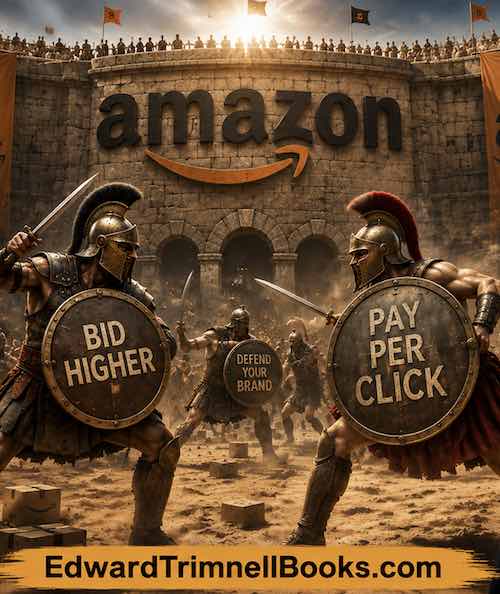
Seth Godin has written an uncharacteristically scathing piece on the Hobbesian state of Amazon advertising. His basic thesis is that Amazon’s reliance on PPC ad revenue has created some perverse incentives.
The company used to focus on delivering the optimal product listings to consumers at the lowest prices. All of this was powered by Amazon’s internal search engine.
This process is known as organic discovery, and it benefited both buyers and sellers.
Organic discovery still exists to a certain extent on Amazon. But now there is something more nefarious and complicated in the mix. Amazon now makes about a billion dollars per week from search ads. PPC (pay-per-click) ads litter every available space on Amazon, including the top of your search results. Because these ads are now so plentiful and prominent on Amazon, anyone who sells there must engage in PPC advertising.
This of course includes new entrants to a particular market, but not only new entrants. Established players must also now invest substantially in defensive advertising on the platform.
Consumers don’t benefit from this excessive ad competition. On the contrary, they end up paying higher prices (because sellers must now recoup high ad costs in product pricing), as well as more limited and shoddier product lines. This is what Seth Godin calls “the Amazon tax”. “Amazon,” declares Godin, “is stealing from the customers they said they were here to serve.” Make of that what you will.
***
I’m an author/publisher. I therefore can’t really comment about how this might affect the electric snow blower market on Amazon. I can, however, say something about its effects on the book market.
If you browse books on Amazon, you may have noticed that almost all indie authors either write in series or attempt to write in series. There are certainly some indie authors whose natural artistic inclinations gravitate toward series. Most, however, are doing this because of the economics of Amazon advertising (and —to a lesser extent—Kindle Unlimited economics).
PPC ad costs are now so high on Amazon that it is almost impossible to make the sale of a single book profitable. It is therefore necessary to use the initial book of a series as a kind of loss leader. The author’s hope, in other words, is that after reading the first book of a particular series, the reader will want to read the next dozen more (or ideally, the next thirty more).
These economics come most brutally into play in high-volume fiction for women. Most authors in the romance field narrow down on very specific niches, and essentially write the same book over and over again. This is why so many romance authors focus only on hockey romances or billionaire reverse harem romances, or whatever.
I’ve sampled a few of these books, just out of curiosity. Are these books filled with intricate plots and characters that come alive, or are they cookie-cutter repetitions of the same storylines, cardboard characters, and hackneyed tropes?
I will withhold comment. I don’t enjoy fending off internet pitchfork mobs.
***
But in publishing, at least, Amazon’s PPC market also responds to another and very real problem. That is the excessively high volume of products (i.e. books) for sale.
When the “indie publishing revolution” first began, many observers in the traditional publishing field warned about a coming “tsunami of crap.” Their dire predictions weren’t entirely incorrect; but it still takes time and effort to write a book of any length. Many new entrants uploaded a self-published book or two to Amazon, found that they got almost no sales, gave up, and went away.
Enter AI. AI makes it possible for people who don’t even speak English (I’m talking here about content farms in places like Vietnam and Pakistan) to mass-produce shoddy fiction at the push of a button.
No, this fiction won’t be very readable. But when you’re publishing at scale, and at zero cost, your publications can essentially work like spam. You only need to get lucky once in a while in order to turn a little bit of a profit.
AI offerings have flooded not only Amazon but the other online book sellers as well. (This is one reason why I’m spending a lot more time on camera nowadays, especially on YouTube. People may or may not like me. They may or may not like my books. But at least they’ll know I’m a real human.)
Amazon has to do something to disincentivize mass uploads of shoddy books onto its platform. The best way to do this would be through a listing fee billed either at the time of publication, or on an annual basis, or perhaps both. Only a very modest per-title amount would be necessary to discourage the mass AI uploaders.
But that’s why Jeff Bezos is a billionaire and I’m just some guy in Ohio. While my idea of modest listing fees would curtail frivolous uploads, Amazon can make a lot more money by requiring all publishers, both legitimate and illegitimate, to participate in a zero-sum PPC ad competition with daily bidding wars and—in some cases—three- and four-figure daily advertising costs. Amazon can make plenty of money on a book that never sells, provided that the author/publisher is willing to participate in the PPC ad market.
***
But back to my experience as a consumer on Amazon. My dad, who retired years ago, has recently gotten into coin collecting. He asked me to purchase some coin collecting supplies for him on Amazon.
I know a little bit about coin collecting. I used to collect coins myself when I was a kid. But that was back in the early 1980s. I haven’t purchased coin collecting supplies for myself in decades—not since they were sold in the Woolworth’s at my local shopping mall.
So I executed a few queries on Amazon. Almost all of the search results were sponsored (i.e., ads). The best-known brands, still sold at brick-and-mortar stores like Hobby Lobby, were listed below the listings of obvious knock-off products made in China.
But there was so much chaff covering the wheat that I was unable to find the complete list of the products that my father sought. I searched and searched, and still couldn’t find what he needed—amid all the freaking ads.
I finally told my dad that I was giving up.
He replied, “What’s the problem, son? I thought you were the Amazon expert.”
(My father is now eighty and I’m pushing sixty. But many of the old parent-child dynamics still apply.)
I didn’t want to take the time to explain the Amazon PPC ad situation to him. So I opted for a diversionary strategy. That always worked when I was a kid, trying to come up with an excuse for not cutting the lawn.
“You know, Dad, it would be a lot easier to order these items from Hobby Lobby.”
And this is exactly what he finally did. At Hobby Lobby he dealt with a real human (instead of an online ad-delivery system), and they had what he needed in less than a week. Problem solved.
-ET