“The Door-to-Door Man”: a short story set in the age of “stranger danger”

It’s an ordinary spring afternoon in suburban Cincinnati, 1980.

Eighteen-year-old Michelle Blevins is home with her younger brother when a stranger rings the doorbell.

The stranger is wearing a blazer, tie, and aviator sunglasses. He says he represents a local law firm. He says Michelle’s parents are in trouble.

And he really wants to come inside.

That’s the setup for “The Door-to-Door Man,” my latest original short story for YouTube.

Those of us who grew up in the 1970s and 1980s will remember that this was the era of “stranger danger.”

In some ways, the world was considerably less connected than it is today. There were no cell phones, doorbell cameras, GPS trackers, or Internet searches. If a stranger appeared at your front door, you couldn’t pull out your phone and immediately find out who he was.

At the same time, people were becoming increasingly aware that the world wasn’t necessarily as safe as they had once imagined.

Serial killers, violent crime, and mysterious disappearances regularly made the news. Parents warned their children about strangers. And yet it was still perfectly normal for unfamiliar people—salesmen, repairmen, deliverymen, religious solicitors, and others—to simply walk up to your house and ring the doorbell.

That combination provides the backdrop for “The Door-to-Door Man.”

I’ve been experimenting with writing very short fiction specifically for YouTube: complete stories that can be read or listened to in a single sitting, accompanied by atmospheric visuals.

“The Door-to-Door Man” is one of these stories. It’s a tale of suspense rather than supernatural horror. There are no ghosts, monsters, or paranormal forces here. Just an ordinary young woman, an ordinary suburban house—and a stranger at the door who may not be what he claims to be.

You can watch and listen to the complete story in the video accompanying this post.

If you enjoy “The Door-to-Door Man”…

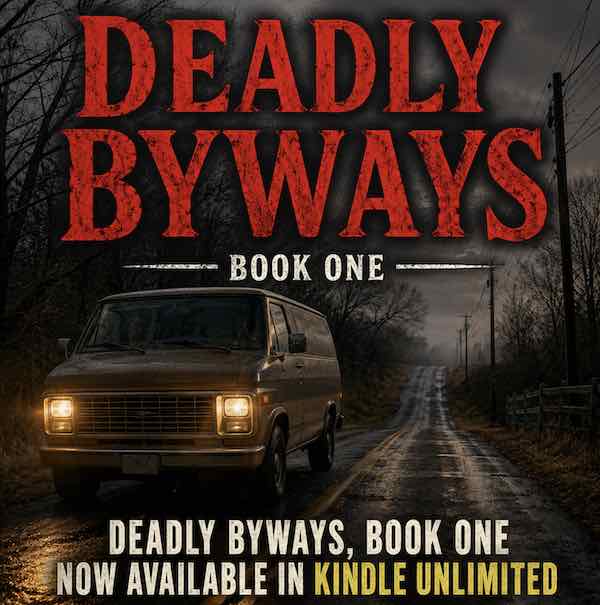
You might also want to check out my DEADLY BYWAYS series.

Deadly Byways consists of six novels set in the late 1970s and early 1980s. Like “The Door-to-Door Man,” these stories explore the darker side of an era that many of us remember with nostalgia—but which had plenty of dangers and shadows of its own.

The books are available on Amazon and can also be read through Kindle Unlimited.

If you enjoy suspense stories about ordinary people confronting extraordinary dangers—especially stories set against the backdrop of America several decades ago—DEADLY BYWAYS may be for you.

In the meantime, I hope you enjoy “The Door-to-Door Man.”

And remember: be careful who you open your front door to.

-ET

Seth Godin, “the Amazon tax”, and pay-per-click battles to the death

Seth Godin has written an uncharacteristically scathing piece on the Hobbesian state of Amazon advertising. His basic thesis is that Amazon’s reliance on PPC ad revenue has created some perverse incentives.

The company used to focus on delivering the optimal product listings to consumers at the lowest prices. All of this was powered by Amazon’s internal search engine.

This process is known as organic discovery, and it benefited both buyers and sellers.

Organic discovery still exists to a certain extent on Amazon. But now there is something more nefarious and complicated in the mix. Amazon now makes about a billion dollars per week from search ads. PPC (pay-per-click) ads litter every available space on Amazon, including the top of your search results. Because these ads are now so plentiful and prominent on Amazon, anyone who sells there must engage in PPC advertising.

This of course includes new entrants to a particular market, but not only new entrants. Established players must also now invest substantially in defensive advertising on the platform.

Consumers don’t benefit from this excessive ad competition. On the contrary, they end up paying higher prices (because sellers must now recoup high ad costs in product pricing), as well as more limited and shoddier product lines. This is what Seth Godin calls “the Amazon tax”. “Amazon,” declares Godin, “is stealing from the customers they said they were here to serve.” Make of that what you will.

***

I’m an author/publisher. I therefore can’t really comment about how this might affect the electric snow blower market on Amazon. I can, however, say something about its effects on the book market. Continue reading “Seth Godin, “the Amazon tax”, and pay-per-click battles to the death”

Don’t Stop for Gas in Zombie Country: a short story

There are still plenty of places in Ohio where you can get off the interstate and, within twenty minutes, find yourself on a narrow country road surrounded by woods, fields, old houses, and small towns.

Those are the places I often have in mind when I write horror.

I’ve always thought that familiar, ordinary settings make some of the best settings for supernatural fiction. An abandoned castle is already creepy. So is a ruined monastery at midnight. The writer doesn’t have to do much work to convince you that something frightening might happen there.

But what about the gas station you’ve passed dozens of times? Or an old country graveyard beside a two-lane road? What about a patch of woods that looks perfectly harmless at four o’clock in the afternoon—but considerably less inviting as the sun begins to go down?

That’s the territory of “Don’t Stop for Gas in Zombie Country,” the short horror story in the video above.

The setup is deliberately simple: an ordinary trip through the Ohio countryside, an inconvenient need for gasoline, and a small rural gas station.

Then things begin to go wrong.

This is also the kind of story I’ve been exploring in my Uncanny Ohio series: macabre tales built around Ohio places, local history, forgotten corners, and the unsettling possibility that the ordinary landscape around us may contain things we don’t quite understand.

The current stories in the series include Involuntary Deeds, Family Secrets, and The Woman in Crosley Tower, and Eleven Miles of Night.

All three are available at Amazon and can also be read through Kindle Unlimited.

But for now, you don’t need a Kindle. Just watch the video above.

And the next time you’re driving through the Ohio countryside late in the day, you might want to keep an eye on the gas gauge.

-ET

Frank Beard and memories of ZZ Top

I was among that first generation of adolescents to discover MTV in the early 1980s. If you were 14 years old in 1982, as I was, MTV was really great stuff.

The ZZ Top videos were among the best. The music itself was catchy. But ZZ Top’s MTV videos often portrayed short stories, often with fantasy elements.

Among the most memorable of these was “Legs” (1983). “Legs” is essentially a miniature fairy tale, set in 1980s America. The video also features cameo appearances by two Playboy Playmates—Jeana Tomasino and Kymberly Herrin. What could be more 80s than that?

But the members of the band, by then men in their early middle age, also provided a distinctive visual trademark to every ZZ Top production.

ZZ Top was a three-man band from Houston, Texas. They had no pretensions of being glam rockers. The guitarist and bassist, Billy Gibbons and Dusty Hill, both sported long beards that made them look like refugees from the Texas Hill Country of some prior decade.

Frank Beard, the drummer, was ironically the only member of the band who did not have a beard. Frank Beard passed away yesterday at the age of 77.

***

My research tells me that Beard was preceded in death by Dusty Hill in 2021. (Hill was 72.)

I’m not going to pretend that either death was a personal loss. But these two men, though strangers, contributed significantly to the pop culture tapestry of my formative years. That pop culture was, on the whole, more upbeat and vibrant than the one we are forced to endure today.

I’m glad that the marketplace rewarded both Beard and Hill for their musical prowess while they were still alive. ZZ Top peaked in popularity decades ago. But their music videos have aged well and are still available on YouTube.

Frank Beard, 77. R.I.P.

-ET

A story for summer: “The Wasp”

It is not quite summer, if you want to get technical about it. Summer will not officially begin until Sunday, June 21, 2026.

We are still in April. The schools won’t let out for another six weeks. 

But the mercury here in southern Ohio will hit 85 degrees today. That’s close enough for me.

The above is one of my early short stories, “The Wasp”. I wrote it back in 2009, and it was first published in my short story collection, HAY MOON AND OTHER STORIES.

This is very much a summertime story. It’s also based my lifetime loathing of wasps. I can handle spiders, snakes, and other creepy-crawlers (to a point, anyway). I love honeybees.

But I absolutely despise wasps.

As the old German proverbs goes, “God made the bee, but the devil made the wasp.”

-ET

1932: supernatural zombie horror in rural Ohio

My maternal grandfather, born in 1921, grew up in rural Adams County, Ohio. He told me so much about that time and place, that I sometimes feel as if I lived it all myself.

“Hay Moon” is a short story set in rural Ohio in the summer of 1932. My grandfather never told me a story like this, filled with supernatural forces and the undead. But his real-life accounts of his childhood years helped me add a realistic flavor to the tale, if I say so myself.

You can listen to the story here, or on my YouTube channel (where you’ll find lots of additional audio content).

You can purchase this story as part of my Hay Moon and Other Stories collection. If you like my approach to historical horror, consider The Rockland Horror historical horror series, which is also available in a five-volume boxset on Kindle.

-ET

Killer robots in the factory

“The Robots of Jericho” is one of my early short stories. I wrote this back in 2009.

I spent a lot of years in the automotive industry, and countless hours in automotive plants.

Many of these factories had industrial robots. If you’ve ever watched industrial robots move, you’ll agree that they often appear to be alive.

Of course, I know that industrial robots aren’t really alive and sentient. But what if they were? “The Robots of Jericho” is a story about such a scenario.

“The Robots of Jericho” is available in print and ebook as one of the stories in my Hay Moon short story collection. But you’re welcome to listen to the story in the video below:

That 1970’s vibe: ‘Revolutionary Ghosts’

REVOLUTIONARY GHOSTS is a coming-of-age supernatural horror novel set near Cincinnati, Ohio in 1976.

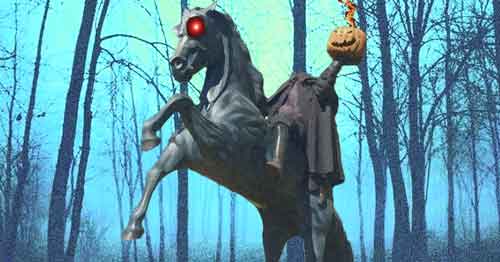
But the novel is based on Washington Irving’s 1820 short story, “The Legend of Sleepy Hollow”.

Revolutionary Ghosts came from the question: “What would have happened, had the Headless Horseman of Washington Irving’s tale invaded 20th-century America in 1976?

In the above video, I describe the series of associations that went into the story, some going back all the way to my childhood. (I was 8 years old in 1976!)

-ET

View REVOLUTIONARY GHOSTS on Amazon!

“Don’t Stop Believin’”: a song with multiple lives 

I was in the 8th grade in 1981-2, when Escape, Journey’s seventh studio album, was the latest thing.

Escape is one of the few rock albums with no duds. Every song is good—if you like Journey’s style of music.

But the best song on the album, perhaps, is “Don’t Stop Believin’”. It is a great song because it is simultaneously specific and universal.

We wonder about the small town girl, and the city boy “born and raised in South Detroit.” What compelled each of them to take “the midnight train going anywhere”?

And at the same time, the song is vague enough that we can each apply it to our individual stories. “Whoa, the movie never ends. It goes on and on and on and on.” My movie has gone on for 44 years since I first heard this song, and counting.

For years, this song instantly took me back to the 1981-2 school year, and the adolescent I was at that time. The song can still do that.

But then a few years ago, I watched The Sopranos from start to finish. (I was about a decade behind everyone else in doing this…the story of my life.) Then, for a long time, I would see the final, iconic scene of The Sopranos when I heard, “Don’t Stop Believin’”.

Most recently, I have discovered First to Eleven’s interpretation of the song. (First to Eleven is a very talented cover band based in Erie, Pennsylvania.)

None of the members of First to Eleven was even born when I heard “Don’t Stop Believin’” for the first time, back in 1981. (They are all very young.) And yet, their music video, and lead vocalist Audra Miller’s performance, put yet another spin on the song for me.

And some people worry—or hope—that AI will replace serious musicians? They base this on the fact (for example) that AI can now reassemble good music into mediocre music. (See my recent post about The Velvet Sundown.)

AI will never be good for anything but mediocrity. Only a human imagination could have come up with “Don’t Stop Believin’” almost half a century ago. And it took human imagination to come up with all these reimaginings of the song since then.

-ET

New 38 Special song

I discovered pop/rock music in 1981-2, when I was still in junior high. Because of the longevity of contemporary rock bands, I sometimes come across new material from bands that I first discovered 40 years ago.

This is always a treat, and it always makes me feel younger. (If the rock bands of your youth are still making new music, you can’t be that old, right? That notion works for the Boomers, so why not for Gen X?)

38 Special is one such still-active band from my junior high years. I became a fan of 38 Special back when their 1982 album Special Forces was new, and reached the number 10 spot on the Billboard 200. This album includes several of the group’s classic songs, including, “Caught Up in You” and “You Keep Runnin’ Away”.

The band has just released a new song on YouTube, “All I Haven’t Said”.

There have been some personnel changes since 1982, of course. (I believe 38 Special has a new lead vocalist.) So the sound is a little different, but the same spirit is there.

I like the new song, and I am glad to see that 38 Special is still around and making music.

-ET