An American abducted by North Korean agents

The writing of THE CONSULTANT.

For fans of:

  • James Clavell
  • Vince Flynn
  • Brad Thor

Here’s a little about the story, and why you’ll enjoy it if you like a.) East Asian settings, and b.) adventure.

North Korean abductions of Japanese citizens

In my prior professional existence, I was deeply involved with Japan. I learned the Japanese language, and even worked as a translator for a time. I also worked for years in the Japanese automotive industry. I made many trips to Japan.

One of the ongoing issues I learned of in Japan was the so-called ratchi mondai 拉致問題, or “abduction problem”. This intractable matter came up whenever there was talk of Japan and North Korea resuming ordinary diplomatic relations.

Throughout the 1970s and part of the 1980s, North Korean agents abducted numerous Japanese citizens on Japanese soil. (Japan and North Korea are quite close, geographically.) These ordinary Japanese people, who happened to become targets of the North Koreans, were taken to North Korea and forced to work in a variety of capacities. Many were employed against their will as Japanese language instructors.

North Korea’s abductions didn’t stop there. In 1978, North Korea abducted Shin Sang-ok and Choi Eun-hee. Shin Sang-ok was a well-known South Korean movie director. Choi Eun-hee, his former wife, was a successful actress. The pair spent about eight years in North Korean captivity. They worked directly for Kim Jong-il, the future Supreme Leader of North Korea. Shin and Choi were tasked with making films for North Korea’s movie industry (against their will, of course.) They finally escaped in 1986.

North Korean abductions and Americans

I knew there was a story there. I wanted to write a story about an American kidnapped by the North Koreans, though. So far as my research could determine, there had never been a documented case of the North Koreans abducting an American on foreign soil.

But why couldn’t it happen? After all, thousands of Americans travel to Japan and South Korea every year. Many are skilled business and technical experts, human assets that Pyongyang would surely covet. And North Korean agents are known to be active in both Japan and South Korea.

An American abducted and taken to North Korea

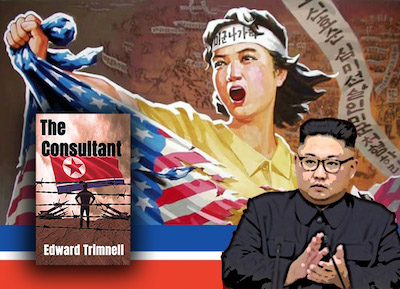
THE CONSULTANT is the story of Barry Lawson, a successful business consultant from Chicago who finds himself in the wrong place at the wrong time.

And then he finds himself in North Korea.

Barry Lawson is an aging Lothario in his late forties. He has a way with the ladies, and this has often gotten him into trouble. Barry is divorced, with two children.

When Barry is approached by an attractive woman at a bar in Osaka, Japan, he can’t resist….even though he knows better.

This is a decision that he’ll soon regret. Within hours, Barry Lawson, successful business consultant and ladies’ man, must find a way to survive in—and hopefully escape from—the hellhole that is North Korea.

He’s not the only foreigner there, though. Barry he meets a Japanese man, Shoji Tanaka, whom the North Koreans abducted from Hokkaido (in northern Japan) when he went out for cigarettes one night.

Barry also meets Anne Henry, a woman who knows the Korean language. Anne, it turns out, has a traumatic abduction story of her own.

***

That’s all for now. I don’t want to ruin the book for you.

THE CONSULTANT is available in paperback and Kindle. (An audiobook is in the works.) You can presently read THE CONSULTANT in Kindle Unlimited, as well.

Want to preview THE CONSULTANT? You can do so below.

Three early novels back in Kindle Unlimited

Most writers tend to change over time. Stephen King’s most recent offering, If It Bleeds, is quite distinct from his early breakout novels like Carrie, ‘Salem’s Lot, and The Shining. If It Bleeds is almost like a book from a different author. 

King is  one of  the best-known examples of writers who’ve changed, but there are many others.

***

I haven’t been writing and publishing for as long as Stephen King, of course. But I’ve been at it for about a decade now, and that’s long enough for my story interests and narrative style to undergo significant changes.

Relatively early in the game, I wrote and published a short story collection, along with three novels: Blood Flats (2011), Termination Man (2012), and The Maze (2013).

The short story collection, Hay Moon and Other Stories, has remained on Amazon since 2011. Readers have liked it, and it sells fairly well, as short story collections  go. 

But the aforementioned novels were a different matter. These are all standalone novels, and in a mix of genres. A marketing nightmare. Although reviews were generally positive, sales languished.

***

These three novels are all long books, well in excess of 100K words. (Blood Flats is about 180K words). This past year I decided that it would be a good idea to take the books off the market for a time, give them a thorough reread, and decide if they needed to be altered, republished as originally written, or scrapped.

I’ve written so much in the intervening years, that rereading these books was a bit like reading three books written by another person. I remembered the general plots of each novel, of course; but I had also forgotten huge swaths of the stories.

I was pleasantly surprised to find out that all of these novels are, well…pretty darn good.

I subjected these books not only to an author’s reread, but also to an external proofread. A handful of typos were found and corrected (though not many). 

I’ve rereleased these books and put them back in Kindle Unlimited. Here they are, with Amazon links and descriptions:

Blood Flats: Lee McCabe is on the run from the law, mafia hitmen, and rural meth dealers. A gun-blazing chase through the badlands of Kentucky.

Termination Man: Sex, lies, and corporate conspiracies! A workplace thriller for fans of John Grisham and Joseph Finder.

The Maze: Three ordinary people step into an alien world of magic and nonstop danger. A modern-day parallel world fantasy with the soul of a thriller!

***

If the above story descriptions appeal to you, then I think you’ll like each of these books. And you can presently read them for free in Kindle Unlimited. 

McDonald’s Arctic Orange Shakes

My coming-of-age supernatural thriller, Revolutionary Ghosts, is set in 1976.  The tale’s hero, an Ohio teenager named Steve Wagner, has a summer job at McDonald’s. 

One of the recurring jokes in the book surrounds the Arctic Orange Shake, which McDonald’s did indeed introduce in the summer of 1976. Continue reading “McDonald’s Arctic Orange Shakes”

Cardio and the writer

I’m an admitted cardio addict. I usually spend about an hour on my exercise bike each day, in addition to my thrice weekly weightlifting sessions. 

Why? First of all, because I used to be a fat guy. But that’s another story for another time.

Cardio is important for writers. Yes, that’s right, you heard me: Cardio is important for writers.

Nature’s mood drug

Most writers suffer from anxiety and depression. (I am prone to both.) 

Exercise is nature’s mood drug. Forget the crap that the pharmaceutical companies are peddling. You don’t need prozac, Ritalin, and all that crap from Big Pharma. 

And you certainly don’t need cannabis. Don’t get me started on the current (and utterly idiotic) cannabis craze.

Exercise floods your body with serotonin. It’s free! No prescription required! Completely legal in all fifty states! 

And while exercise is addicting, it’s a good form of addiction.

Reading and brainstorming

Time spent on the exercise bike is also a great time to catch up reading. I read whenever I’m on my bike, or on the Stairmaster at the gym.

But what about actually writing? Or preparing to write?

When the weather in southern Ohio is pleasant (and it often isn’t pleasant), I sometimes go for walks. 

I find walking to be conducive to brainstorming. If an aspect of a story is puzzling me, I can usually work it out during a walk. 

I’m not alone in this regard, by the way—Charles Dickens famously walked as many as twenty miles a day. He plotted his stories in his head during these long peregrinations.

Dickens also suffered from insomnia. It wasn’t uncommon for him to go walking at two o’clock in the morning.

If you’re a writer, then exercise should be a regular part of your routine. Especially cardio. And Charles Dickens, no less, would agree with me.