
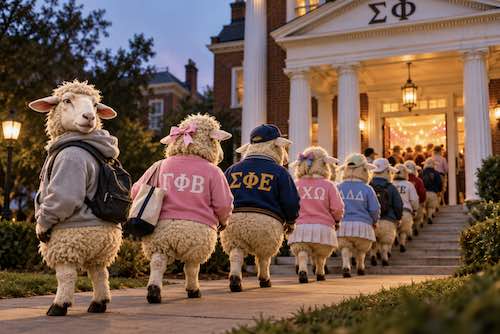
You might have noticed that we almost never hear any positive news stories about fraternities and sororities.
Yes, I’m alluding to the recent “Cornell 7” case.
But the details of that case are not what I’m going to discuss here—as the relevant facts are still coming in, and everyone else is talking about that incident.
Instead, I’m going to begin at the University of Cincinnati, in January 1982.
Before many of you were even born.
***
On Sunday, January 17, 1982, the University of Cincinnati chapter of Sigma Alpha Epsilon (SAE) held what it called a “Martin Luther King Jr. trash party.” The event was held the night before UC’s observance of King’s birthday.
Guests were encouraged to bring items such as canceled welfare checks, boomboxes, and crowbars. Ku Klux Klan hoods were welcome. Invitations for the party also suggested that attendees bring photos of James Earl Ray—Martin Luther King’s assassin.
According to contemporary accounts, one partygoer wore a Martin Luther King mask with a bullet hole in it.
All that happened back in 1982.
***
I was not a student at the University of Cincinnati in January 1982. I was an eighth-grader in the nearby suburbs. Sigma Alpha Epsilon’s “Martin Luther King Jr. trash party” was a local source of ignominy in Cincinnati that winter. The incident was a common topic on local TV and radio channels.
The scandal eventually received national attention, but this was limited. (Remember: there was no internet back then.)
In February 1982, UC president Henry Winkler ordered a two-year suspension of Sigma Alpha Epsilon. That suspension has long since expired, of course. Sigma Alpha Epsilon has a chapter on the University of Cincinnati campus today. Some of the current members’ fathers, one imagines, had not even been born yet in 1982.
***
Alleged gang rapes, and incidents like the Martin Luther King Jr. trash party, are sensational events that linger in the media for months or even years. Far more common are the comparatively mundane stories of a new pledge dying from alcohol poisoning after drinking himself into oblivion as part of the fraternity’s hazing procedures.
What about sororities, though? Where sororities are concerned, the news stories are usually a little less toxic. The big problem with sororities seems to be the incredible amounts of money that parents will invest trying to get their daughter into a very specific sorority. Often this involves spending thousands of dollars for sorority rush consultants and various designer brands.
But back, briefly, to the Cornell 7 case. The alleged perpetrators were all members of the Chi Phi fraternity chapter at Cornell University. The alleged victim was a member of a sorority. Frat boys and sorority sisters tend to hang out together, attend the same parties, and hook up together.
***
None of the above implies that every member of a fraternity is a racist or a rapist. Nor can we conclude that every member of a sorority is a hapless ingénue, ready to fall for any proposition presented by the right fraternity brother.
But we can make certain speculations. There are people who have a deep emotional need for group affiliation. Such individuals have a strong tendency to merge their own identities with the identity of a particular group—a group that gives them a sense of acceptance and social standing.
Such individuals are often attracted to fraternities and sororities. People with low degrees of personal independence naturally gravitate toward these organizations. This is the selection effect in action.
Members of fraternities and sororities are not necessarily any more malevolent or gullible at an individual level than members of the general population. They are, however, arguably more susceptible to peer pressure. The need to be liked and accepted by a particular group can override individual codes of ethics—and even self-preservation.
Consider the Sigma Alpha Epsilon “MLK trash party of 1982.” Attendees at this event could not reasonably have expected to acquire conventional rewards such as sex, money, or career advancement. They could, however, acquire more peer group approval.
Ayn Rand once wrote that the word “we” is the root of all evil. I wouldn’t go quite that far. Moreover, excessive contrarianism—when practiced for its own sake—can become counterproductive.
But college fraternities and sororities do seem to bring out the worst in people who suffer from a strong need for group affiliation. Adulthood is supposed to be about personal growth and independence. Fraternities and sororities encourage exactly the opposite—even when tragedies and public scandals aren’t their result.
-ET
**View NO SURE THING on Amazon**