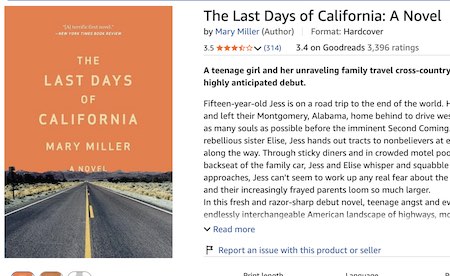
About a decade ago, I read a review of Mary Miller’s 2014 novel, The Last Days of California, in a print magazine. The reviewer, a book critic whom I knew by name and trusted, highly recommended Miller’s novel.
I was skeptical. The Last Days of California is a teenage girl’s coming-of-age story. I was a middle-aged man. Not long before that, a young woman in my social circle had recommended John Green’s emotional teen novel The Fault in Our Stars. Against my better judgment, I had purchased The Fault in Our Stars and tried to read it. I was unable to finish—not because The Fault in Our Stars was a bad book, but simply because I was the wrong reader for it.
Nevertheless, I ordered The Last Days of California from Amazon. The book promised to be not only a coming-of-age story, but also a story about the dynamics of 21st-century family life with a little bit of the culture wars mixed in. I was intrigued.
I’m glad I took a chance on The Last Days of California. It turned out to be a wonderful story, even though this is the kind of book I rarely read. (My personal reading tastes veer more toward Michael Connelly and Lee Child.)
But the collective readership of Amazon and Goodreads does not agree with me—at least not the ones who are leaving ratings and reviews. At the time of this writing, The Last Days of California has a 3.5 cumulative average on Amazon and a 3.4 cumulative average on Goodreads.
If I had consulted the online peanut gallery, I would have skipped Mary Miller’s book entirely. Fortunately, by 2014 I already knew the truth about mass online review venues like Amazon and Goodreads.
In 2012, it was discovered that John Locke, a bestselling indie author famous for his Donovan Creed series, purchased reviews from review farms. He personally compensated some other reviewers.
Black hat practices like that are harder to carry out in 2026. (There was a widespread backlash over the John Locke scandal, and Amazon took some steps to penalize outright review scammers.)
But gray hat practices persist in the publishing industry. Major publishers and imprints retain lists of friendly reader-reviewers, who can always be counted on to give a particular author a 5-star review. Indie authors are not far behind. Most know better than to specifically compensate for reviews, but there are still indie authors who will raffle iPads for their reader-reviewers. That sends a message—and broadcasts certain incentives.
Negative reviews are even more muddled. Since the culture wars heated up, there have been cases of both negative and positive review-bombing, both from the political right and left. In 2016, Amazon felt compelled to remove blatantly political reviews/ratings of Megyn Kelly’s book, Settle for More. The book contained passages that were critical of President-elect Donald Trump. Some Trump supporters thought that they could bolster Trump by discrediting Kelly’s book with 1-star reviews.
On the other side, there have been numerous occasions of a book being 1-star review-bombed because some jackanapes on Goodreads decided that it was racist, sexist, homophobic, culturally appropriating, or prejudicial to left-handed redheads residing in Iowa.
I have seen books given 1-star reviews on Goodreads and Amazon because a dog happened to die in the story. (Are animals not allowed to die in fiction?) One panned a book because it did not have any dragons, and he/she only read books with dragons.
One reader-reviewer gave one of my books a 2-star review. His review began with the sentence, “I’m not sure I would have read this if I knew it started in the late 1800s.” And yet, the very first line of the Amazon book description states that the story is set in 1882. Go figure.
In many cases, a book gets a poor review because it ended up in the hands of the wrong reader. I will refer you again to my poor experience with John Green’s The Fault in Our Stars. This is a book that has clearly moved millions of readers. But the book struck me as melodramatic and self-indulgent. (I did not leave a one-star review—or any review—for The Fault in Our Stars. I recognized that the real flaw here was not the book, but the mismatch between reader and book.)
Amazon’s review system became even more opaque circa 2020, when the online bookseller began allowing customers to leave numerical ratings sans reviews. We now have no way to know why a reader gave a book one star or five. Was it because a dog died—or because there were no dragons in the story?
Only 1% to 3% of readers will take the time to write a review. A slightly higher percentage—1% to 10%—will leave a numerical rating. But that tiny minority wields disproportionate power, with a book industry that seems to care so much about online reviews.
The irony here is glaring. We aren’t in 2005, after all. Most of us long ago learned to discount comments on social media platforms. Why, then, do we continue to care so much about online book ratings and reviews—which are just as random and just as dodgy?
There have been some dissenting voices—especially among the indie writer community. The late T.S. Paul often said that he did not care about online reviews. Dean Wesley Smith has coined the term “review begging” to characterize the indie author practice of cajoling, hectoring, and bribing readers to please, please, please leave them a review (and hopefully a glowing review accompanied by a 5-star rating!)
It is important to consider the purpose behind the machinery. Online reviews are not about enabling prospective readers to make informed decisions about a book purchase. (There are much better ways to do that, such as reading the free online sample that is available for practically every title on every major bookseller.) Online reviews are ultimately about driving algorithms, and creating the appearance of lots of activity taking place around a particular product or book title.
The above paragraphs may lead some of my readers to believe that I actively discourage reviews and ratings of my titles.
I wouldn’t go quite that far. If you’ve read one of my books and happened to have enjoyed it, I of course won’t complain if you leave a corresponding rating/review.
But this isn’t my primary aim. Unlike many indie authors, I deliberately avoid “review begging.” I have never pandered to the online masses in exchange for 5-star belly rubs. As a result, some of my titles have few reviews and/or misleading numerical rating averages.
So if you liked one of my books and are inclined to publicly praise it, by all means do so.
I would much prefer, however, that you read my next title—whether you purchase it, or read it for free in your Amazon Kindle Unlimited subscription. Where writers and readers are concerned, reading the next title will always be the highest—and most welcome—form of praise.
-ET