(And that’s why indie authors have to spend so much money on Facebook ads—and worry endlessly about AI)
The other day I was scrolling through my Facebook feed when I came upon an ad for an indie-published military science fiction series.
The ad was slickly produced with AI video that was only available to movie studios a few short years ago. The ad promised tales of drone swarms, planets in peril, and gritty space marines!
Hoo-rah!
I was curious. And so I exited Facebook and did a little research on the author using Google. I also searched for his books on Amazon.
He was the author of a five-book space marine saga.
Hoo-rah!
As soon as I returned to Facebook, Meta’s algorithm continued to show me ads from this same author.
But that wasn’t all. Meta also had now identified me as someone interested in space marine stories (hoo-rah!)—probably because of my Googling and my searches on Amazon.
For the rest of the day I was served more ads for indie-authored space marine sagas. They all had the same exact tropes.
A planet in peril!
Terrifying aliens!
Drone swarms!
Space marines!
Hoo-rah!
But no discussion of mind-numbing sameness in indie publishing would be complete without mentioning the romance field. Indie romance authors now write almost exclusively in hyper-focused niches: hockey romance, billionaire romance, enemies to lovers, cowboy billionaire romance, etc. (And that’s without delving into the really weird, hyper-focused romance niches, which I don’t care to mention here.)
There is an indie author who openly copies the Jack Reacher novels. I mean—openly copies them to the point of borderline plagiarism. The hero of these novels behaves exactly like Jack Reacher, all the way down to Reacher’s famous black coffee habit.
Indie publishing was supposed to provide room for creative freedom and literary diversity. (I mean that word in its best, truest sense.) But then the indie author “gurus” convinced indie authors to pick a narrow lane, and mass-produce the same kinds of books written by other authors working in that same lane.
This has made most of indie publishing both tiresome and mediocre. The market is filled with “me-too” offerings that capitalize on prefabbed packages of tropes.
This must bore the bejesus out of readers. I mean—seriously—how many books of the exact same kind does the market really need?
It has also made indie authors highly dependent on an increasingly complex, ridiculously expensive PPC ad ecosystem. Most authors working inside constricted trope lanes have little space to differentiate themselves. They must therefore rely on the brute force of high-bid, pay-per-click advertising. Many indie authors are spending more than half their revenues on Meta and Amazon ads. Some indie authors are outright underwater because of high ad spends.
That path is not for me. Whether you like my stories or not, each one of them is mine. I would never write by committee with “beta readers” (one of indie publishing’s most ridiculous concepts). Nor would I ever want to churn out repetitive stories to a trope standard. If I’d wanted to march in lockstep with a specific, clannish little group, I would have stayed in the corporate world.
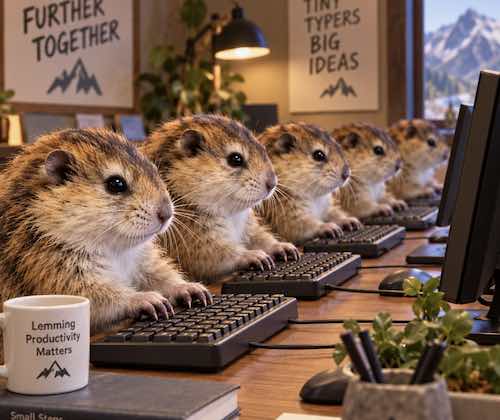
But there’s another problem with the lemming-like approach so common in indie author circles. Many indie authors are fretting about the threat from AI: software penning novels—whiz bang!—with a handful of prompts.
The best way to yield literature to soulless AI is to make each story a soulless, standardized product. Yet that’s exactly what so many indie authors are doing nowadays.
-ET