
Kansas and the perils of creative indecision

Kansas was one of my favorite bands while growing up. But this was always something of a minority viewpoint. Sadly, Kansas is a band that never reached its full potential.

Kansas, like the Canadian rock trio Rush, always had an intellectual, progressive streak. Kansas always wanted to make rock music “something more”.

Here’s an example: the band’s debut, self-titled album contains a song called “Journey from Mariabronn.”

What the heck is Mariabronn, you ask? That’s a reference to German-Swiss author Herman Hesse’s 1930 novel, Narcissus and Goldmund.

Highbrow, yes. But a little too highbrow for popular music. Even in the artistically indulgent 1970s. How many 16-year-olds—either then or now—are conversant in mid-twentieth-century German classic literature?

Kansas basically had two commercially successful albums: Leftoverture (1976) and Point of Know Return (1977).

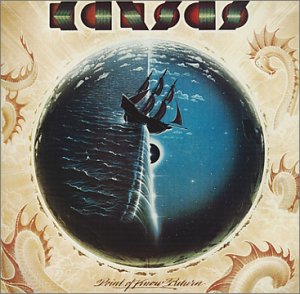
Leftoverture contains the spiritual rock anthem “Carry On Wayward Son”. This song brought the band mainstream success. This is also the Kansas song that non-devotees are most likely to recognize.

On Point of Know Return you’ll find “Dust in the Wind”, another Kansas song that still gets a fair amount of airplay.

That was about it, as far as commercial success went for Kansas. Although the band soldiered on for years (a version of Kansas continues as a going concern today), the group was fading out by the mid-1980s.

Kansas’s songs are well-thought-out, often to the point of being abstruse. In short, most of the group’s music isn’t immediately accessible to the casual listener. And that’s a fatal flaw in rock music, where the competition is fierce, and audience attention spans are notoriously short.

Kansas was also riven by an internal philosophical dispute. Founding member and chief songwriter Kerry Livegren became a born-again Christian in 1979. He often infused Kansas’s lyrics with quasi-Christian themes. These were seldom preachy or bombastic, but their spiritual import was hard to miss.

The other members of the band weren’t on board with this new direction. Many of Kansas’s albums during the 1980s (Drastic Measures (1983), comes to mind here) contain songs that aren’t really enough of one thing or another. It wasn’t explicitly Christian music, but it wasn’t mainstream rock—or even progressive rock—either.

The last Kansas album I bought was Power (1986). Kerry Livegren had left the band by this time, and the remaining members cobbled together an album that was imitative of the commercial rock music that was popular at that time.

Power contained a few worthwhile songs. But by this time Kansas had simply become too unpredictable as a musical entity—even for fans like myself.
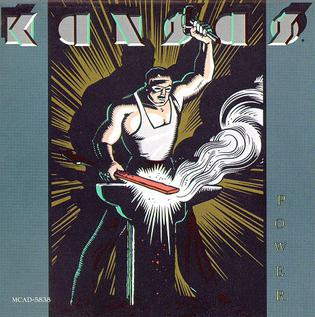
Kansas had a good run in the 1970s, but the band ultimately floundered because its members couldn’t agree on what the band was supposed to represent musically and artistically.

Kansas was never going to be Foreigner or Journey, let alone a Led Zeppelin. All the group’s movements in those mainstream directions were awkward stumbles.

Christian rock was a thing in the 1980s and beyond. (The Christian rock group Stryper, founded in 1983, still has a fan base.) But Kansas never fully cultivated that market, because at least half of the band’s members were uncomfortable with the “Christian rock” label.

So Kansas was ultimately a lot of half-hearted missteps in many competing directions. But not enough of any one thing.

What’s the lesson here? Creator, know thyself. That advice applies not only to rock bands, but to anyone trying to stand out in a marketplace filled with “me-too” offerings.

-ET

‘The Osbournes Want to Believe’: quick review

Watch The Osbournes Want to Believe on Amazon 

The music of Ozzy Osbourne has long been one of my guilty pleasures. I’m from the Ozzy generation, you might say. I hit adolescence in the early 1980s, perfect timing for Ozzy’s three breakout albums: Blizzard of Oz (1980), Diary of a Madman (1981) and Bark at the Moon (1983).

By the time I graduated from high school in 1986, Ozzy Osbourne’s music  was already becoming somewhat predictable and repetitive. Or maybe I was just getting older?…Who knows? But anyway—if you were around in the early 1980s and into rock music, you’ll surely remember the energy of those first few albums. They were really something.

Ozzy Osbourne was always more of an entertainer than a technical musician. From the beginning of his solo career, the former Black Sabbath frontman effected this macabre persona, which was uniquely appealing to 13-year-old boys, circa 1981. Then there was the thing about him biting the head off a dove at a meeting with CBS record executives. (He was intoxicated at the time.)

By the early 2000s, Ozzy Osbourne’s style of music was long past its expiration date. The singer pivoted—to reality TV. From 2002 to 2005, MTV aired The Osbournes. Each episode of The Osbournes was basically a day-in-the-life with the singer and his family. I caught about fifteen minutes of one such episode, and immediately knew that The Osbournes wasn’t for me. I’m not a big fan of reality TV to begin with, and I found Ozzy’s two teenage children, Kelly and Jack, somewhat annoying.

I was therefore a bit skeptical when I tuned into my first episode of The Osbournes Want to Believe, which now airs on the Travel Channel. But the The Osbournes Want to Believe is actually not too bad…if you’re willing to accept it for what it is.

The Osbournes Want to Believe presents a new spin on the well-traveled paranormal investigation/ghosthunting TV genre. This show doesn’t feature parapsychologists and professional skeptics, breaking down videos of shadowy figures and independently moving objects. Here, instead, you watch and listen as three members of the Osbourne family give their take on such matters.

Son Jack serves as the host of the show. Yes, I found him annoying 18 years ago; but he’s now 35 and actually pretty good as a television host.

Ozzy Osbourne, meanwhile, is a shadow of his former self. To quote his Wikipedia entry, Ozzy “has abused alcohol and other drugs for most of his adult life.” In 1978, he unapologetically told a journalist, “I get high, I get f***ed up … what the hell’s wrong with getting f***ed  up? There must be something wrong with the system if so many people have to get f***ed up … I never take dope or anything before I go on stage. I’ll smoke a joint or whatever afterwards.”

The singer is now in his early seventies, and his decades of substance abuse are readily apparent. Ozzy is always likable, and at times genuinely witty; but he seems constantly on the verge of falling asleep. If not for his reputation, Ozzy could be mistaken for Joe Biden giving an unscripted press conference. (Sorry! I couldn’t resist.) No one need wonder, though, why Jack serves as the show’s moderator. Ozzy would not be up to the task.

Sharon Osbourne, of The Talk, is perfectly lucid and endlessly chirpy. Nor is she exactly unlikable. But—like the class clown of everyone’s school days— she tries too hard to turn every remark into a joke. Her humor doesn’t always miss the mark; but it rapidly wears thin because it just never stops.

The overall tone of the show is informal and conversational. The set looks like a room in one of the homes owned by Osbourne. Watching The Osbournes Want to Believe gives you the sense that you’re sitting around with this oddball family, watching these weird videos of weird happenings.

The Osbournes Want to Believe is not cutting-edge television; but it isn’t trying to be. And although I’m not an expert on such matters, it doesn’t appear to be cutting-edge in the field of paranormal research, either. Most of the commentary—however witty and occasionally funny—is purely speculative and anecdotal. 

This show seems to be yet one more attempt to cash in on the Ozzy Osbourne brand. That brand was launched more than 50 years ago, when the first Black Sabbath album hit the record stores in 1970.

How long can the Ozzy brand go on and continue to make money? Probably for as long as Ozzy can be dissuaded from completely obliterating himself with drugs and alcohol.