From The Northerner, the student newspaper of NKU. (I attended NKU as an undergrad from 1986~7, then as a grad student from 2002~4, by the way.)
I have an opinion on this matter, of course. The best Cincinnati films to date are Traffic (2000), and Fresh Horses (1988).
Rain Man (1988), which tends to get the most attention, left me cold, even though I’ve liked most movies with Tom Cruise or Dustin Hoffman.
Traffic, though, is a multilayered, engrossing story about the narcotics underworld. I recently saw it for the second time, and it’s held up well over the past two decades.
Fresh Horses is a coming-of-age movie starring Molly Ringwald and Andrew McCarthy. This movie is a little dated, and a bit uneven in places; but it isn’t bad for 30-year-old teen movie from the late Reagan era.
Also, one scene in Fresh Horses features the University of Cincinnati lecture hall where I took organic chemistry in 1987, after I transferred to UC from NKU.
I can still remember the first time I saw Oliver Stone’s Vietnam War epic, Platoon, in a cinema in South Carolina during the summer of 1986.
At that time, the men who had served in the war were still mostly in their late thirties and early forties. The Vietnam War was as recent to the present as the first term of George H.W. Bush, and the US-led invasion of Iraq, are recent to us today.
I was only a few weeks away from turning eighteen when I watched Platoon that afternoon. Born in 1968, I was too young to recall the Vietnam War, but I had grown up in its shadow. The Vietnam War was a constant cultural reference point—kind of like the war in Iraq is now.
Platoon was not the first movie to feature the Vietnam War; but most of the previous efforts in this regard had turned out badly. Apocalypse Now (1979) was simply weird, and completely lacking realism. The Deer Hunter (1978) was depressing and nihilistic.
Platoon was the first major film that addressed the Vietnam War in a manner that was realistic and artistically engaging. This movie didn’t flinch from the dark side of the conflict; but this was no self-indulgent wallow in the gloom. There are characters in this movie worth knowing, and the film ends on a redemptive note.
I found the movie powerful in 1986, but I wasn’t quite sure why. At the age of eighteen, I really had no idea of the difficult choices that the real world requires of us all: between right and wrong, idealism and pragmatism, serving others and serving oneself.
This theme is present throughout the film, but it’s encapsulated in the above scene, “I am Reality”. That famous line from Sgt. Barnes:
“There’s the way it oughta be, and there’s the way it is.”
This line went over my head on that teenage summer afternoon almost thirty-four years ago. All teens see the world, and themselves, in absolute, black-and-white terms. I was no exception.
I rewatched the movie a few nights ago. At the age of fifty-one, I understand the significance of Sgt. Barnes’s line, and how the real world is many shades of gray.
And this—to me, at least—is what the movie is all about. This is why Platoon will continue to be a classic, long after the Vietnam War generation (and we, their children), have passed into history.
I can still remember the first time I saw The Evil Dead—sometime back in the 1980s, on VHS. (I don’t believe this 1981 film had a long run at the theaters—it wasn’t exactly date night stuff.)
The Evil Dead wasn’t like The Exorcist, in the sense that it would send your imagination running and keep you awake at night. Rather, The Evil Dead was one long series of endless jump scares.
The movie started intense, and it just never stopped.
The Evil Dead was also Sam Raimi’s best work. There was a certain dark humor in the film. But Raimi didn’t overplay the humor element—as he would in subsequent installments of the franchise, and later movies like Drag Me to Hell (2009).
The setup was simple: A group of people spend the night in a remote cabin. They play a recording that summons evil spirits from the bowels of the earth.
One by one, they are turned into homicidal zombies. The End.
And yet—maybe horror tales (whether on the page or on the screen) are best when they have simple, readily accessible plots. I remember reading Dan Simmons’s overlong Carrion Comfort and thinking, man this is just too much plot for a horror novel.
The Evil Dead was good storytelling. The special effects are primitive, by today’s standards. But the movie is still quite unnerving to watch.
I’m presently rewatching the original Fright Night.
I saw this movie at the cinema in 1985, and I figured that after 34 years, I owed it another viewing. I enjoyed the movie the first time, after all.
Fright Night is a fun movie. This isn’t cutting-edge horror. And unless you’re of an extremely sensitive bent, it won’t give you nightmares or keep you awake at night.
I usually don’t like comedy-horror. The modern comedy-horror zombie movies are too often just gross, and/or in extremely bad taste.
Fright Night, on the other hand, is clever, and the main characters are people you like, and want to see survive their horror movie ordeal.
(When I watched Woody Harrelson in Zombieland—big mistake on my part!–I found myself rooting for the zombies…Anything to shut up Harrelson’s annoying protagonist. But I digress.)
Fright Night has just enough horror to maintain the sense of dread, and just enough humor to keep things light. The opposing forces of horror and comedy are difficult to balance, but they’re balanced here. Almost perfectly.
Yes, I know that there is a 2011 Fright Night remake that stars Colin Farrell. I haven’t seen that one yet, but I’ve seen the previews, and it looks promising. I’ve added that one to my “to-watch” list.
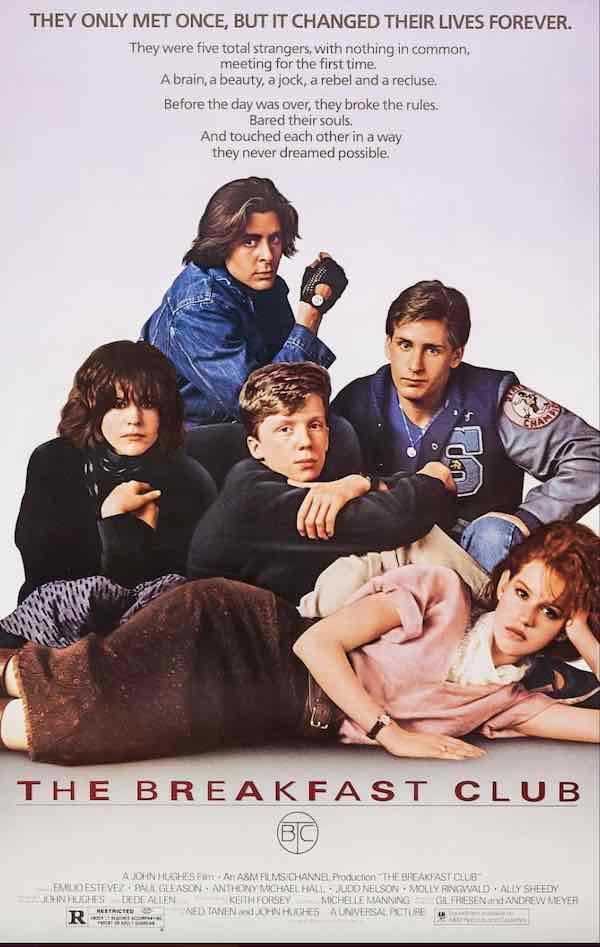
This was one of the big teen movies of my youth. I saw it when it came out in the mid-1980s. I recently watched it again as a middle-age (51) adult.
The basic idea of The Breakfast Club is immediately relatable: Five very different teens (a nerd, a jock, a princess, a basket case, a hoodlum) are thrown together in the enclosed space of their high school’s library. They are then forced to interact over the course of a day-long detention period on a Saturday.
This is a small drama, but also a much larger one: The setup for the movie provides a concentrated and contained view of all teenage interactions.
Why we like The Breakfast Club
I liked The Breakfast Club, for all the usual reasons that millions of people have liked the movie since it first hit cinemas in February 1985. Everyone who has ever been a teenager can relate to feeling awkward and misunderstood; and The Breakfast Club has teenage angst in spades. The cast of characters is diverse enough that each of us can see parts of ourselves in at least one of these kids.
The Breakfast Club is free of the gratuitous nudity that was somewhat common in the teensploitation films of the era. There is no Breakfast Club equivalent to Phoebe Cates’s topless walk beside the swimming pool in Fast Times at Ridgemont High. (There is a brief glimpse of what is supposed to be Molly Ringwald’s panties. But since Ringwald was a minor at the time, an adult actress filled in as a double for this shot.)
Nor are any of the actors especially good-looking or flashy. They all look like normal people. No one paid to see this movie for its star power or sex appeal. The Breakfast Club succeeded on the basis of its script, and solid acting and production values.
What I didn’t see in 1985
I enjoyed the movie the second time around, too. I have to admit, though, that teenage self-absorption can seem a little irksome when viewed through adult eyes. Even the teenage self-absorption of one’s own generation.
I’m the same age as Michael Anthony Hall and Molly Ringwald; we were all born in 1968. The other actors in the film are all within ten years of my age. Nevertheless, this time I was watching their teenage drama unfold as an older person—not as a teenager myself. Teenage drama is, by its very nature, trivial (and yes, a little annoying) when viewed from an adult perspective.
The movie also makes all adults look corrupt, stupid, or craven—as opposed to the hapless and victimized, but essentially idealistic and blameless—teens. Every young character in The Breakfast Club blames his or her parents for their problems, and these assertions are never really challenged.
We get only a few shots of the parents, when the kids are being dropped off for their day of detention. The parents are all portrayed as simplistic naggers.
The teens’ adult nemesis throughout the movie, Assistant Principal Vernon, is a caricature, a teenager’s skewed perception of the evil adult authority figure. The school janitor, meanwhile, is no working-class hero–but a sly operator who blackmails Vernon for $50.
A movie written for its audience
One of the reasons you liked this movie if you were a teenager in 1985 is that it flattered you–without challenging your myopic, teenage perspective of the world. If you weren’t happy, it was probably because of something your parents did, not anything that you did–or failed to do.
That may have been a marketing decision. Who knows? The Breakfast Club goes out of its way to flatter its target audience–the suburban teenager of the mid-1980s. I suppose I didn’t see that when I was a member of that demographic. I see it now, though.
Tonight I finally got around to watching the original Alien movie.
I was too young (11) for this film when it came out in 1979, and I never got around to watching it until tonight. Better late than never…the story of my life.
Overall, I found Alien to be a very entertaining sci-fi horror flick. Some of the special effects are a little primitive by 21st-century standards, but hey…1979. Jimmy Carter was president when this movie was made. 40 years ago!
A few quibbles: The film depicts smoking aboard a spaceship, which should have seemed an unlikely scenario even to filmmakers in 1979. The spaceship in the film, Nostromo, is also home to a pet cat.
The cat does fulfill several functions in the plot. But once again, this unlikely depiction momentarily knocked me out of suspension-of-disbelief mode. As a former cat owner, I’m all too aware of the practical difficulties that would be involved in keeping a cat on a spaceship.