
Most of us never expected Rush to tour again. And then it happened. The band’s 2026 Fifty Something tour has met with wide acclaim.
This has resulted in Rush getting more attention than it got during its heyday. One such accolade is the appearance of the band’s two surviving founders—Alex Lifeson and Geddy Lee—on the cover of Rolling Stone.
I understand that this represents something of a milestone, even for a band that has been famous for decades. I have never cared a hoot about Rolling Stone magazine; but I am a longtime fan of Rush.
According to the backstory I have read on the internet, Rush was previously persona non grata at Rolling Stone magazine, for either musical or (perhaps) political reasons.
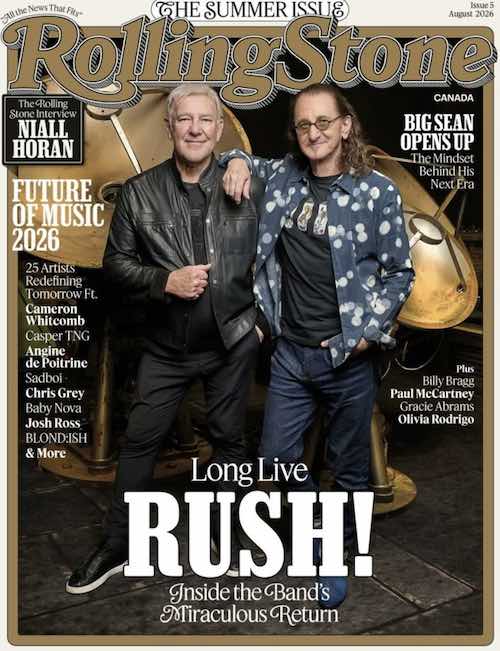
Since this was apparently such a big deal among Rush fans, the Rolling Stone cover did make the rounds on social media. That meant comments, of course.
Among the most persistent comments I saw in such threads were remarks like, “Where is Anika?” or “Anika Nilles should have been on the cover, too.”
These complaints did not come from Gen Z feminists who had jumped into the conversation. They came from mostly male, mostly middle-aged Rush fans who seemed eager to demonstrate their acceptance of Anika Nilles. More on that shortly.
***
It is almost inevitable that a band will have some personnel changes over the years. That said, some bands from the 1970s and 1980s (Kansas and Foreigner come to mind here) are so altered from their original lineups that they now resemble cover or tribute bands.
This should not happen to Rush—lest Rush lose its fundamental nature. Rush has always been “different”. The longstanding trio of Peart, Lifeson, and Lee was cemented in 1974, when Neil Peart joined the band. This brought something highly distinctive and original to rock music.
That “something” didn’t suit everyone’s taste. Rush’s oeuvre includes very few conventional love songs, and no self-referential odes to rock-n-roll. There are, however, Rush songs about the French Revolution (“Bastille Day”), the development of the atom bomb (“Manhattan Project”), and the space shuttle (“Countdown”).
Maybe that’s your jam and maybe it isn’t; but no one ever accused Rush of being derivative.
After joining the band, Neil Peart wrote almost all of Rush’s lyrics. Rush’s subject matter wouldn’t be so brilliant (or “odd”, depending on your view) without Neil Peart’s creative choices.
***
Which brings us back to Anika Nilles. Anika Nilles is Rush’s touring drummer. She is neither a member nor a co-owner of the band. To be blunt about the matter, she’s a contract employee.
She is also a very competent contract employee. I’ve watched a lot of concert footage from the Fifty Something tour these past few months. Nilles comes as close as any drummer reasonably could to filling Neil Peart’s shoes as an onstage drummer.
That said, she is not a member of Rush.
Nor could one easily imagine Nilles replacing Neil Peart in his essential role as a Rush lyricist. Not unless there is much about Nilles that we don’t yet know. Nilles—excellent drummer though she is—is nearly two generations younger than the rest of the band. She comes from a different temporal and cultural reference point. A native German speaker, English is her second language.
***
Why then, all the gushing about Anika, and complaints about her not being included on the Rolling Stone cover?
Rush fans have historically skewed male. While there are no hard statistics that I’m aware of, no one knowledgeable of the band would seriously dispute this assertion. Rush fandom’s masculine tilt has long been observed at Rush concerts, and in conversations about the band. (All the Rush fans you meet seem to be male.)
Why might this be? Rush has always appealed to a fan base that is analytical, bookish, introverted, and freethinking. To be sure, there are female music fans who would fit this description. But the anecdotal evidence suggests that most female music fans are looking for something else. Rush’s deliberate downplay of romantic and sexual themes further alienated female music fans of the 1970s and 1980s.
Rush, moreover, never had a charismatic lead singer that appealed to women in the way Jon Bon Jovi, David Lee Roth, or Joe Elliott all did in their prime years.
(Certain generational factors could be in play here, as well. Somewhat ironically, most of the female Rush fans I have encountered, both in person and on the internet, have been members of the Millennial generation and Gen Z, all of whom were either too young to be music fans—or not even born yet—when the most commercially successful Rush albums came out.)
Some male Rush fans, in this age of political polarization and political correctness, seem to have a hangup about the notion of Rush fandom as a boys’ club, even though women have never been overtly excluded.
To be fair on this point: when Rush announced their Fifty Something tour last year, there were some early snide remarks on social media about the Anika Nilles selection. Some of these grumblings had sexist overtones. “Is Rush going DEI now?” a few anonymous yahoos sniped on Facebook and X.
These comments were idiotic—not to mention ahistorical, in Rush terms. Rush’s 1987 song “Time Stand Still” includes vocals by (female) singer Aimee Mann. So if Rush has a “DEI” policy, they’ve had it since the mid-1980s.
But the correction in the opposite direction has gone too far. On some social media platforms, lengthy, effusive praise for Anika Nilles has now become a mandatory preamble for any positive post about the Fifty Something tour.
The ironic thing here is that Anika Nilles is not the only concert musician hired for the Fifty Something tour. Keyboardist Loren Gold was also hired for the Fifty Something tour. Despite his gender-ambiguous first name, Loren Gold is male. And like Anika Nilles, he hasn’t been made an official member of Rush.
Nor did Loren Gold join Alex Lifeson and Geddy Lee on the cover of Rolling Stone.
***
The internet has a way of making the most extreme viewpoints prominent. If one jackanapes on Facebook makes a sexist comment, that remark will have an outsized impact. Very few Rush fans—who are mostly male and now mostly middle-aged—ever had a problem with Anika Nilles as a fill-in concert drummer. Neil Peart, after all, passed away almost seven years ago. If Rush is going to tour again, someone else has to play the drums onstage.
Anika Nilles is a virtuoso concert drummer. Let that be said. (It is no longer necessary to say it, however, at great length, and in every single social media post about Rush’s 2026 Fifty Something tour). But as a creative going concern, Rush is now a two-man operation. The band that was once a trio is now a duo.
-ET
**View RUSH merchandise on Amazon**